
devspace is a free, open source cloud infrastructure management project written in Go and released under Apache-2.0. It has 5,187 GitHub stars, 425 forks and 92 open issues, and was last pushed 3 days ago. On this registry it ranks #42 of 70 tracked projects in Cloud Infrastructure Management, with 5 head-to-head comparisons available.

What is devspace?

DevSpace is an open-source, client-only command-line tool that lets developers build, test, and debug applications directly inside Kubernetes, and it is aimed at software teams running cloud-native microservices who want one standardized deployment and development workflow.

What it is

DevSpace is a CLI written in Go and released under the Apache-2.0 licence. It was created by Loft Labs and is a Cloud Native Computing Foundation (CNCF) sandbox project. The tool is client-only: it installs on the developer machine and drives a Kubernetes cluster rather than requiring a server-side component of its own. Its work covers image building, deployment, dependency deployment, log streaming, debugger attachment, container terminals, and hot reloading of running containers. The registry lists it under Infrastructure & Operations / Cloud Infrastructure Management, with the repository at 5187 stars, 425 forks, and 92 open issues, and documentation hosted at devspace.sh.

The concrete problem it solves is that building distributed, highly scalable microservices on Kubernetes is hard, and it becomes harder still for large teams of developers. Without a shared workflow definition, every developer has to reconstruct the same sequence of image builds and deployments for the project and its dependencies, and the knowledge about how to do that lives in individual heads rather than in the repository. DevSpace replaces that per-developer, manually reassembled process with a single declarative configuration file, devspace.yaml, which codifies how images are built, how the project and its dependencies are deployed, and how repetitive tasks are automated. That file is committed and versioned together with the code, so any older version of a project can be brought up with a single command.

Key capabilities

  • A single declarative configuration file, devspace.yaml, stores the whole workflow: image building, project deployment, dependency deployment, and automated repetitive tasks.
  • The devspace deploy command runs the full pipeline, including image building and deployment of the project and related projects, so a checked-out repository can be brought to a running instance in one step.
  • Hot reloading updates running containers without rebuilding images or restarting containers, while the developer keeps editing with an IDE.
  • High-performance, bi-directional file synchronization detects code changes immediately and syncs files between the local development environment and the containers running in Kubernetes.
  • Config variables support one base configuration that still allows per-developer differences, such as different sub-domains for testing.
  • Logs can be streamed, debuggers connected, and a container terminal opened directly from the IDE.
  • Deployment workflows can be unified across development, staging, and production environments.

Who uses it and how

  • Large teams building distributed microservices on Kubernetes, the case the project explicitly targets as hardest.
  • Teams where one DevOps or Kubernetes expert writes devspace.yaml and commits it through git, while the rest of the developers only need to run devspace deploy to get a running instance of the project.
  • Teams that want to standardize deployment and development workflows without requiring every developer to become a Kubernetes expert.
  • Developers who iterate with a local IDE and expect code edits to reload inside the running container rather than waiting on an image rebuild and redeployment cycle.
  • Engineering organizations that need on-demand Kubernetes access for many developers; the README points to loft.sh for sharing development clusters across a team.

Getting started

Workflow starts from a devspace.yaml configuration file in the project, and deployment runs through the devspace deploy command, which handles image building and deployment of the project and its dependencies. Quickstart and full documentation are published on the website at devspace.sh.

How it compares

No comparable or competing tools are named in the facts for this entry. DevSpace stands alone in this registry on the evidence provided.

When to use it — and when not to

Because DevSpace is client-only, a self-hoster has no DevSpace server, database, or storage layer to run, but a Kubernetes cluster is still required, along with someone on the team who understands Kubernetes well enough to author the initial devspace.yaml. Teams without Kubernetes, or with applications that are not containerized, gain nothing from it, and a solo developer without a cluster should not pick it. The registry shows a mature but not idle project — 5187 stars and 92 open issues at last push — while the primary documentation lives off-repository at devspace.sh, so the README alone is not a complete reference.

project readme (upstream, from github) — read inline

WebsiteQuickstartDocumentationBlogTwitter

Build Status Passing Latest Release License: Apache-2.0 Total Downloads (GitHub Releases) OpenSSF Best Practices

Join us on Slack!

Client-Only Developer Tool for Cloud-Native Development with Kubernetes

  • Build, test and debug applications directly inside Kubernetes
  • Develop with hot reloading: updates your running containers without rebuilding images or restarting containers
  • Unify deployment workflows within your team and across dev, staging and production
  • Automate repetitive tasks for image building and deployment

DevSpace Compatibility


⭐️ Do you like DevSpace? Support the project with a star ⭐️


DevSpace was created by Loft Labs and is a Cloud Native Computing Foundation (CNCF) sandbox project.


Contents


Why DevSpace?

Building modern, distributed and highly scalable microservices with Kubernetes is hard - and it is even harder for large teams of developers. DevSpace is the next-generation tool for fast cloud-native software development.

Standardize & Version Your Workflows

DevSpace allows you to store all your workflows in one declarative config file: devspace.yaml

  • Codify workflow knowledge about building images, deploying your project and its dependencies etc.
  • Version your workflows together with your code (i.e. you can get any old version up and running with just a single command)
  • Share your workflows with your team mates

Let Everyone on Your Team Deploy to Kubernetes

DevSpace helps your team to standardize deployment and development workflows without requiring everyone on your team to become a Kubernetes expert.

  • The DevOps and Kubernetes expert on your team can configure DevSpace using devspace.yaml and simply commits it via git
  • If other developers on your team check out the project, they only need to run devspace deploy to deploy the project (including image building and deployment of other related project etc.) and they have a running instance of the project
  • The configuration of DevSpace is highly dynamic, so you can configure everything using config variables that make it much easier to have one base configuration but still allow differences among developers (e.g. different sub-domains for testing)

Giving everyone on your team on-demand access to a Kubernetes cluster is a challenging problem for system administrators and infrastructure managers. If you want to efficiently share dev clusters for your engineering team, take a look at www.loft.sh.


Speed Up Cloud-Native Development

Instead of rebuilding images and redeploying containers, DevSpace allows you to hot reload running containers while you are coding:

  • Simply edit your files with your IDE and see how your application reloads within the running container.
  • The high performance, bi-directional file synchronization detects code changes immediately and synchronizes files immediately between your local dev environment and the containers running in Kubernetes
  • Stream logs, connect debuggers or open a container terminal directly from your IDE with just a single command.

Automate Repetitive Tasks

Deploying and debugging services with Kubernetes requires a lot of knowledge and forces you to repeatedly run commands like kubectl get pod and copy pod ids back and forth. Stop wasting time and let DevSpace automate the tedious parts of working with Kubernetes:

  • DevSpace lets you build multiple images in parallel, tag them automatically and and deploy your entire application (including its dependencies) with just a single command
  • Let DevSpace automatically start port-fowarding and log streaming, so you don't have to constantly copy and paste pod ids or run 10 commands to get everything started.

Works with Any Kubernetes Clusters

DevSpace is battle tested with many Kubernetes distributions including:

  • local Kubernetes clusters like minikube, k3s, MikroK8s, kind
  • managed Kubernetes clusters in GKE (Google Cloud), EKS (Amazon Web Service), AKS (Microsoft Azure), Digital Ocean
  • self-managed Kubernetes clusters created with Rancher

DevSpace also lets you switch seamlessly between clusters and namespaces. You can work with a local cluster as long as that is sufficient. If things get more advanced, you need cloud power like GPUs or you simply want to share a complex system such as Kafka with your team, simply tell DevSpace to use a remote cluster by switching your kube-context and continue working.


Quickstart

Please take a look at our getting started guide.


Architecture & Workflow
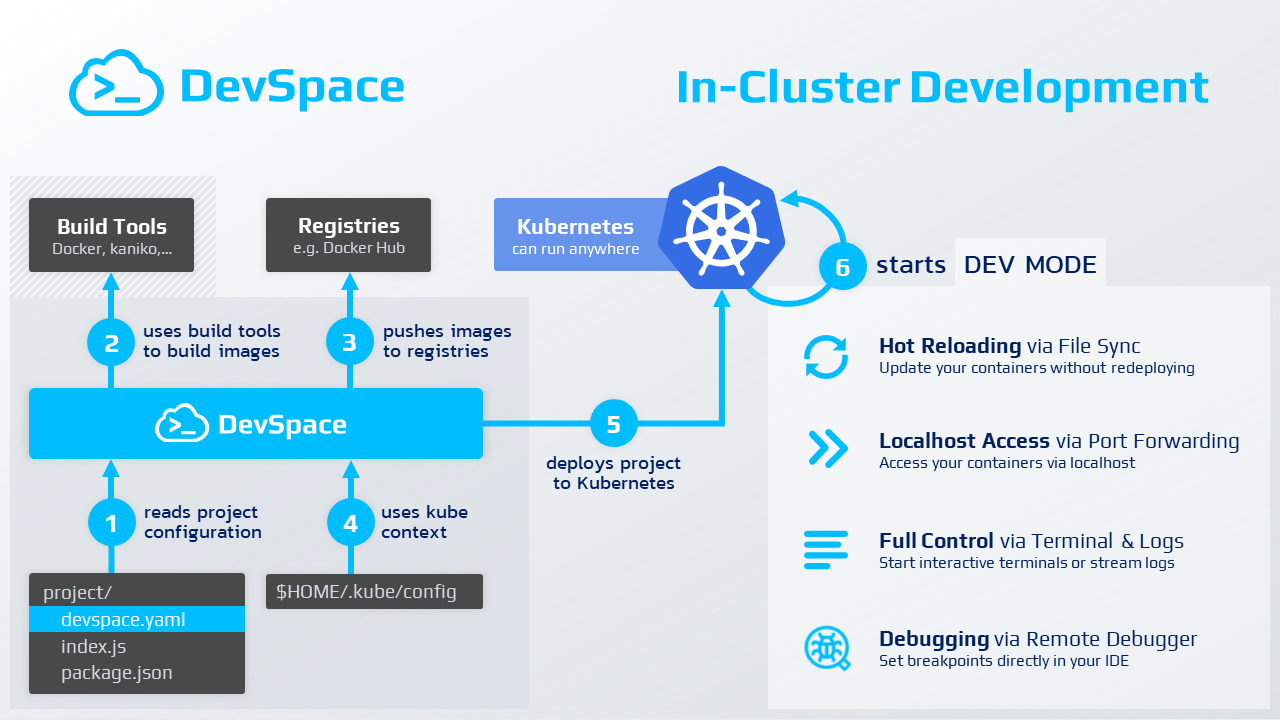
DevSpace Workflow

DevSpace runs as a single binary CLI tool directly on your computer and ideally, you use it straight from the terminal within your IDE. DevSpace does not require a server-side component as it communicates directly to your Kubernetes cluster using your kube-context, just like kubectl.


Contributing

Participation in the DevSpace project is governed by the CNCF code of conduct.

Help us make DevSpace the best tool for developing, deploying and debugging Kubernetes apps.

Join us on Slack!

Reporting Issues

If you find a bug while working with the DevSpace, please open an issue on GitHub and let us know what went wrong. We will try to fix it as quickly as we can.

Feedback & Feature Requests

You are more than welcome to open issues in this project to:

Contributing Code

This project is mainly written in Golang. If you want to contribute code:

  1. Ensure you are running golang version 1.11.4 or greater for go module support
  2. Set the following environment variables:
    GO111MODULE=on
    GOFLAGS=-mod=vendor
    
  3. Check-out the project: git clone https://github.com/loft-sh/devspace && cd devspace
  4. Make changes to the code
  5. Build the project, e.g. via go build -o devspace[.exe]
  6. Evaluate and test your changes ./devspace [SOME_COMMAND]

See Contributing Guidelines for more information.

The DevSpace project follows the CNCF Code of Conduct.


FAQ

What is DevSpace?

DevSpace is an open-source command-line tool that provides everything you need to develop, deploy and debug applications with Docker and Kubernetes. It lets you streamline deployment workflows and share them with your colleagues through a declarative configuration file devspace.yaml.

Is DevSpace free?

YES. DevSpace is open-source and you can use it for free for any private projects and even for commercial projects.

Do I need a Kubernetes cluster to use DevSpace?

Yes. You can either use a

readme truncated — read the full docs on github

Frequently asked questions

Is devspace free to use?

devspace is open source under the Apache-2.0 licence. There is no licence fee and no seat count — you can self-host it or, where the project offers one, pay a vendor for a managed version instead.

What does devspace do?

DevSpace - The Fastest Developer Tool for Kubernetes ⚡ Automate your deployment workflow with DevSpace and develop software directly inside Kubernetes.

What is devspace written in?

devspace is primarily written in Go. Its source is publicly available at https://github.com/devspace-sh/devspace, and it has 5,187 GitHub stars.