DeepAnalyze is a free, open source ai interaction & interfaces project written in Python and released under MIT. It has 4,636 GitHub stars, 735 forks and 27 open issues, and was last pushed 7 days ago. On this registry it ranks #56 of 113 tracked projects in AI Interaction & Interfaces, with 5 head-to-head comparisons available.

What is DeepAnalyze?

DeepAnalyze is an open-source agentic large language model that autonomously carries out data science work — data preparation, analysis, modeling, visualization, and report generation — for data analysts, researchers, and engineering teams that want to run those pipelines on their own infrastructure instead of through a hosted assistant.

What it is

DeepAnalyze is presented as the first agentic LLM for autonomous data science. It is developed by authors Shaolei Zhang, Ju Fan, Meihao Fan, Guoliang Li, and Xiaoyong Du, affiliated with Renmin University of China and Tsinghua University, and it is documented in the paper arXiv 2510.16872. The released model is DeepAnalyze-8B, published on Hugging Face under RUC-DataLab. The project is written in Python and licensed under MIT, with 4,636 stars, 735 forks, and 27 open issues in its GitHub repository. Model, code, training data, and demo are all open-sourced, and the project's stated goal is that a user can deploy or extend their own data analysis assistant.

The concrete problem it addresses is the manual stitching that normally surrounds analytical work: pulling data out of a database or a CSV file, cleaning it, modeling it, charting it, and then writing the findings up by hand. DeepAnalyze claims to run that entire sequence autonomously, without human intervention between steps, and to close the loop by producing an analyst-grade research report rather than a loose collection of intermediate artifacts. Because the model weights, the repository, the dataset, and the demo are all public, the project also replaces the alternative of relying on a closed hosted assistant for the same work, giving teams the option to inspect, self-host, or fine-tune the component that performs the analysis.

Key capabilities

  • Runs an entire data science pipeline autonomously: data preparation, analysis, modeling, visualization, and report generation, without human intervention.
  • Conducts open-ended data research across structured sources (databases, CSV, Excel), semi-structured sources (JSON, XML, YAML), and unstructured sources (TXT, Markdown).
  • Emits analyst-grade research reports as the final output of that research, rather than only intermediate code or charts.
  • Ships as DeepAnalyze-8B on Hugging Face, with a hosted demo on the same model page.
  • Releases training data as DataScience-Instruct-500K under RUC-DataLab, alongside the model and code.
  • Published under the MIT licence in Python, with a public repository and a project homepage at https://ruc-deepanalyze.github.io.
  • Adds SkillAdam, released in September 2026, a plugin that generates tasks, evaluates a current skill, proposes improvements, validates the revision, and updates the skill when changes pass evaluation.

Who uses it and how

  • Analyst and research teams that want an assistant they can self-host and extend, since weights, code, and training data are all available for local deployment or further training.
  • Research groups working across mixed formats, where a single request may touch a database, a CSV or Excel sheet, a JSON or YAML configuration, and Markdown or plain text notes before a report is produced.
  • Agent builders who already work inside Codex, Claude Code, Cursor Agent, or GitHub Copilot and want to improve an agent skill automatically through SkillAdam, supplying a SKILL.md and a description of the desired improvement.
  • Report-writing workflows that expect a finished analyst-grade document as the deliverable rather than a notebook of intermediate steps.
  • Projects with an existing audience and community footprint: the repository has accumulated 4,636 stars and 735 forks.

Getting started

The README excerpt provides no package name, Docker image, or compose file; the documented entry points are the Hugging Face model RUC-DataLab/DeepAnalyze-8B, its demo, the GitHub code repository, and the DataScience-Instruct-500K dataset, with the homepage at https://ruc-deepanalyze.github.io collecting cases.

How it compares

The facts provided name no paid products that DeepAnalyze replaces, and they name no directly comparable open-source alternatives. On the evidence given here, it stands alone in this registry as an agentic model for autonomous data science.

When to use it — and when not to

Choose it when the goal is an autonomous analytical pipeline over heterogeneous files and databases and the team is willing to run or extend an 8B model itself. Avoid it if a turnkey hosted service is expected: the README excerpt shown here carries no installation, packaging, or deployment commands, so the practical starting point is the Hugging Face model card and repository rather than a one-line install. Note also that the excerpt is truncated, and apart from the 2026.09 SkillAdam release there is no release cadence stated beyond the last repository push.

project readme (upstream, from github) — read inline

ruc-datalab%2FDeepAnalyze | Trendshift

DeepAnalyze: Agentic Large Language Models for Autonomous Data Science


arXiv homepage model data star Badge wechat

twitter twitter twitter twitter twitter twitter

Authors: Shaolei Zhang, Ju Fan*, Meihao Fan, Guoliang Li, Xiaoyong Du

Renmin University of China, Tsinghua University

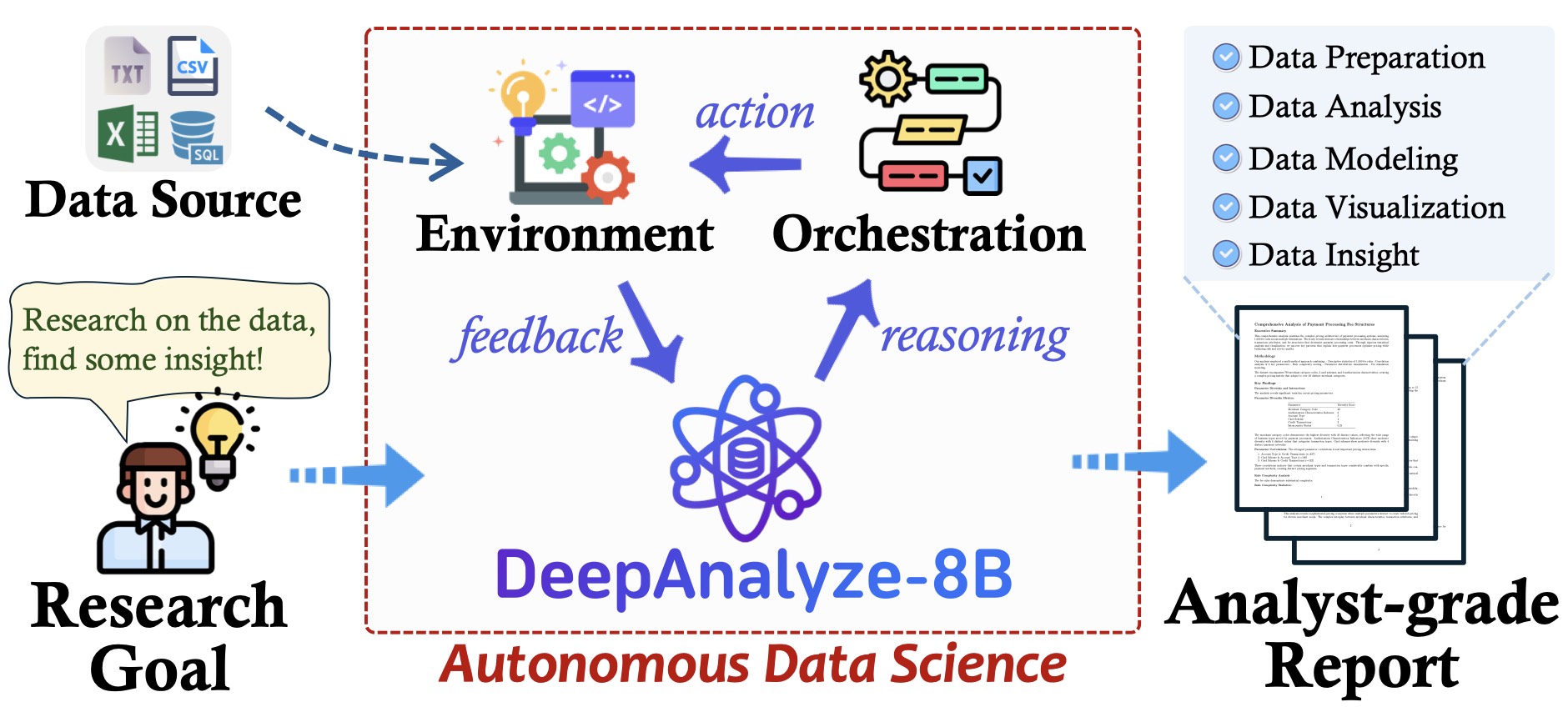
DeepAnalyze is the first agentic LLM for autonomous data science. It can autonomously complete a wide range of data-centric tasks without human intervention, supporting:

  • 🛠 Entire data science pipeline: Automatically perform any data science tasks such as data preparation, analysis, modeling, visualization, and report generation.
  • 🔍 Open-ended data research: Conduct deep research on diverse data sources, including structured data (Databases, CSV, Excel), semi-structured data (JSON, XML, YAML), and unstructured data (TXT, Markdown), and finally produce analyst-grade research reports.
  • 📊 Fully open-source: The model, code, training data, and demo of DeepAnalyze are all open-sourced, allowing you to deploy or extend your own data analysis assistant.
🔥 News

  • [2026.09]: We release SkillAdam 🚀, an easy-to-use plugin for automatically improving the skills of your AI agents. SkillAdam integrates directly with Codex, Claude Code, Cursor Agent, and GitHub Copilot, with simple installation and no need for a local GPU, Docker, or a separate model API key.
More about SkillAdam

SkillAdam makes skill optimization simple and automatic. Just provide a SKILL.md and describe what you want to improve. SkillAdam automatically generates relevant tasks, evaluates the current skill, proposes improvements, validates the revised version, and updates the skill when the changes pass evaluation. With a one-step installer, it works directly inside the coding agent you already use.

▶️ Demo:

https://github.com/user-attachments/assets/a15049ee-90b5-4cda-a270-7628a60f76ed

  • [2026.07]: We look forward to releasing DeepPrep, a data-preparation companion to DeepAnalyze that turns raw tables into analysis-ready data.
More about DeepPrep

DeepPrep is an LLM-powered agentic system for autonomous data preparation. It constructs data-preparation pipelines through execution-grounded interaction with intermediate table states and runtime feedback, helping clean, transform, and standardize raw data before downstream analysis.

▶️ Demo:

https://github.com/user-attachments/assets/6b94927f-5c0c-4cfe-bc33-de56b8e459cd

  • [2026.06.15]: We release CoDA-Bench, a benchmark for evaluating whether code agents can handle data-intensive analytical tasks, closely aligned with DeepAnalyze's target scenarios.
More about CoDA-Bench

CoDA-Bench evaluates agents in a Linux sandbox with hundreds of data files. Given a natural-language question, an agent must discover relevant data, write executable code, and produce the final answer. It provides a benchmark setting for the same type of data discovery and code-execution challenges targeted by DeepAnalyze.

▶️ Demo:

https://github.com/user-attachments/assets/34e50a62-744b-4079-8988-6a8bbfe166a0

  • [2026.05.31]: DA-Studio, the system behind DeepAnalyze WebUI v2 (demo/chat_v2), has been accepted to the VLDB 2026 Demonstration Track.

  • [2026.03.16]: Update DeepAnalyze WebUI v2, featuring a smoother UI, support for the HeyWhale API, and support for Docker-based sandboxed code execution. More details in Readme .

  • [2026.01.31]: 🎉🎉🎉DeepAnalyze served as the official agent supporting the 2026年(第19届)中国大学生计算机设计大赛大数据主题赛 (2026 (19th) China Collegiate Computer Design Contest – Big Data Track).

  • [2025.12.28] ANNOUNCEMENT: DeepAnalyze API Keys Are Now Available 🎉🎉🎉 You can now apply for your API key via this Google Form or this Feishu Form. For full details and usage instructions, please refer to the Guide or the Feishu Wiki.

  • [2025.11.13]: DeepAnalyze now supports OpenAI-style API endpointsis and is accessible through the Command Line Terminal UI. Thanks to the contributor @LIUyizheSDU

  • [2025.11.08]: DeepAnalyze is now accessible through the JupyterUI, building based on jupyter-mcp-server. Thanks to the contributor @ChengJiale150.

  • [2025.10.28]: We welcome all contributions, including improving the DeepAnalyze and sharing use cases (see CONTRIBUTION.md). All merged PRs will be listed as contributors.

  • [2025.10.27]: DeepAnalyze has attracted widespread attention, gaining 1K+ GitHub stars and 200K+ Twitter views within a week.

  • [2025.10.21]: DeepAnalyze's paper, code, model, training data are released!

🖥 Demo

WebUI

https://github.com/user-attachments/assets/04184975-7ee7-4ae0-8761-7a7550c5c8fe

Upload the data, DeepAnalyze can perform data-oriented deep research 🔍 and any data-centric tasks 🛠

readme truncated — read the full docs on github

Frequently asked questions

Is DeepAnalyze free to use?

DeepAnalyze is open source under the MIT licence. There is no licence fee and no seat count — you can self-host it or, where the project offers one, pay a vendor for a managed version instead.

What does DeepAnalyze do?

DeepAnalyze is the first agentic LLM for autonomous data science. 🎈你的AI数据分析师,自动分析大量数据,一键生成专业分析报告!

What is DeepAnalyze written in?

DeepAnalyze is primarily written in Python. Its source is publicly available at https://github.com/ruc-datalab/DeepAnalyze, and it has 4,636 GitHub stars.







