




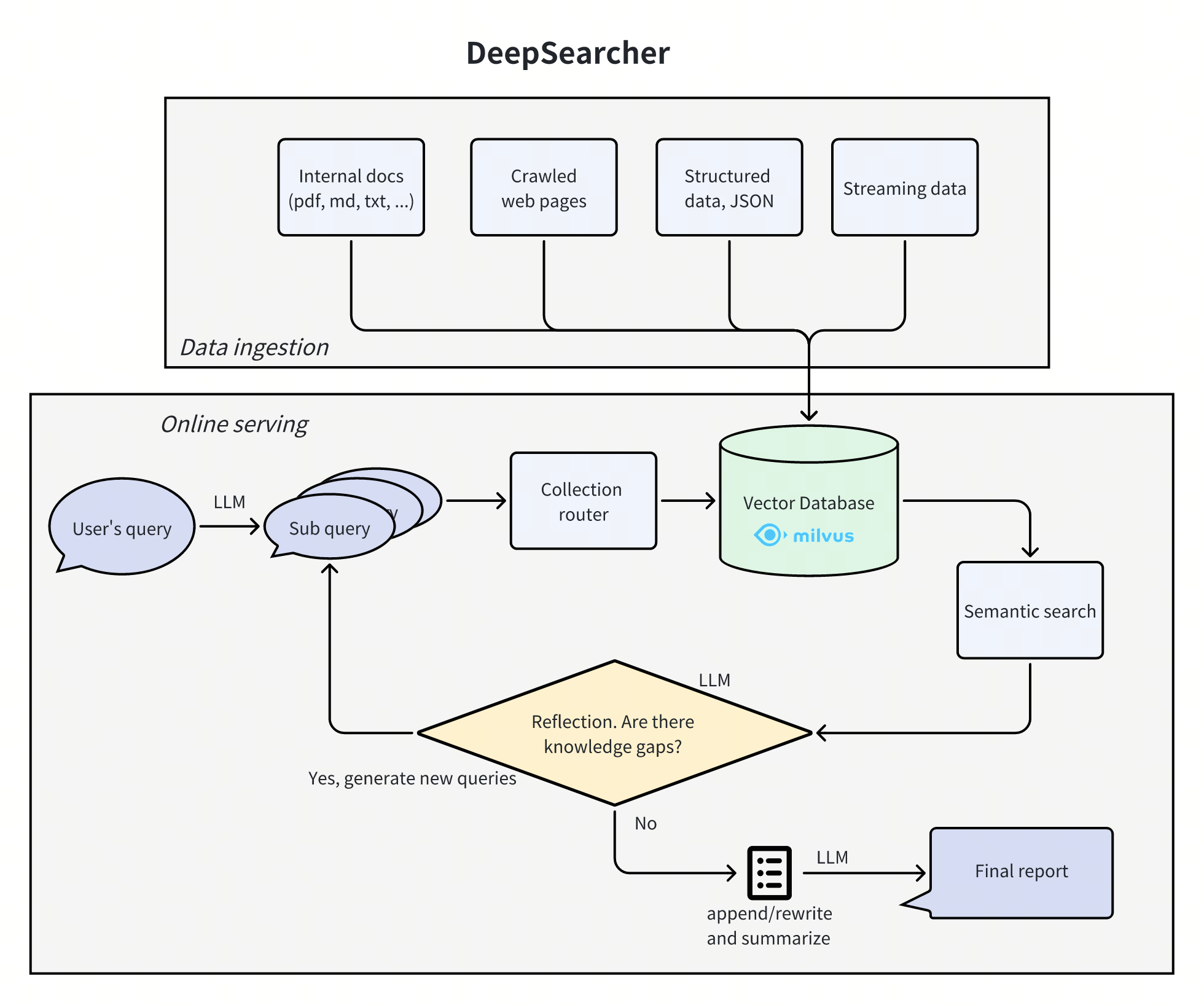
DeepSearcher combines cutting-edge LLMs (OpenAI o3, Qwen3, DeepSeek, Grok 4, Claude 4 Sonnet, Llama 4, QwQ, etc.) and Vector Databases (Milvus, Zilliz Cloud etc.) to perform search, evaluation, and reasoning based on private data, providing highly accurate answer and comprehensive report. This project is suitable for enterprise knowledge management, intelligent Q&A systems, and information retrieval scenarios.
🚀 Features
- Private Data Search: Maximizes the utilization of enterprise internal data while ensuring data security. When necessary, it can integrate online content for more accurate answers.
- Vector Database Management: Supports Milvus and other vector databases, allowing data partitioning for efficient retrieval.
- Flexible Embedding Options: Compatible with multiple embedding models for optimal selection.
- Multiple LLM Support: Supports DeepSeek, OpenAI, and other large models for intelligent Q&A and content generation.
- Document Loader: Supports local file loading, with web crawling capabilities under development.
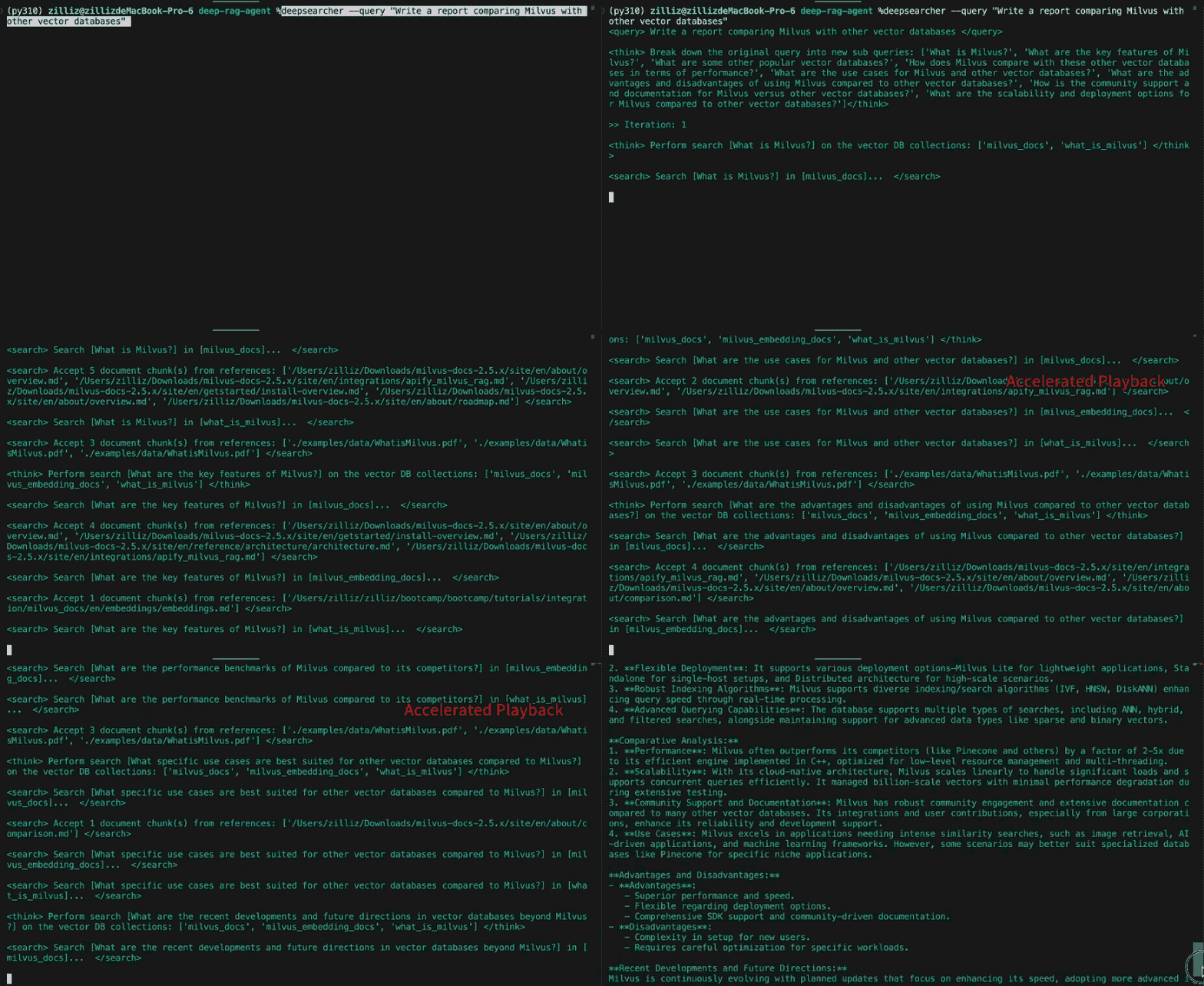
🎉 Demo
📖 Quick Start
Installation
Install DeepSearcher using one of the following methods:
Option 1: Using pip
Create and activate a virtual environment(Python 3.10 version is recommended).
python -m venv .venv
source .venv/bin/activate
Install DeepSearcher
pip install deepsearcher
For optional dependencies, e.g., ollama:
pip install "deepsearcher[ollama]"
Option 2: Install in Development Mode
We recommend using uv for faster and more reliable installation. Follow the offical installation instructions to install it.
Clone the repository and navigate to the project directory:
git clone https://github.com/zilliztech/deep-searcher.git && cd deep-searcher
Synchronize and install dependencies:
uv sync
source .venv/bin/activate
For more detailed development setup and optional dependency installation options, see CONTRIBUTING.md.
Quick start demo
To run this quick start demo, please prepare your OPENAI_API_KEY in your environment variables. If you change the LLM in the configuration, make sure to prepare the corresponding API key.
from deepsearcher.configuration import Configuration, init_config
from deepsearcher.online_query import query

config = Configuration()

# Customize your config here,
# more configuration see the Configuration Details section below.
config.set_provider_config("llm", "OpenAI", {"model": "o1-mini"})
config.set_provider_config("embedding", "OpenAIEmbedding", {"model": "text-embedding-ada-002"})
init_config(config = config)

# Load your local data
from deepsearcher.offline_loading import load_from_local_files
load_from_local_files(paths_or_directory=your_local_path)

# (Optional) Load from web crawling (`FIRECRAWL_API_KEY` env variable required)
from deepsearcher.offline_loading import load_from_website
load_from_website(urls=website_url)

# Query
result = query("Write a report about xxx.") # Your question here
Configuration Details:
LLM Configuration
config.set_provider_config("llm", "(LLMName)", "(Arguments dict)")The "LLMName" can be one of the following: ["DeepSeek", "OpenAI", "XAI", "SiliconFlow", "Aliyun", "PPIO", "TogetherAI", "Gemini", "Ollama", "Novita", "Jiekou.AI"]
The "Arguments dict" is a dictionary that contains the necessary arguments for the LLM class.
Example (OpenAI)
Make sure you have prepared your OPENAI API KEY as an env variable OPENAI_API_KEY.
config.set_provider_config("llm", "OpenAI", {"model": "o1-mini"})More details about OpenAI models: https://platform.openai.com/docs/models
Example (Qwen3 from Aliyun Bailian)
Make sure you have prepared your Bailian API KEY as an env variable DASHSCOPE_API_KEY.
config.set_provider_config("llm", "Aliyun", {"model": "qwen-plus-latest"})More details about Aliyun Bailian models: https://bailian.console.aliyun.com
Example (Qwen3 from OpenRouter)
config.set_provider_config("llm", "OpenAI", {"model": "qwen/qwen3-235b-a22b:free", "base_url": "https://openrouter.ai/api/v1", "api_key": "OPENROUTER_API_KEY"})More details about OpenRouter models: https://openrouter.ai/qwen/qwen3-235b-a22b:free
Example (DeepSeek from official)
Make sure you have prepared your DEEPSEEK API KEY as an env variable DEEPSEEK_API_KEY.
config.set_provider_config("llm", "DeepSeek", {"model": "deepseek-reasoner"})More details about DeepSeek: https://api-docs.deepseek.com/
Example (DeepSeek from SiliconFlow)
Make sure you have prepared your SILICONFLOW API KEY as an env variable SILICONFLOW_API_KEY.
config.set_provider_config("llm", "SiliconFlow", {"model": "deepseek-ai/DeepSeek-R1"})More details about SiliconFlow: https://docs.siliconflow.cn/quickstart
Example (DeepSeek from TogetherAI)
Make sure you have prepared your TOGETHER API KEY as an env variable TOGETHER_API_KEY.
config.set_provider_config("llm", "TogetherAI", {"model": "deepseek-ai/DeepSeek-R1"})config.set_provider_config("llm", "TogetherAI", {"model": "meta-llama/Llama-4-Scout-17B-16E-Instruct"}) You need to install together before running, execute: pip install together. More details about TogetherAI: https://www.together.ai/
Example (XAI Grok)
Make sure you have prepared your XAI API KEY as an env variable XAI_API_KEY.
config.set_provider_config("llm", "XAI", {"model": "grok-4-0709"})More details about XAI Grok: https://docs.x.ai/docs/overview#featured-models
Example (Claude)
Make sure you have prepared your ANTHROPIC API KEY as an env variable ANTHROPIC_API_KEY.
config.set_provider_config("llm", "Anthropic", {"model": "claude-sonnet-4-0"})More details about Anthropic Claude: https://docs.anthropic.com/en/home
Example (Google Gemini)
Make sure you have prepared your GEMINI API KEY as an env variable GEMINI_API_KEY.
config.set_provider_config('llm', 'Gemini', { 'model': 'gemini-2.0-flash' }) You need to install gemini before running, execute: pip install google-genai. More details about Gemini: https://ai.google.dev/gemini-api/docs
Example (DeepSeek from PPIO)
Make sure you have prepared your PPIO API KEY as an env variable PPIO_API_KEY. You can create an API Key here.
config.set_provider_config("llm", "PPIO", {"model": "deepseek/deepseek-r1-turbo"})More details about PPIO: https://ppinfra.com/docs/get-started/quickstart.html?utm_source=github_deep-searcher
Example (Claude Sonnet 4.5 from Jiekou.AI)
Make sure you have prepared your Jiekou.AI API KEY as an env variable JIEKOU_API_KEY. You can create an API Key here.
config.set_provider_config("llm", "JiekouAI", {"model": "claude-sonnet-4-5-20250929"})More details about