
DB-GPT is a free, open source ai development platforms project written in Python and released under MIT. It has 19,997 GitHub stars, 2,934 forks and 439 open issues, and was last pushed 41 hours ago. On this registry it ranks #39 of 61 tracked projects in AI Development Platforms, with 5 head-to-head comparisons available.

What is DB-GPT?

DB-GPT is an open-source, MIT-licensed agentic AI data assistant written in Python that connects to databases, CSV and Excel files, warehouses, and knowledge bases so large language models can write SQL and code, run reusable skills in sandboxed environments, and turn analysis into charts, dashboards, HTML reports, and written insights.

What it is

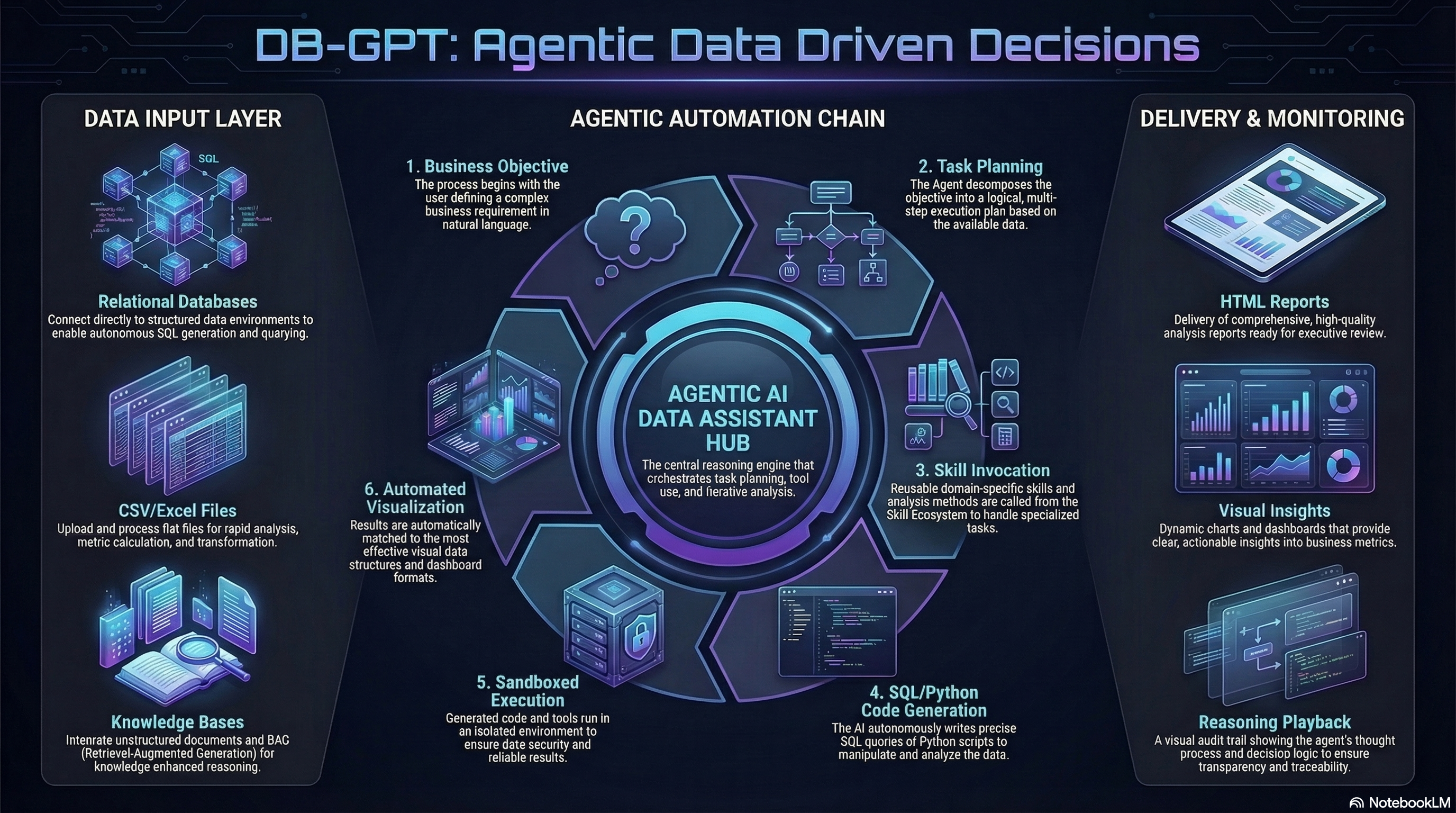
DB-GPT is an agentic AI data assistant for the next generation of AI + Data products. It lives in the Python and LLM agent ecosystem, and it doubles as a platform for building AI-native data agents, workflows, and applications using agents, AWEL, RAG, and multi-model support. A user connects structured and unstructured sources, asks a question in natural language, and the system plans the task, breaks it into steps, calls tools, writes SQL autonomously, runs Python and code-driven analysis, and produces decision-ready output. All of that executes inside sandboxed environments rather than on the host machine.

The concrete problem it solves is the manual loop that surrounds data analysis. Without an assistant of this kind, someone hand-writes SQL, moves results into a notebook, glues together scripts for cleaning and metrics, then rebuilds charts and a summary by hand, repeating the whole path for every new question. DB-GPT collapses connect, ask, generate, execute, and report into a single agentic workflow, and it packages repeatable domain knowledge as skills so the same business analysis can be re-run instead of reconstructed.

Key capabilities

  • Natural-language questioning that produces autonomously written SQL against connected databases.
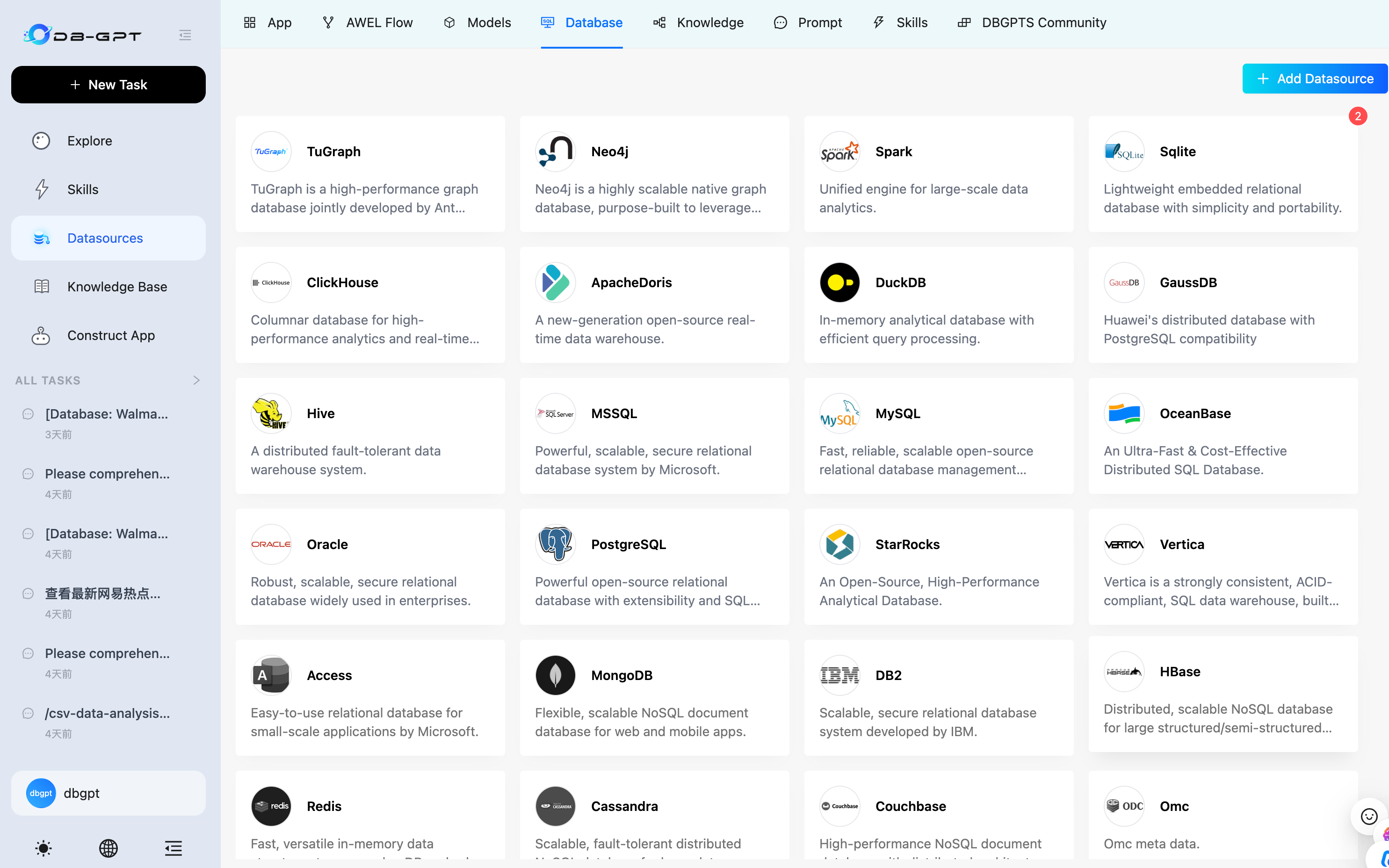
  • Multi-source access spanning databases, CSV and Excel files, warehouses, documents, and knowledge bases.
  • Python and code-driven analysis workflows that clean datasets, compute metrics, and emit outputs.
  • Reusable skills that package domain knowledge, analysis methods, and execution workflows, including importing skills from GitHub.
  • Sandboxed execution that runs code and tools in isolated environments.
  • Output generation covering charts, dashboards, HTML reports, and analysis summaries.
  • Platform building blocks for AI-native data applications: agents, AWEL, RAG, and multi-model support.

Who uses it and how

  • Engineering and data teams building AI + Data assistants for their own product or internal users, deployed self-hosted with the "private" and "security" topics reflecting that posture.
  • Analysts who point DB-GPT at CSV and Excel files and receive visual reports without writing the plotting code themselves.
  • Data teams that connect a database and receive profiling reports as a first-pass understanding of unfamiliar tables.
  • Finance-oriented users performing financial report analysis with code, charts, and narrative summaries.
  • Organisations that codify recurring SQL analysis into skills and domain workflows so repeatable business analysis does not restart from zero each time.

Getting started

Run the one-line installer for macOS and Linux with curl -fsSL https://raw.githubusercontent.com/eosphoros-ai/DB-GPT/main/scripts/install/install.sh | bash, or pass a profile and key directly, for example OPENAI_API_KEY=sk-xxx with --profile openai. Configuration for Kimi 2.5 through the Moonshot API follows the same installer pattern, and full documentation lives at http://docs.dbgpt.cn.

How it compares

No comparable or paid products are named in the available material, so DB-GPT stands alone in this registry on that axis. Contrasts against specific commercial data assistants cannot be drawn from the facts provided.

When to use it — and when not to

A self-hoster must operate the Python service itself, provide model credentials such as OPENAI_API_KEY or a Moonshot API key, supply the data connections, and provide a sandboxed runtime for code and tool execution; the documented installer covers macOS and Linux. Teams that want a fully managed service with no operational surface, or Windows-first environments, should look elsewhere. The project is under active development, with 439 open issues and a last push on 2026-09-16, which means a moving codebase and a substantial backlog alongside the permissive MIT licence.

project readme (upstream, from github) — read inline

DB-GPT: Open-Source Agentic AI Data Assistant
stars forks Official Website License: MIT Release Notes Open Issues X (formerly Twitter) Follow Medium Follow Bilibili Space Slack Open in GitHub Codespaces

English 简体中文 日本語

Documents | Contact Us | Community | Paper

An open-source AI data assistant that connects to your data, writes SQL and code, runs skills in sandboxed environments, and turns analysis into reports, insights, and action.

welcome_page

What is DB-GPT?

DB-GPT is an open-source agentic AI data assistant for the next generation of AI + Data products.

It helps users and teams:

  • connect to databases, CSV / Excel files, warehouses, and knowledge bases
  • ask questions in natural language and let AI write SQL autonomously
  • run Python- and code-driven analysis workflows
  • load and execute reusable skills for domain-specific tasks
  • generate charts, dashboards, HTML reports, and analysis summaries
  • execute tasks safely in sandboxed environments

DB-GPT is also a platform for building AI-native data agents, workflows, and applications with agents, AWEL, RAG, and multi-model support.

Why DB-GPT?

1. Agentic data analysis

Plan tasks, break work into steps, call tools, and complete analysis workflows end to end. csv_data_analysis_demo_en

2. Autonomous SQL + code execution

Generate SQL and code to query data, clean datasets, compute metrics, and produce outputs. agentic_write_code sql_query

3. Multi-source data access

Work across structured and unstructured sources, including databases, spreadsheets, documents, and knowledge bases.
datasource

4. Skills-driven extensibility

Package domain knowledge, analysis methods, and execution workflows into reusable skills.

import_github_skill

5. Sandboxed execution

Run code and tools in isolated environments for safer, more reliable analysis. sandbox

What you can do with DB-GPT

  • Analyze CSV / Excel files and generate visual reports
  • Connect to databases and produce profiling reports
  • Ask business questions in natural language and let AI write SQL automatically
  • Perform financial report analysis with code, charts, and narrative summaries
  • Create and reuse SQL analysis skills and domain workflows
  • Combine code, SQL, retrieval, and tools in a single agentic workflow
  • Build next-generation AI + Data assistants for your team or product

Product Workflow

Explore data

Connect files, databases, and knowledge bases in one workspace.

Plan and execute

Let AI reason through the task, write SQL and code, and execute step by step.

Use skills

Load reusable skills for repeatable business analysis workflows.

Generate reports

Produce charts, dashboards, HTML reports, and decision-ready outputs.

Quick Start

Get DB-GPT running in minutes with the one-line installer (macOS & Linux):

curl -fsSL https://raw.githubusercontent.com/eosphoros-ai/DB-GPT/main/scripts/install/install.sh | bash

Or specify a profile and API key directly:

curl -fsSL https://raw.githubusercontent.com/eosphoros-ai/DB-GPT/main/scripts/install/install.sh \
  | OPENAI_API_KEY=sk-xxx bash -s -- --profile openai

For Kimi 2.5 via Moonshot API:

curl -fsSL https://raw.githubusercontent.com/eosphoros-ai/DB-GPT/main/scripts/install/install.sh \
  | MOONSHOT_API_KEY=sk-xxx bash -s -- --profile kimi

For MiniMax via the OpenAI-compatible API:

curl -fsSL https://raw.githubusercontent.com/eosphoros-ai/DB-GPT/main/scripts/install/install.sh \
  | MINIMAX_API_KEY=sk-xxx bash -s -- --profile minimax

Already have a local DB-GPT checkout? Reuse it instead of cloning ~/.dbgpt/DB-GPT:

OPENAI_API_KEY=sk-xxx \
  bash scripts/install/install.sh --profile openai --repo-dir "$(pwd)" --yes

Or reuse your local repo with Kimi 2.5:

MOONSHOT_API_KEY=sk-xxx \
  bash scripts/install/install.sh --profile kimi --repo-dir "$(pwd)" --yes

Or reuse your local repo with MiniMax:

MINIMAX_API_KEY=sk-xxx \
  bash scripts/install/install.sh --profile minimax --repo-dir "$(pwd)" --yes

After installation, start the server with the generated profile config:

cd ~/.dbgpt/DB-GPT && uv run dbgpt start webserver --profile <profile>

Then open http://localhost:5670.

Prefer to review the script first?

curl -fsSL https://raw.githubusercontent.com/eosphoros-ai/DB-GPT/main/scripts/install/install.sh -o install.sh
less install.sh
bash install.sh --profile openai

Install via PyPI

Install DB-GPT from PyPI and start it with a single command — no source checkout required.

Prerequisites: Python 3.10+ and uv (recommended) or pip.

1. Install

# Recommended: use uv
uv pip install dbgpt-app

# Or with pip
pip install dbgpt-app

The default installation includes the core framework (CLI, FastAPI, Agent), OpenAI-compatible LLM support, DashScope / Tongyi support, RAG document parsing, and ChromaDB vector store.

2. Start

dbgpt start

On first run, an interactive setup wizard will guide you through choosing an LLM provider and entering your API key. Once complete, the web server starts automatically.

3. Open the Web UI

Visit http://localhost:5670 — you're all set! 🎉

Advanced Installation

Docker Linux ![macOS](https://img.shields.io/badge/mac%20os-000000

readme truncated — read the full docs on github

Frequently asked questions

Is DB-GPT free to use?

DB-GPT is open source under the MIT licence. There is no licence fee and no seat count — you can self-host it or, where the project offers one, pay a vendor for a managed version instead.

What does DB-GPT do?

open-source agentic AI data assistant for the next generation of AI + Data products.

What is DB-GPT written in?

DB-GPT is primarily written in Python. Its source is publicly available at https://github.com/eosphoros-ai/DB-GPT, and it has 19,997 GitHub stars.



