 DataChain: The Context Layer for Unstructured Data





A Python library that turns files in S3, GCS, and Azure into versioned, typed datasets, queryable at warehouse speed.
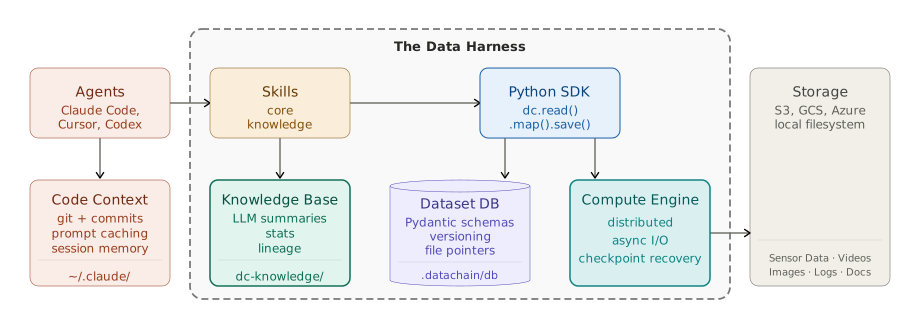
- Compute Engine: parallel Python over files, distributed on Studio. Async I/O, checkpoint recovery, incremental updates.
- Dataset DB: Pydantic schemas, versioning, file pointers, automatic lineage. Sub-second filter, join, and group_by over millions of typed records locally, hundreds of millions on Studio. Vector search over the same rows, no separate store.
Optional, for agent workflows:
- Knowledge Base: markdown summaries derived from the Dataset DB and enriched by LLM. Readable by humans and LLMs.
- Agent Harness: a skill that plugs all three into Claude Code, Cursor, Codex, GitHub Copilot, and Pi, so they understand your data. On Studio, agents reach the same datasets over MCP.
Bytes never leave your storage. Every run deposits a typed dataset the next pipeline (or agent) reads instead of recomputing.
1. Install
pip install datachain
To add the agent skill (Knowledge Base + code generation):
datachain skill install --target claude # also: cursor, codex, copilot, pi
Works with S3, GCS, Azure, and local filesystems.
2. Quickstart: agent-driven pipeline
Task: find dogs in S3 similar to a reference image, filtered by breed, mask availability, and image dimensions.
Grab a reference image and run Claude Code (or other agent):
datachain cp --anon s3://dc-readme/fiona.jpg .

claude
Prompt:
Find dogs in s3://dc-readme/oxford-pets-micro/ similar to ./fiona.jpg:
  - Pull breed metadata and mask files from annotations/
  - Exclude images without mask
  - Exclude Cocker Spaniels
  - Only include images wider than 400px
Result:
  ┌──────┬───────────────────────────────────┬────────────────────────────┬──────────┐
  │ Rank │               Image               │           Breed            │ Distance │
  ├──────┼───────────────────────────────────┼────────────────────────────┼──────────┤
  │    1 │ shiba_inu_52.jpg                  │ shiba_inu                  │    0.244 │
  ├──────┼───────────────────────────────────┼────────────────────────────┼──────────┤
  │    2 │ shiba_inu_53.jpg                  │ shiba_inu                  │    0.323 │
  ├──────┼───────────────────────────────────┼────────────────────────────┼──────────┤
  │    3 │ great_pyrenees_17.jpg             │ great_pyrenees             │    0.325 │
  └──────┴───────────────────────────────────┴────────────────────────────┴──────────┘

  Fiona's closest matches are shiba inus (both top spots), which makes sense given her
  tan coloring and pointed ears.
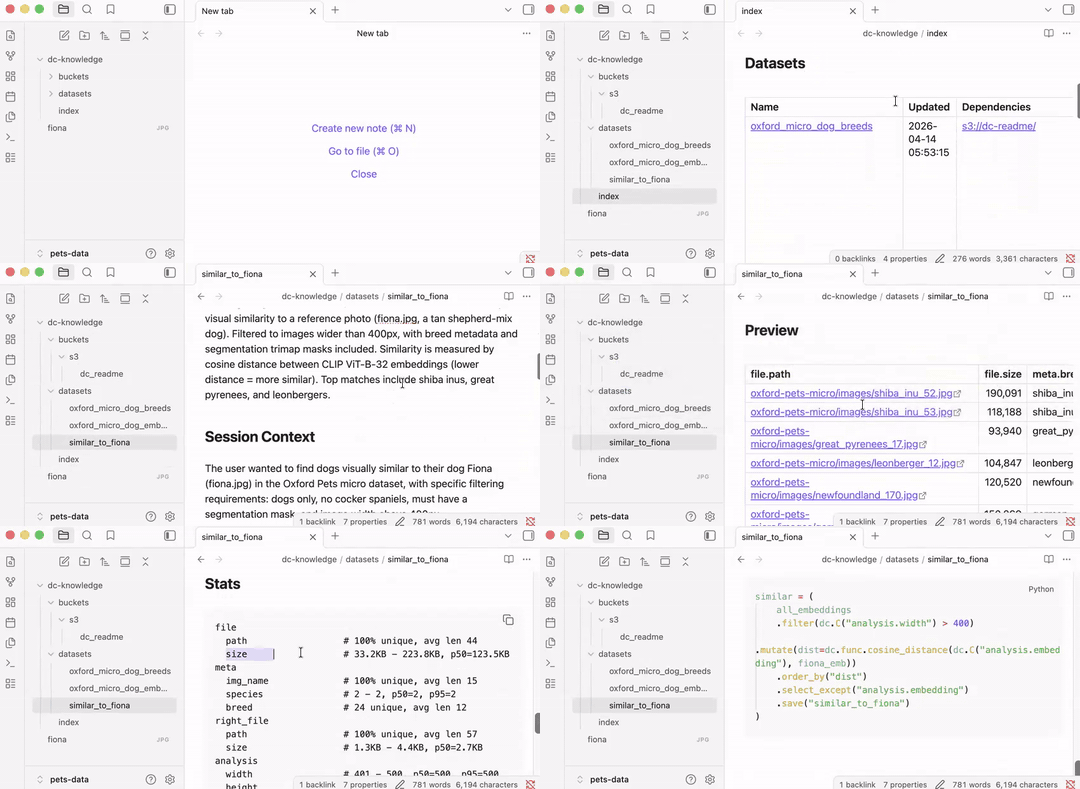
The agent decomposed the task into steps - embeddings, breed metadata, mask join, quality filter - and saved each as a named, versioned dataset. Next time you ask a related question, it starts from what's already built.
The datasets are registered in a Knowledge Base optimized for both agents and humans:
dc-knowledge
├── buckets
│   └── s3
│       └── dc_readme.md
├── datasets
│   ├── oxford_micro_dog_breeds.md
│   ├── oxford_micro_dog_embeddings.md
│   └── similar_to_fiona.md
└── index.md
Browse it as markdown files, navigate with wikilinks, or open in Obsidian:
3. Data Harness
Code harnesses (Claude Code, Cursor, Codex, GitHub Copilot, Pi) give agents repo context, dedicated tools, and memory across sessions. DataChain adds the same for data: typed datasets the agent reads, chain operations the agent calls (read_storage, map, save), a Dataset DB where its results persist.
A dataset is the unit of work - a named, versioned result of a pipeline step like [email protected]. Every .save() registers one.
For the data-flow architecture (Compute Engine, Dataset DB, Knowledge Base) and how the components connect, see Architecture.
4. Core concepts
4.1. Dataset
A dataset is a versioned data reasoning step - what was computed, from what input, producing what schema. DataChain indexes your storage into one: no data copied, just typed metadata and file pointers. Re-runs only process new or changed files.
Create a dataset manually create_dataset.py:
from PIL import Image
import io
from pydantic import BaseModel
import datachain as dc


class ImageInfo(BaseModel):
    width: int
    height: int


def get_info(file: dc.File) -> ImageInfo:
    img = Image.open(io.BytesIO(file.read()))
    return ImageInfo(width=img.width, height=img.height)


ds = (
    dc.read_storage(
        "s3://dc-readme/oxford-pets-micro/images/**/*.jpg",
        anon=True,
        update=True,
        delta=True,  # re-runs skip unchanged files
    )
    .settings(prefetch=64)
    .map(info=get_info)
    .save("pets_images")
)
ds.show(5)
[email protected] is now the shared reference to this data - schema, version, lineage, and metadata.
Every .save() registers the dataset in the Dataset DB, DataChain's persistent store for schemas, versions, lineage, and processing state, kept locally in SQLite DB .datachain/db. Pipelines reference datasets by name, not paths. When the code or input data changes, the next run bumps dataset version.
This is what makes a dataset a management unit: owned, versioned, and queryable by everyone on the team.
4.2. Schemas and types
DataChain uses Pydantic to define the shape of every column. The return type of your UDF becomes the dataset schema - each field a queryable column in the Dataset DB.
show() in the previous script renders nested fields as dotted columns:
                                          file    file  info   info
                                          path    size width height
0  oxford-pets-micro/images/Abyssinian_141.jpg  111270   461    500
1  oxford-pets-micro/images/Abyssinian_157.jpg  139948   500    375
2  oxford-pets-micro/images/Abyssinian_175.jpg   31265   600    234
3  oxford-pets-micro/images/Abyssinian_220.jpg   10687   300    225
4    oxford-pets-micro/images/Abyssinian_3.jpg   61533   600    869

[Limited by 5 rows]
print(ds.schema) renders its schema:
file: File@v1
  source: str
  path: str
  size: int
  version: str
  etag: str
  is_latest: bool
  last_modified: datetime
  location: Union[dict, list[dict], NoneType]
info: ImageInfo
  width: int
  height: int
Models can be arbitrarily nested - a BBox inside an Annotation, a List[Citation] inside an LLM Response - every leaf field stays queryable the same way. The schema lives in the Dataset DB and is enforced at dataset creation time.
The Dataset DB handles datasets of any size - 100 millions of files, hundreds of metadata rows - without loading anything into memory. Pandas is limited by RAM; DataChain is not. Export to pandas when you need it, on a filtered subset:
import datachain as dc

df = dc.read_dataset("pets_images").filter(dc.C("info.width") > 500).to_pandas()
print(df)
4.3. Fast queries
Filters, aggregations, and joins run as vectorized operations directly against the Dataset DB - metadata never leaves your machine, no files downloaded.
import datachain as dc

cnt = (
    dc.read_dataset("pets_images")
    .filter(
        (dc.C("info.width") > 400)
        & ~dc.C("file.path").ilike("%cocker_spaniel%")  # case-insensitive
    )
    .count()
)
print(f"Large images with Cocker Spaniel: {cnt}")
Milliseconds, even at 100M-file scale.
Large images with Cocker Spaniel: 6
5. Resilient Pipelines
When computation is expensive, bugs and new data are both inevitable. DataChain tracks processing state in the Dataset DB - so crashes and new data are handled automatically, without changing how you write pipelines.
5.1. Data checkpoints
Save to embed.py:
import open_clip, torch, io
from PIL import Image
import datachain as dc

model, _, preprocess = open_clip.create_model_and_transforms(
    "ViT-B-32", "laion2b_s34b_b79k"
)
model.eval()

counter = 0


def encode(file: dc.File, model, preprocess) -> list[float]:
    global count