Databunker
Databunker is a self-hosted, GDPR compliant, Go-based tool for secure personal records tokenization and storage - PII/PHI/KYC: https://databunker.org/





Databunker intro
💣 The Big Problem with Traditional Database Encryption
Traditional database encryption solutions often provide a false sense of security. While they may encrypt data at rest, they leave critical vulnerabilities:
- Encryption alone isn’t enough: Most vendors offer only disk-block encryption, ignoring API-level encryption
- Vulnerable GraphQL Queries: Unfiltered queries can expose unencrypted data to attackers
- SQL Injection Risks: Attackers can retrieve plaintext data through SQL injections
Databunker addresses these gaps with a secure, developer-focused solution for personal data tokenization and storage.
🛠️ DataBunker Features
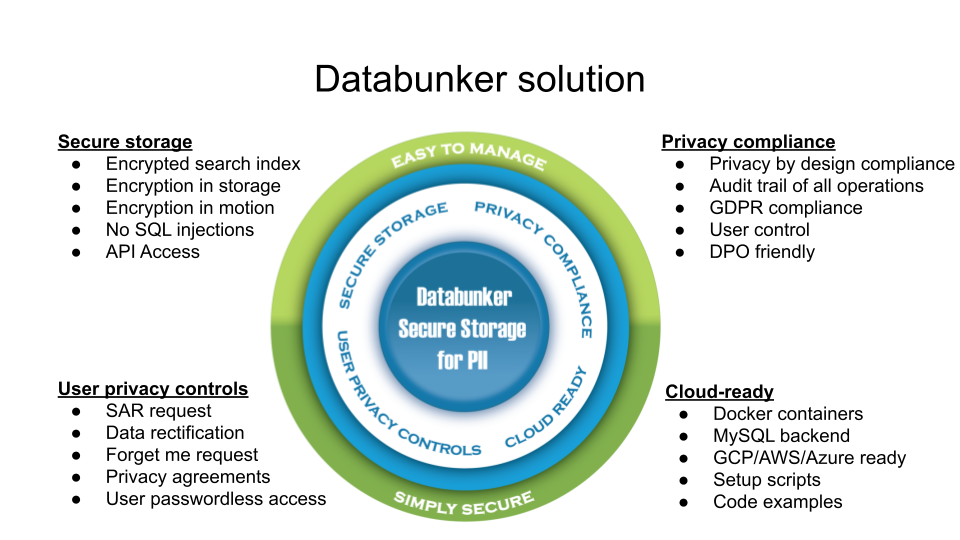
- Tokenization Engine: Generates UUID tokens for safe data referencing in applications
- Encrypted Storage: Secures sensitive records with advanced encryption layer
- Injection Protection: Blocks SQL and GraphQL injection attacks by design
- Secure Indexing: Uses hash-based indexing for search queries
- No Plaintext Storage: Ensures all data is encrypted at rest
- Restricted Bulk Retrieval: Disabled by default to prevent data leaks
- API-Based Access: Integrates with your backend via a NoSQL-like API
- Fast Integration: Set up secure data protection in under 10 minutes
For credit-card tokenization or enterprise security features check out the Databunker Pro.
⚡ Why Databunker?
Databunker provides a robust, open-source vault that eliminates the false sense of security from traditional encryption methods, offering developers a practical way to protect sensitive data.
🚀 Deployment & Usage
- Self-Hosted: Run on your cloud or on-premises infrastructure
- Open-Source: Licensed under MIT for free commercial use
- GDPR Compliant: Meets modern privacy regulation requirements
- High Performance: Go-powered API ensures fast tokenization and data access
🔐 How It Works
- Store sensitive data in Databunker via API calls
- Receive UUID tokens to reference data securely in your application
- Query data using secure, hash-based indexing
- Benefit from built-in protections against injections and bulk data leaks
🚀 Quick Start (5 minutes)
# Pull and run Databunker container
docker pull securitybunker/databunker
docker run -p 3000:3000 -d --rm --name dbunker securitybunker/databunker demo

# Create user records
curl -s http://localhost:3000/v1/user -X POST \
  -H "X-Bunker-Token: DEMO" \
  -H "Content-Type: application/json" \
  -d '{"first":"John","last":"Doe","login":"john","email":"[email protected]"}'

# Get user by login, email, phone, or token
curl -s -H "X-Bunker-Token: DEMO" -X GET http://localhost:3000/v1/user/login/john

# Admin UI: http://localhost:3000
💡 What Problems Does Databunker Solve?
Prevents Data Breaches
- Eliminates SQL injection vulnerabilities
- Protects against GraphQL data exposure
- Segregates sensitive data from your main database
Simplifies Compliance
- GDPR, CCPA, HIPAA ready out of the box
- Built-in consent management
- Automated data minimization
- Full audit trail of all operations
Reduces Development Time
- Simple REST API for all operations
- SDK available for popular languages
- Drop-in replacement for your user table
- Built-in session management
Project demo is available at: https://databunker.org/doc/demo/.
Please add a star if you like our project.
🔒 Key Security Features
- Encrypted Storage: All personal records are encrypted using AES-256
- Secure API: REST API with strong authentication
- Tokenization: Replace sensitive data with tokens in your main database
- Access Control: Fine-grained permissions and audit logging
- Data Segregation: Physical separation from your application database
🔌 Integration Examples
// Node.js Example
const { Databunker } = require('databunker-sdk');
const db = new Databunker({
  url: 'http://localhost:3000',
  token: 'DEMO'
});

// Store user record
await db.users.create({
  email: '[email protected]',
  name: 'John Doe',
  phone: '+1-415-555-0123'
});

// Retrieve user by email
const user = await db.users.findByEmail('[email protected]');
📊 Use Cases
- User Profile Storage: Secure storage for user personal data
- Healthcare Records: HIPAA-compliant patient data storage
- Financial Services: PCI DSS compliant customer records
- Identity Management: Secure user authentication and session storage
- GDPR Compliance: Built-in tools for data privacy regulations
🔧 Technical Specifications
- Written in Go for high performance
- Supports MySQL and PostgreSQL
- REST API with OpenAPI specification
- Containerized deployment
- Horizontal scaling support
- Automated backups
- High availability options
📚 Resources
- GDPR compliance and Databunker introduction video https://www.youtube.com/watch?v=QESOuL3LMj0
- https://oppetmoln.se/20220223/databunker-en-oppen-losning-for-gdpr-saker-lagring-av-kundinformation/
- https://anchor.fm/techandmain/episodes/Huawei--Microsoft-and-DataBunker--Yuli-Stremovsky-evl385
- https://www.freecodecamp.org/news/how-to-stay-gdpr-compliant-with-access-logs/
- https://hackernoon.com/data-leak-prevention-with-databunker-xnn33u9
- https://nocomplexity.com/documents/simplifyprivacy/databunker.html
- https://marcusolsson.dev/data-privacy-vaults-using-databunker/
- https://ipv6.rs/tutorial/FreeBSD_Latest/Databunker/
- https://selfhostedworld.com/software/databunker
- https://ipv6.rs/tutorial/Void_Linux/Databunker/
- https://news.ycombinator.com/item?id=26690279
- https://slashdot.org/software/p/Databunker/
- https://github.com/expressjs/session
- https://stackshare.io/databunker
- https://dbweekly.com/issues/348
- https://databunker.org/
📘 GDPR: Out of the box solution for:
- Right of access
- Right to restrict processing / Consent withdrawal
- Right to be forgotten
- Right to rectification
- Right to data portability
⚡ Databunker use cases
Detailed information can be found at https://databunker.org/use-case/
- A perfect backend for a KYC system for a crypto startup
- Temporary record identities for secure data exchange
- Audit trail and tracing customer profile changes
- Critical Data Segregation: Implementation Guide
- Continuous Data Protection for PII/PHI records
- Custom Privacy-Enhancing Technology - PET
- User rights and privacy controls
- PII/PHI storage and tokenization
- Automatic log retention policy
- Privacy by Design Compliance
- Simplify user login backend
- Consent Management Platform
- Personal Data minimization
- [Secure session storage](https://databunker.org/use-case/secure-session-storag