DarkMoon
Open-source autonomous AI penetration testing platform that finds and proves every vulnerability with a real exploit, on a local model





⭐ Star DarkMoon · 🚀 Quick Start · 📊 Benchmark · 🔒 Darkmoon Pro · ▶️ Watch the demo (Pro)
DarkMoon is autonomous AI penetration testing for your own infrastructure. Point it at an authorized target and it runs the whole assessment on its own, then returns proof for every finding.
- 🟢 Truly open source. GPLv3 and self-hosted, every agent's methodology is plain Markdown you can read, diff and fork.
- 🎯 Finds AND proves. Each vulnerability ships with the exact command, the raw output and a working exploit, so there is almost nothing to triage.
- 🔒 Runs on a local LLM + Privacy Gateway. The gateway tokenizes your real IPs, hosts and credentials locally, so the model reasons on placeholders while real values stay on your perimeter.
See the open source engine (CLI)
The open source Darkmoon is a command line tool. This is what you get when you clone the repo. You launch an assessment from the command line and watch every agent, command and finding stream past in real time.
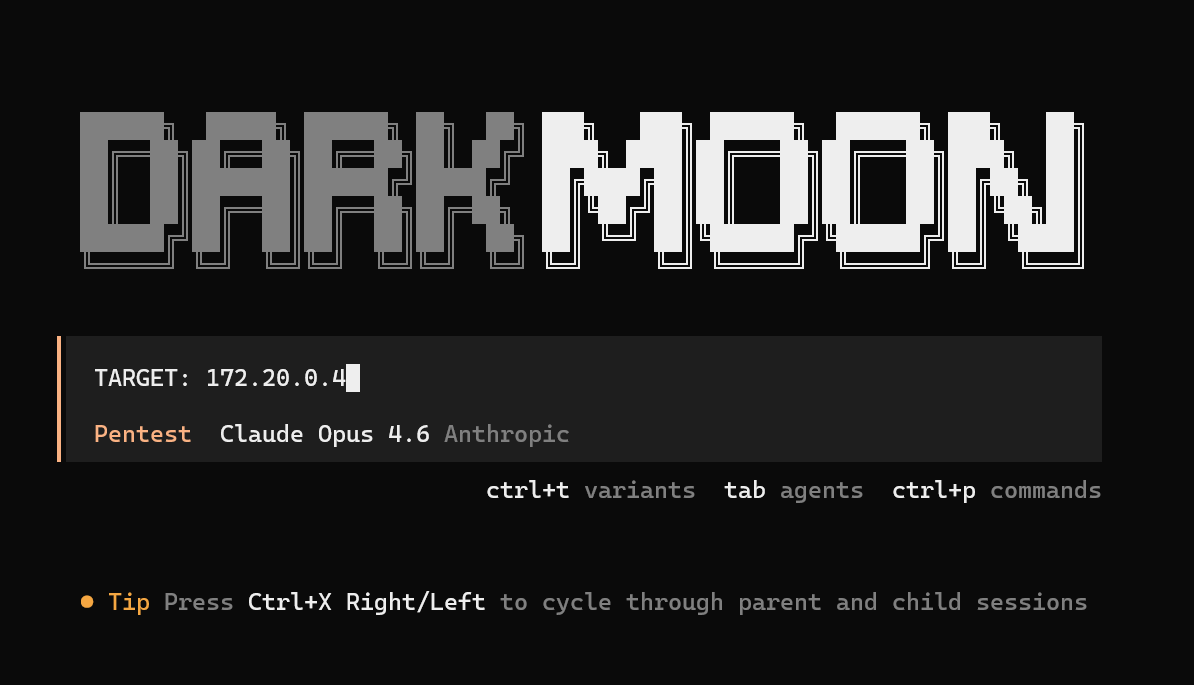
Kick off a run from the CLI. One |
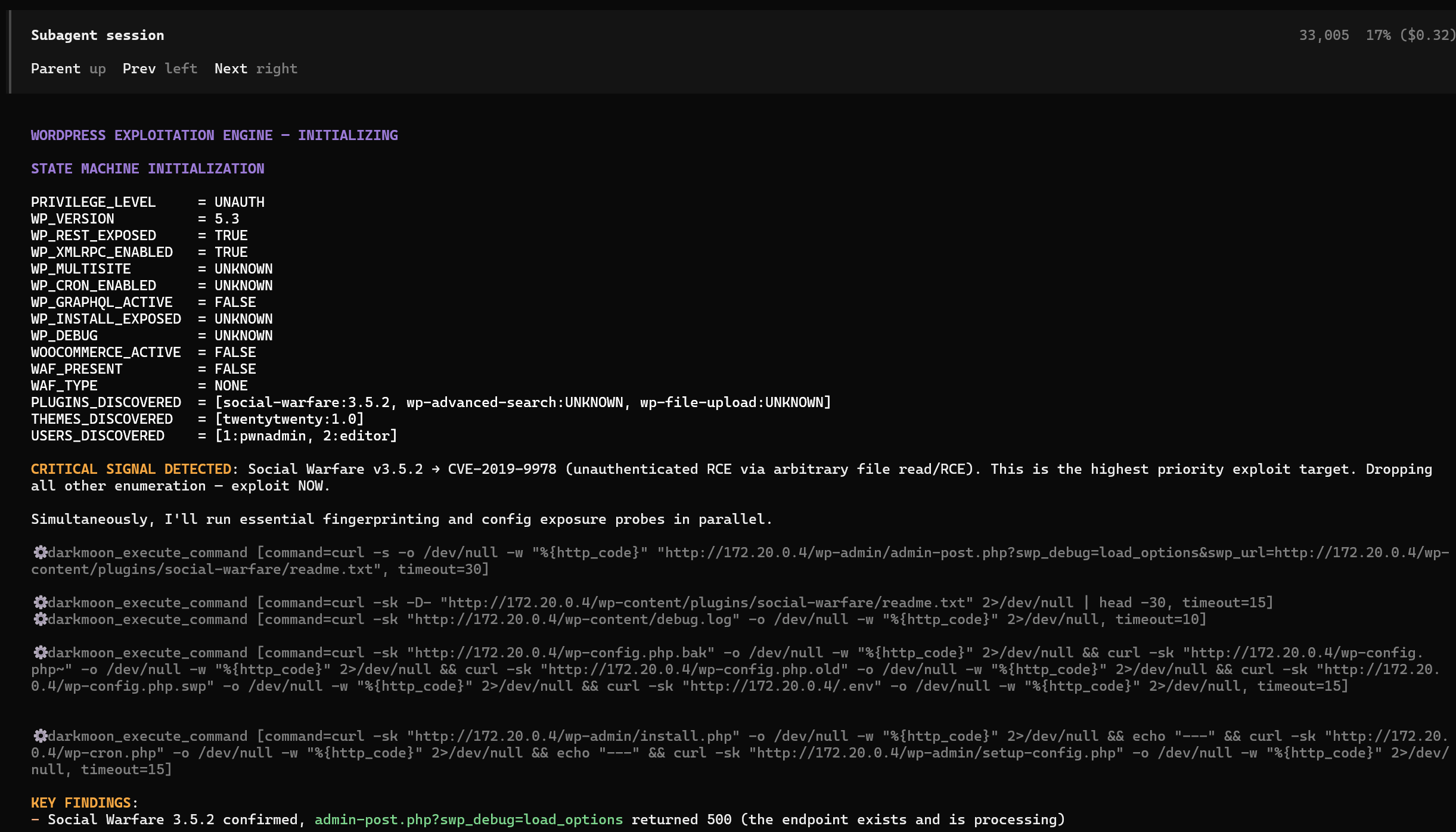
Autonomous agents reason and exploit, live in your terminal. Here a sub-agent flags CVE-2019-9978 and pivots straight to exploitation. |
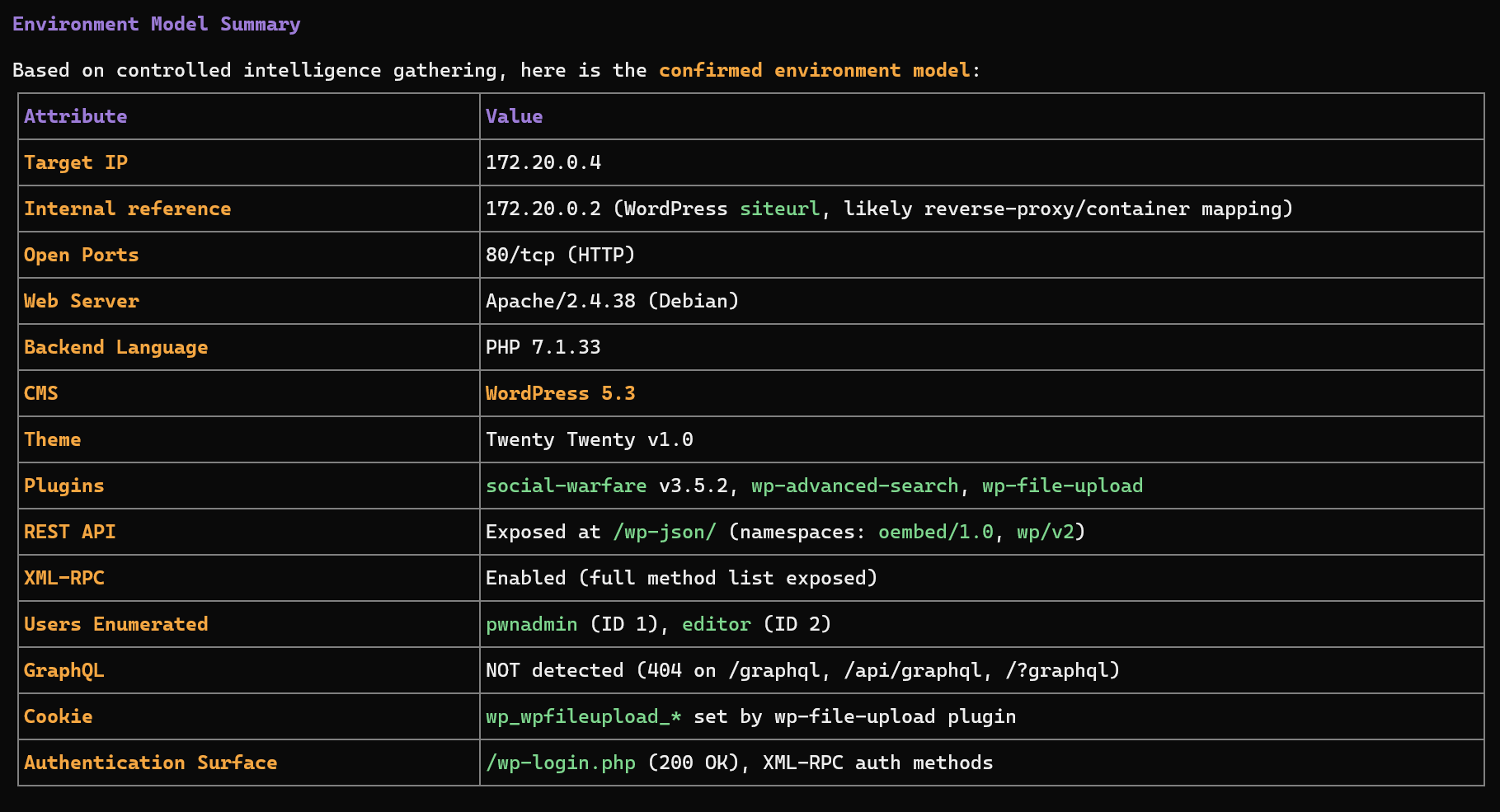
Recon and environment model. DarkMoon fingerprints the stack and confirms the attack surface before it strikes. |
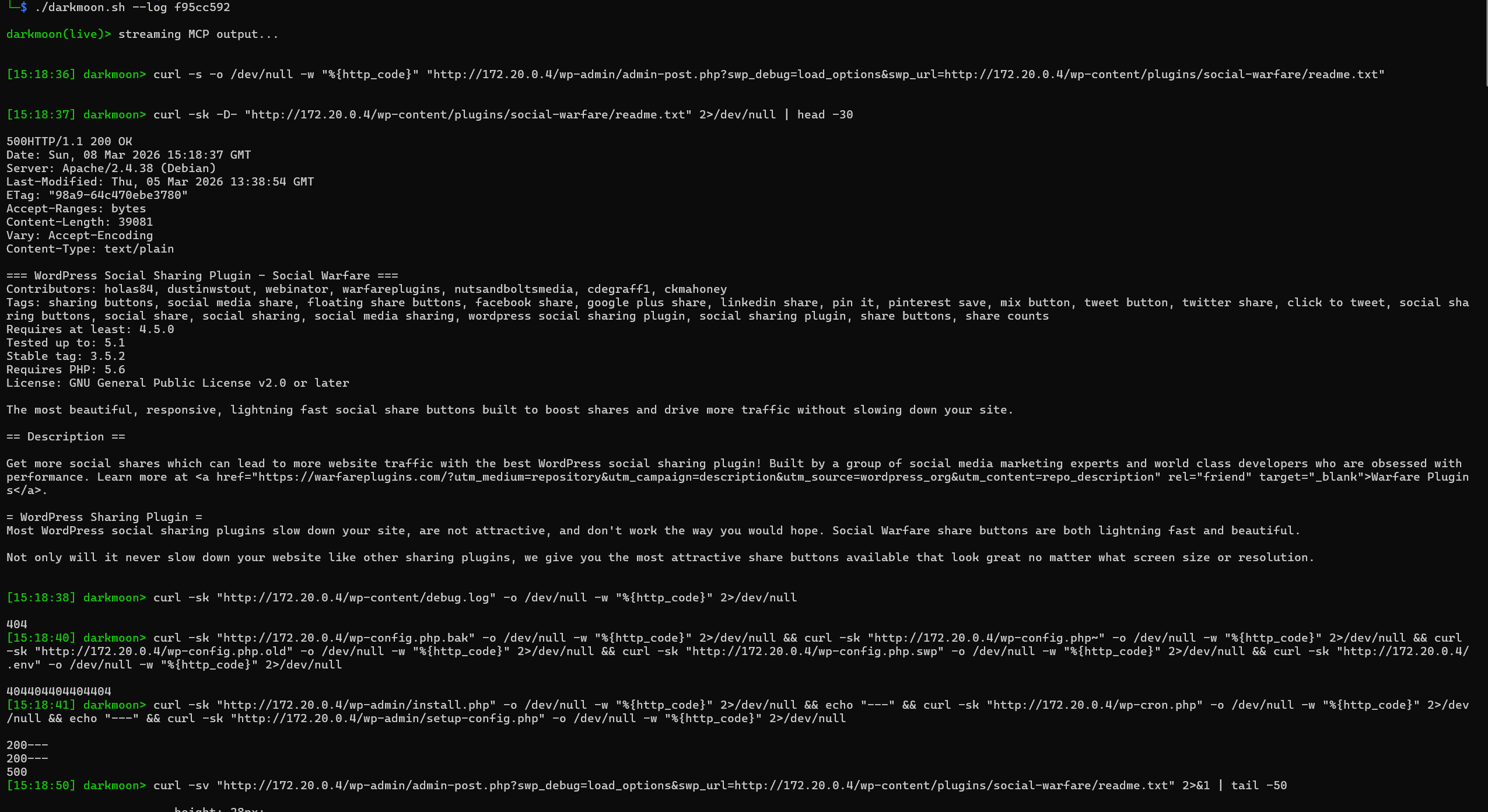
Live MCP stream. Every command the agent runs and its raw output, timestamped, with |
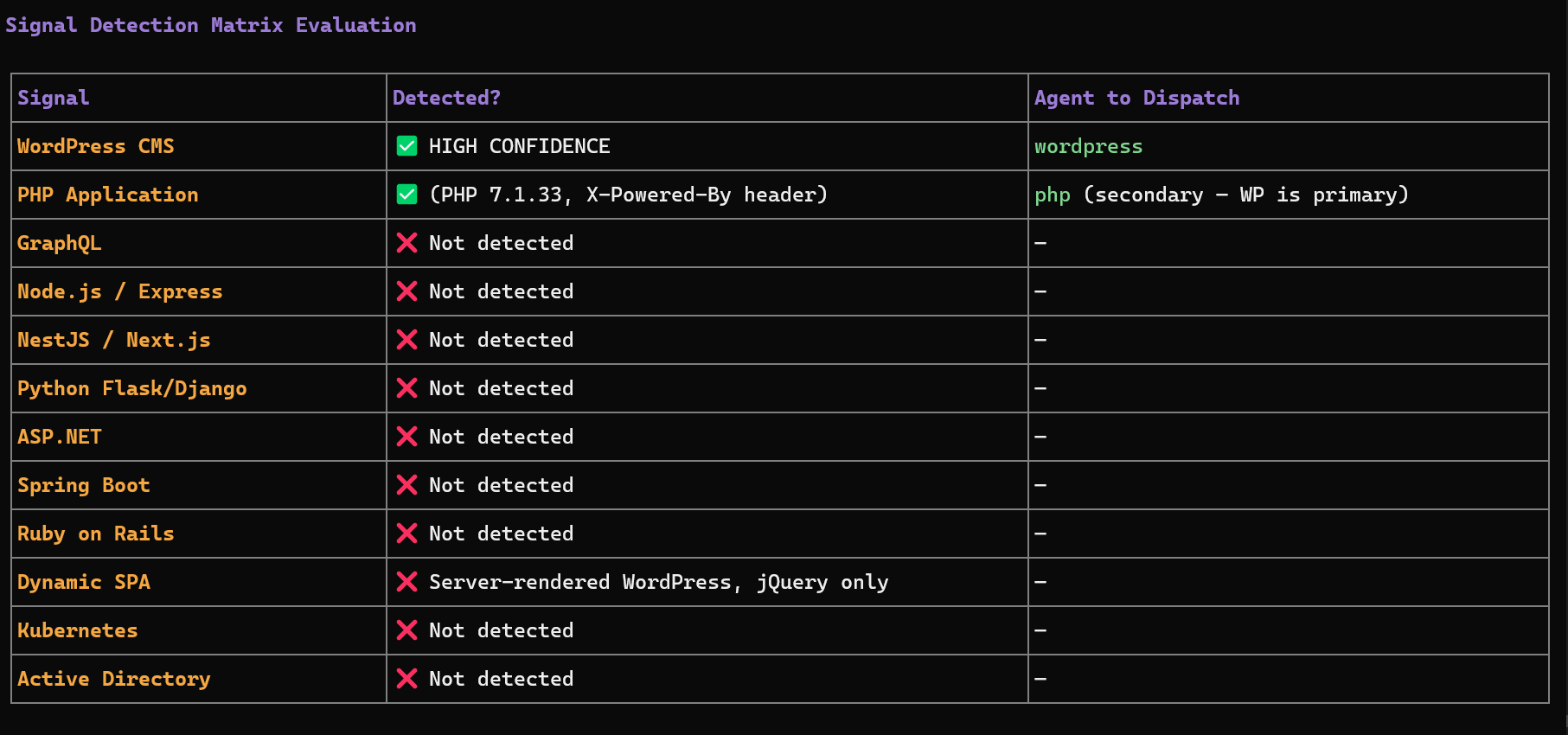
Signal to agent dispatch. DarkMoon decides which specialist agents to deploy from exactly what it detects on the target.
As featured in Help Net Security · Cyber Security News · DevOps.com · SecurityBrief · LinuxLinks · IT Brief · ChannelLife
Quick Start
git clone https://github.com/ASCIT31/Dark-Moon.git
cd Dark-Moon
./install.sh
install.sh configures your LLM provider interactively (no need to edit docker-compose.yml) and builds the full stack:
./install.sh           # skip form if .opencode.env already configured
./install.sh --init    # force reconfiguration (cloud or local model)
./install.sh --help    # show usage
Supports cloud providers (Anthropic, OpenAI, OpenRouter…) and local models (Ollama, llama.cpp). Then run your first assessment and watch it live:
./darkmoon.sh "TARGET: example.com"
./darkmoon.sh --log <session_id>
Prerequisites: Docker & Docker Compose, and an LLM API key (or a local model). GPU setup, environment variables and the full flags reference live in the Full Documentation.
Feature grid
| 🧠 50 specialist agents | One agentic system reasons, plans and dispatches specialist agents across every surface it discovers. |
| 🌐 Every surface | Web, APIs, Active Directory, Kubernetes, cloud (AWS, Azure, GCP), CI/CD, databases, IoT firmware and AI/LLM endpoints, chained end to end. |
| 🔒 Privacy Gateway | Reversible local tokenization turns real IPs, hosts, URLs and credentials into deterministic placeholders, rehydrated only locally at the moment a tool runs. |
| 🏠 Local model | Run the whole assessment on a local LLM (Ollama, llama.cpp) so your infrastructure values stay on your own perimeter. |
| 🧾 Proof, not scores | Every finding ships with the exact command, raw output and a reproducible exploit. |
| 🛡️ Security by design | The AI never runs a command directly, every action flows through a controlled, logged MCP interface. |
| 🤖 Pentests your AI too | A dedicated LLM agent probes AI/LLM inference endpoints for the OWASP LLM Top 10 with garak-backed probes. |
| ♾️ CI/CD native | Trigger a pentest in the pipeline and get findings back as artifacts. |
| 🔌 MCP + n8n | Orchestrate 50+ offensive tools over MCP, and drive DarkMoon from an n8n workflow. |
| 🔧 Fix it (Pro) | The paid Pro tier turns findings into human-reviewed pull requests, retested against the original exploit. |
Built for security teams, DevSecOps engineers, red teamers and ethical hacking professionals.
🔒 Darkmoon Pro — paid edition: web dashboard and automated remediation
🔒 These are Darkmoon Pro features (paid). The open source edition is the CLI shown above; the web dashboard and the automated remediation to pull requests are not in the open source build.
The screenshots below are the paid Darkmoon Pro web dashboard. They are not part of the open source repository you clone. The open source edition is the command line tool shown in the section above.
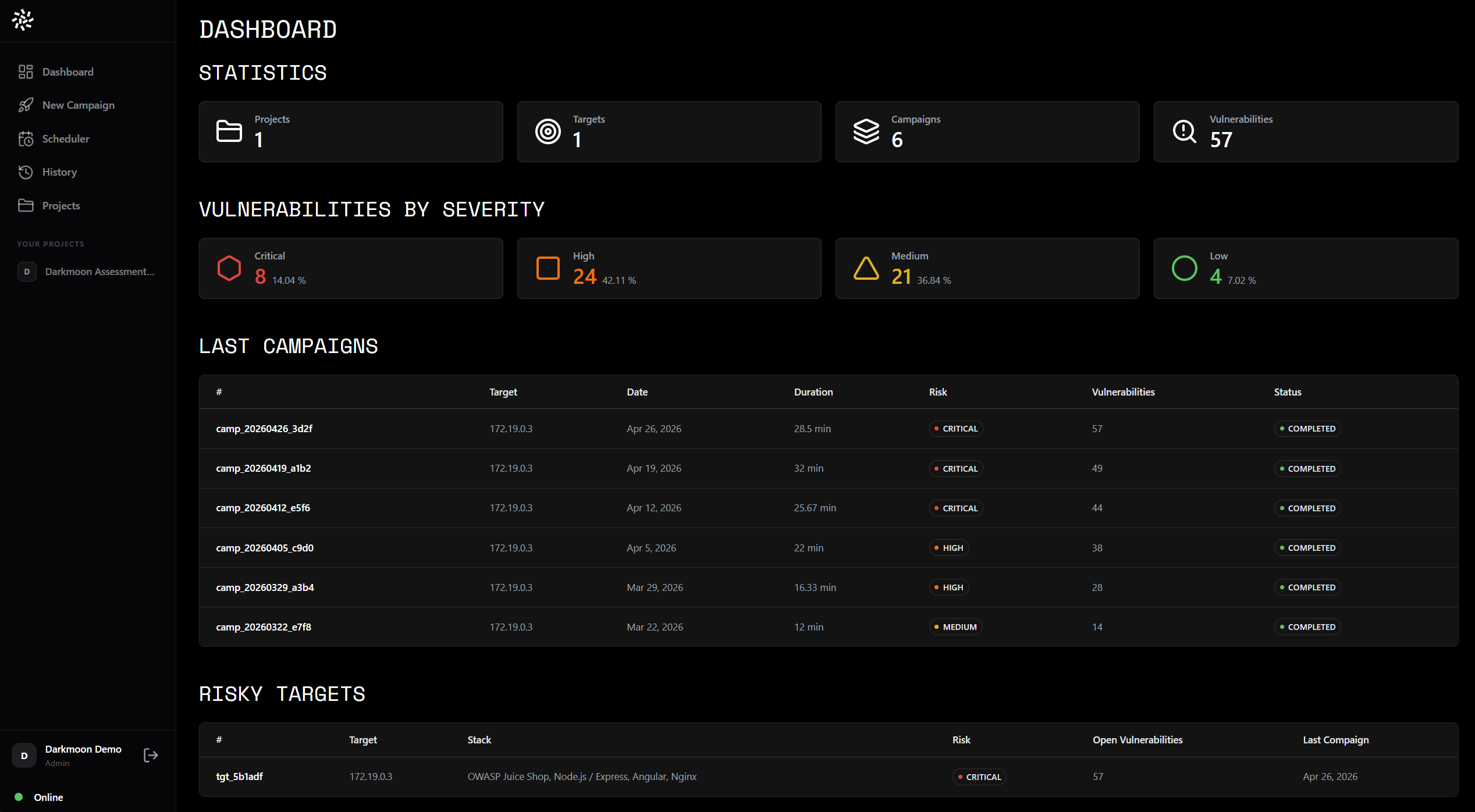
Pro: live web dashboard. Projects, targets and campaigns at a glance, with every finding bucketed by severity. |
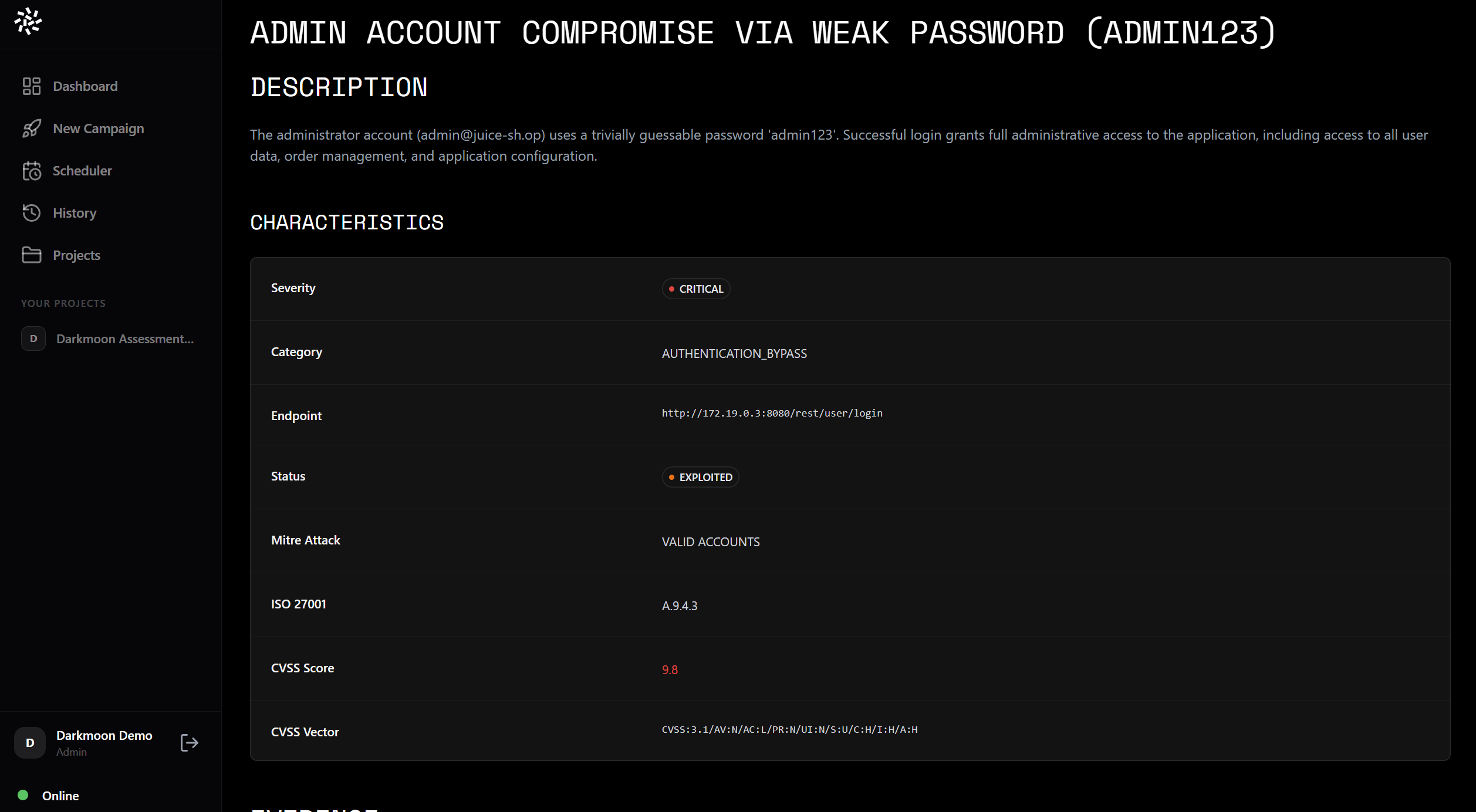
Pro: findings with CVSS and ATT&CK mapping. Each finding carries CVSS, MITRE ATT&CK and ISO 27001 mapping with an |
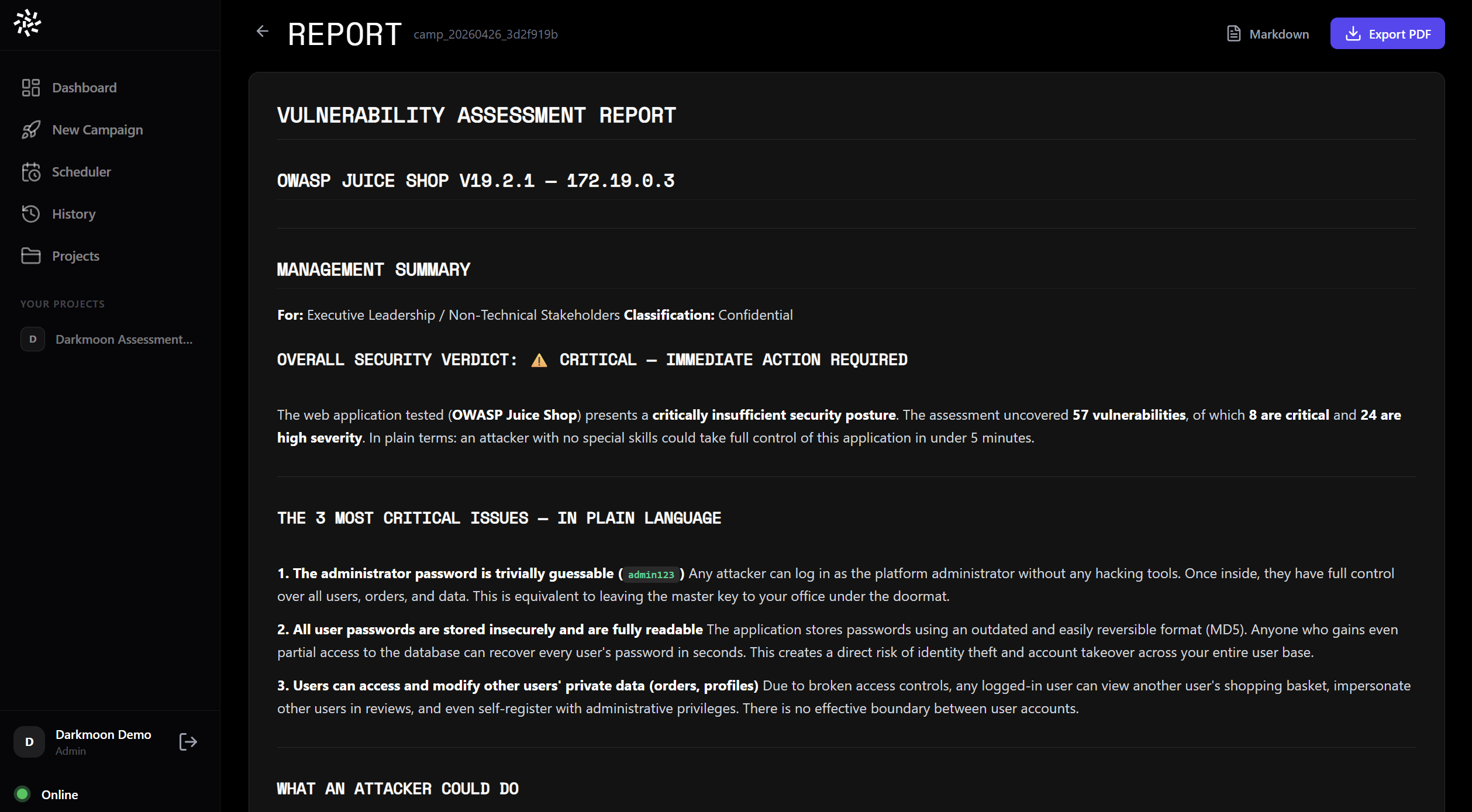
Pro: exportable web reports. A management summary in plain language plus full technical detail, exportable to Markdown and PDF. |
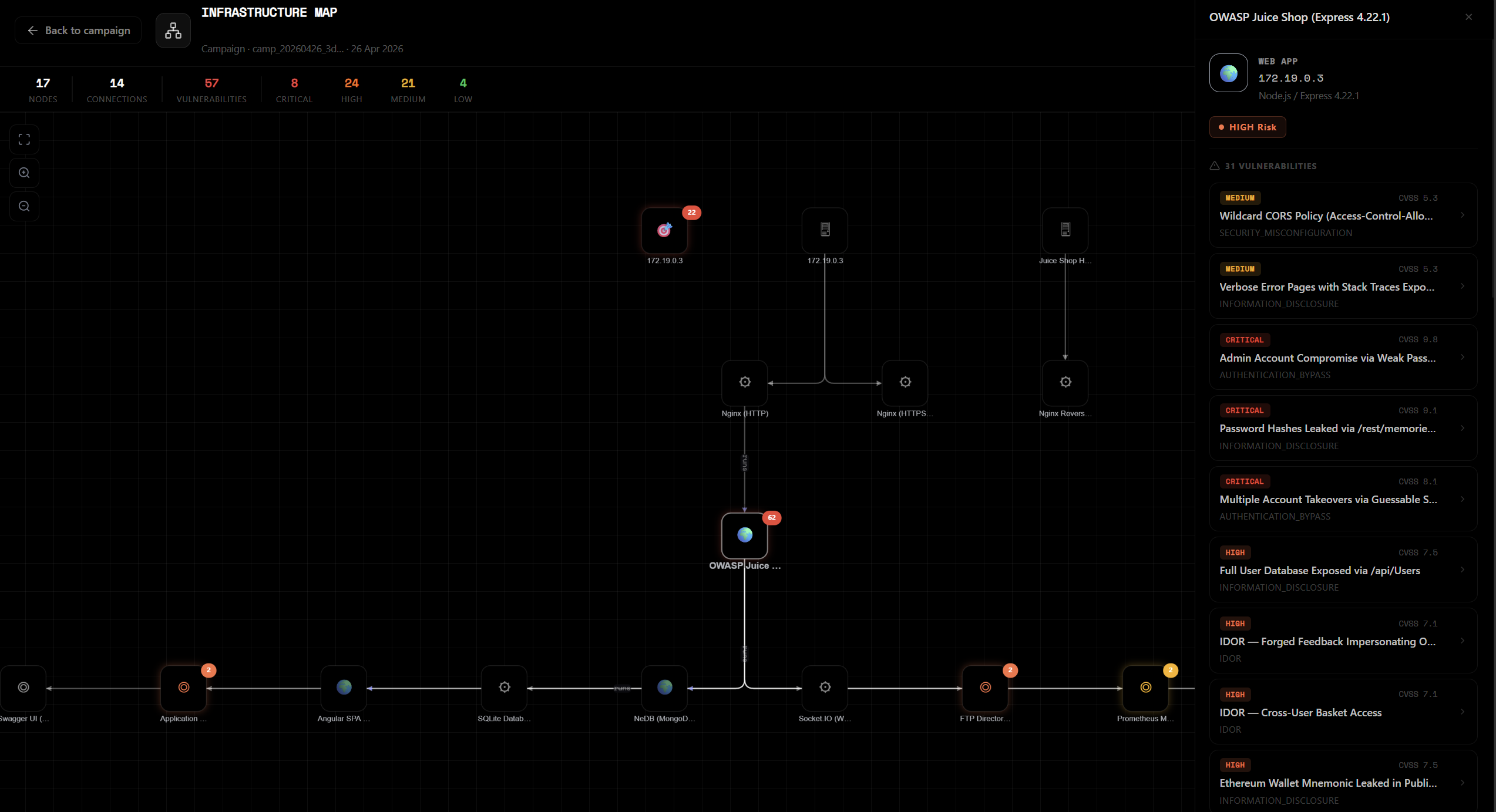
Pro: interactive attack-surface map. A graph of nodes, connections and per-node vulnerabilities across the whole target. |
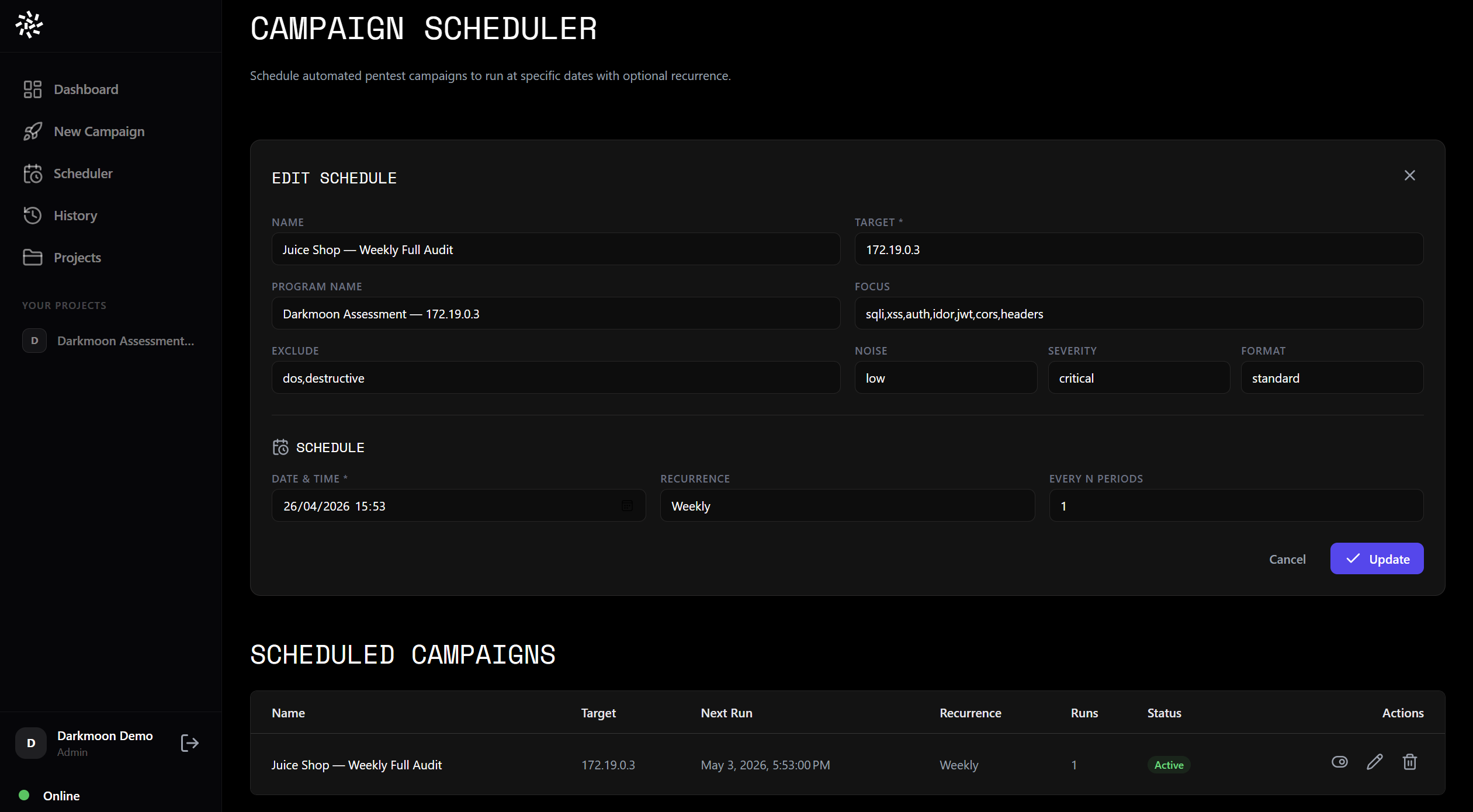
Pro: scheduled recurring runs. Recurring automated campaigns with FOCUS, severity and recurrence built into the web dashboard. |
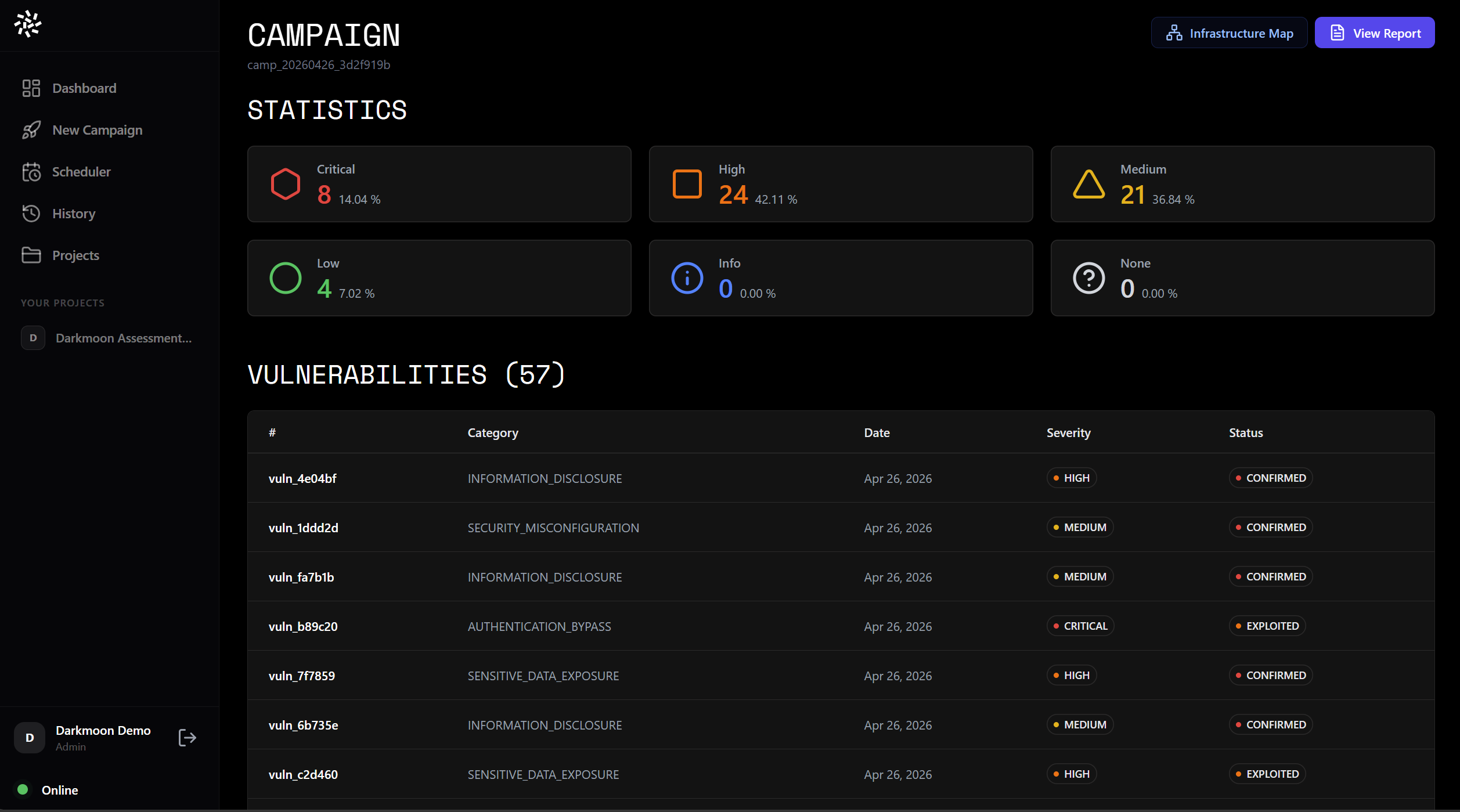
Pro: campaign view. Every vulnerability in a campaign with its severity and confirmation status. |
🔒 Pro: from finding to fix (automated remediation, paid)
🔒 Paid Pro feature. The open source engine finds and proves vulnerabilities. Automated remediation into pull requests is available only in Darkmoon Pro.
In the paid Pro tier, every finding flows finding → sandbox-validated fix → human-reviewed pull request, retested against the original exploit, and is never auto-merged. On our OWASP Juice Shop demonstration, the Pro remediation agent fixed 42 of 57 findings end-to-end with a clean live exploit-retest (a fix only counts when the original exploit is re-run and confirmed closed). See the remediation benchmark, the remediation agent docs and the 57 open PRs on ASCIT31/juice-shop.

▶️ Watch the demo (shows the Darkmoon Pro web dashboard)
What is DarkMoon?
DarkMoon is an open-source AI penetration testing platform. Point it at a target you are authorized to test, and it runs the whole assessment on its own: it reasons, plans, and dispatches 50 specialist agents that execute real offensive operations through a controlled MCP layer, then reports every vulnerability with the exact command, the raw output and the proof behind it.
It does not replace the pentester. It clears the repetitive part of an assessment with evidence, so your experts spend their time on judgment, not toil.
📊 Benchmark: 57 real vulnerabilities on OWASP Juice Shop
Real, reproducible black-box run against OWASP Juice Shop on a local LLM (nothing leaves your infrastructure):
| Metric | Result |
|---|---|
| Vulnerabilities found | 57 (8 critical / 24 high / 21 medium / 4 low) |
| Wall-clock time | 28.5 min |
| Proof-of-exploitation | per finding |
| LLM | local (Ollama / llama.cpp) |
Reproduce it and compare tools yourself: ASCIT31/Darkmoon-Benchmarks.
🆚 How DarkMoon compares
| DarkMoon | strix | shannon | PentAGI | |
|---|---|---|---|---|
| Runs on local LLM (data never leaves) | ✅ | ❌ cloud | ❌ cloud | partial |
| Privacy Gateway (local tokenization) | ✅ | ❌ | ❌ | ❌ |
| Active Directory + Kubernetes | ✅ | ❌ | ❌ | partial |
| Proof-of-exploitation | ✅ | ✅ | ✅ | ✅ |
| Open source | ✅ GPL-3.0 | ✅ | ✅ | ✅ |
Compiled from public repos/docs (2026-08); corrections welcome via PR.
How It Works
DarkMoon operates as a strategic AI security agent orchestrator aligned with ISO 27001, NIST SP 800-115, and MITRE ATT&CK methodologies.
When you provide a target, the platform automatically:
- 🔍 Discovers the target environment (ports, services, protocols)
- 🧠 Fingerprints the technology stack (frameworks, CMS, APIs)
- 🎯 Models the attack surface
- 🚀 Deploys specialized sub-agents based on detected technologies
- 🔬 Executes an intelligent vulnerability scanning loop with reactive adaptation
- ✅ Validates findings with evidence (requests, payloads, responses)
- 📝 Generates a structured audit report
Sub-Agent Orchestration
DarkMoon dynamically selects and dispatches specialized agents depending on the technologies discovered:
| Detected Technology | Agent Triggered |
|---|---|
| WordPress, Drupal, Joomla, Magento, PrestaShop, Moodle | CMS-specific agent |
| PHP, Node.js, Flask, ASP.NET, Spring Boot, Ruby on Rails, Go | Stack-specific agent |
| GraphQL | GraphQL agent |
| LLM / AI inference endpoint (OpenAI-compatible, Ollama, vLLM, TGI) | LLM agent |
| Active Directory | AD agent |
| Kubernetes | Kubernetes agent |
| AWS, Azure, GCP | Cloud-provider agent |
| Entra ID (Microsoft identity) | Identity agent |
| GitHub, GitLab, Jenkins | SCM & CI/CD agent |
| Terraform, Ansible | Infrastructure-as-Code agent |
| Docker, container registries | Container agent |
| HashiCorp Vault | Secrets agent |
| PostgreSQL, MySQL, MSSQL, Oracle | Database agent |
| Redis, RabbitMQ, Kafka, MQTT | Messaging & cache agent |
| Firmware / IoT images | Firmware agent |
| Headless browser required | Headless browser agent |
Multiple agents can execute in parallel across hybrid architectures.
Planes that require credentials to be meaningful (cloud accounts, CI/CD, secret stores, databases, Active Directory, Kubernetes) are never dispatched on inference. They fire only when a concrete artifact is found (a key, a token, a reachable metadata endpoint) or when you authorize them explicitly, and are otherwise flagged in the report.
Note: For the complete list of agents, their structure, lifecycle, and how to create custom agents, see Full Documentation, AI Agents.
Architecture Overview
User ──> DarkmoonCLI ──> OpenCode (AI Brain) ──> MCP (Security Gatekeeper) ──> Docker Toolbox (Real Tools)
sequenceDiagram
  participant U as User
  participant O as OpenCode
  participant A as AI Agent
  participant M as MCP Darkmoon
  participant T as Docker Toolbox

  U->>O: User prompt
  O->>A: Delegate task
  A->>M: MCP function call
  M->>T: Execute real tool
  T-->>M: Results
  M-->>A: Structured output
  A-->>O: Next decision
  O-->>U: Summary / result
The AI reasons and plans. The MCP controls what can be executed. The Toolbox runs isolated tools inside Docker. The AI never directly touches the system, this is security by design.
Note: For the full architecture breakdown (deployment diagrams, network flows, security boundaries), see Full Documentation, Architecture.
Scope Definition
DarkMoon supports flexible scope definition directly from the command line.
Quick pentest (zero config):
./darkmoon.sh "TARGET: http://172.19.0.3:3000"
Bug bounty mode (flags activate automatically):
./darkmoon.sh "TARGET: http://172.19.0.3:3000 PROGRAM=\"Juice Shop\" FOCUS=sqli,xss,idor NOISE=moderate FORMAT=h1"
Key flags include FOCUS, EXCLUDE, CREDS, TOKEN, NOISE, SEVERITY, FORMAT, and more, all interpreted naturally by the AI.
Note: For the complete flags reference, asset types, EXCLUDE/FOCUS free-form syntax, and advanced multi-target scoping, see Full Documentation, Scope Definition.
Integrated Toolbox
DarkMoon ships with a purpose-built Docker image containing 50+ security tools compiled and optimized in a multi-stage build:
| Category | Tools (examples) |
|---|---|
| Port scanning | Naabu (discovery), nmap (targeted service probes) |
| Web scanning | Nuclei, ffuf, dirb, sqlmap, Arjun, wafw00f |
| Recon & crawling | Subfinder, Katana, Waybackurls, httpx |
| CMS | WPScan, CMSeeK, WhatWeb |
| Active Directory | NetExec, BloodHound, Impacket (30+ scripts) |
| Kubernetes | kubectl, Kubescape, Kubeletctl, kube-bench, rbac-police |
| Cloud CLIs | aws, az, gcloud, gsutil, bq |
| Databases & cache | psql, mysql, redis-cli, sqlite3 |
| Firmware / IoT | binwalk, unsquashfs, sasquatch, firmwalker |
| Cracking | hashcat, john, 7z2john |
| Network | Hydra, curl, dig, SNMP tools |
| Browser | Lightpanda (headless) |
All tools are directly accessible, no path configuration needed.
Note: For the complete tools list with installation details and how to add new tools, see Full Documentation, Toolbox.
📖 Documentation Guide
DarkMoon's Full Documentation covers everything you need to operate the platform. Here is a quick reference to the most important sections:
| Topic | What You'll Find | Link |
|---|---|---|
| GPU & Driver Setup | NVIDIA troubleshooting for Docker, WSL, and native Linux | GPU Guide |
| Environment Variables | LLM provider configuration, API keys, model selection | Environment Config |
| Startup & Build | install.sh behavior, docker compose build, stack management | Build & Launch |
| Scope & Flags | TARGET syntax, bug bounty mode, FOCUS/EXCLUDE, credentials | Scope Definition |
| Assessment Workflow | Step-by-step: discovery, fingerprinting, agents, reporting | Assessment Engine |
| Real-Time Session Logs | Monitor commands executed by the MCP server live | Session Logs |
| AI Agents | Agent structure, lifecycle, how to create or modify agents | AI Agents |
| Architecture | Deployment diagrams, security boundaries, execution flow | Architecture |
| Toolbox | Complete tool list, adding tools, Docker image internals | Toolbox |
| MCP Workflows | Workflow structure, creating custom workflows, best practices | MCP Workflows |
| Available Tools List | Full table of 50+ tools with paths and sources | Tools List |
| Training Labs | Recommended vulnerable labs to train DarkMoon | Pentester Labs |
| Remediation Agent (Pro) | Findings → sandbox-validated fix → pull request for human review (never merged) | Remediation Agent |
| n8n Integration | Community node to trigger a pentest, pull findings and review fix PRs from an n8n workflow | n8n Node |
Use Cases
DarkMoon is designed as a versatile security testing platform for:
- 🔒 Security teams, run continuous automated penetration testing across your infrastructure
- ⚙️ DevSecOps pipelines, integrate AI-driven security research into CI/CD workflows
- 🎯 Bug bounty hunters, accelerate ethical hacking with autonomous target analysis
- 🔬 Security researchers, explore attack surfaces with an AI cybersecurity platform that adapts in real time
- 🎓 Training & education, learn offensive security with guided, reproducible assessments
Example Prompts
# Web application pentest
./darkmoon.sh "TARGET: http://172.19.0.3:3000"

# Active Directory assessment
./darkmoon.sh "TARGET: 192.168.1.10"

# Bug bounty with specific focus
./darkmoon.sh "TARGET: https://app.example.com PROGRAM=\"Example BB\" FOCUS=sqli,rce,ssrf EXCLUDE=H1 FORMAT=h1"
Note: For more prompt examples including DVGA, Juice Shop, and headless browser scenarios, see Full Documentation, Prompt Examples.
Contributing
DarkMoon is open source and welcomes contributions. Whether you want to add new agents, integrate tools, create workflows, or improve documentation, see CONTRIBUTING.md for guidelines.
License
This project is licensed under the GNU General Public License v3.0. See LICENSE for details.
Built by ASC-IT with 💚 for the global security community
🔒 Open Source · 🤖 AI-Powered · 🇫🇷 Made in France
⭐ Star us on GitHub · 📖 Full Documentation · ▶️ Watch the Demo (Pro dashboard)