CrowdSec is an open-source, MIT-licensed intrusion detection and prevention system, WAF and bot-detection engine that analyses logs and HTTP requests and blocks malicious IPs at the firewall, reverse proxy or CDN, built for Linux, Windows, Docker and Kubernetes operators who want community-sourced threat intelligence sitting behind their own infrastructure.
What it is
CrowdSec is a participative security solution written in Go and released under the MIT licence. Its centre is the CrowdSec Security Engine, an all-in-one IDS/IPS and WAF that detects bad behaviour by analysing log sources and HTTP requests, and then allows active remediation through Remediation Components, commonly called bouncers. Detection rules are published on the CrowdSec Hub under the MIT licence. The project also operates a Community Blocklist, a curated list of IP addresses identified as malicious by CrowdSec, which the Security Engine blocks proactively so those addresses never reach the protected systems. It ships with default scenarios covering brute force, port scan and web scan behaviour, and more scenarios can be taken from the Hub, adapted from existing ones or written from scratch.
The concrete problem it solves is the coupling of detection to enforcement. CrowdSec reads the same log files as fail2ban and bans the same IPs, but parsing and blocking are decoupled: logs can be parsed on one machine while the block is applied at the firewall, reverse proxy or CDN on another, an approach the documentation calls "Detect Here, Remedy There". Because attacks reported by one installation feed the Community Blocklist, an IP that hits one user gets blocked for everyone else before it reaches them, which is the crowding-out effect the name refers to. The same engine additionally answers an HTTP request with an AppSec component, so web-layer filtering no longer requires a separate WAF stack.
Key capabilities
- Security Engine functioning as a combined IDS/IPS log processor and WAF, deployed on Linux, Windows, Docker, OpnSense and Kubernetes.
- Remediation Components (bouncers) that apply active remediation at the applicative, system or infrastructural layer of a stack.
- Community Blocklist of curated malicious IPs that the Security Engine blocks proactively.
- AppSec WAF built on Coraza, so SecLang rules and the OWASP Core Rule Set load as-is, alongside an additional YAML rule format.
- JavaScript proof-of-work challenge for suspicious requests, at a tunable difficulty, stopping headless browsers and scrapers while letting verified crawlers such as Googlebot through.
- Default scenarios for brute force, port scan and web scan, extensible with further scenarios from the Hub at hub.crowdsec.net.
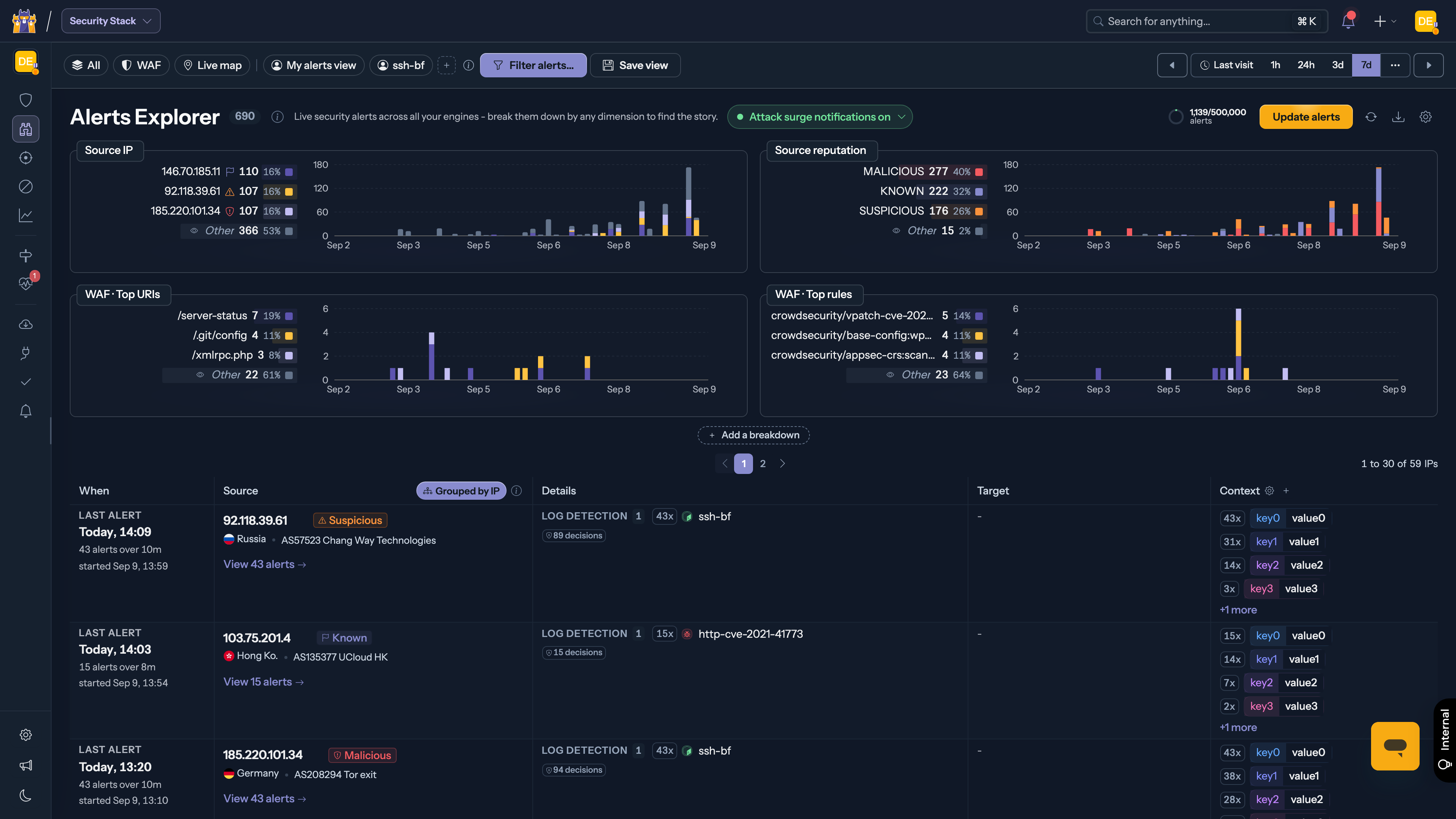
- CrowdSec Console for visualization, management, extra blocklists and premium features.
Who uses it and how
- Teams running multi-tier infrastructure that want logs collected in one place and blocks enforced elsewhere, whether at the firewall, the reverse proxy or the CDN edge.
- Kubernetes and Docker operators protecting containerised workloads, using the platform support indicated by the repository topics.
- Hosts already running fail2ban that want the same log-based bans without the coupling of detection to a single local firewall.
- Web-facing services that need WAF coverage under existing SecLang or OWASP Core Rule Set rules without adopting a standalone ModSecurity deployment.
- Organisations willing to share the threats they observe and receive the Community Blocklist in return, with the Console used for monitoring and automation of the security stack.
Getting started
Installation is done by following the documentation at docs.crowdsec.net, which covers installation on Linux, Windows, Docker, OpnSense, Kubernetes and more.
How it compares
Against fail2ban, CrowdSec reads the same log files and bans the same IPs, but decouples detection from remediation so blocking can happen on a different machine, and feeds reported attacks into a community blocklist. Against ModSecurity, Coraza and naxsi, the AppSec component is a WAF built on Coraza, so SecLang rules and the OWASP Core Rule Set load as-is, and it adds a YAML rule format while sharing the IP reputation and remediation layer with the log-based engine.
When to use it — and when not to
A self-hoster must operate the Security Engine itself, connect the relevant log sources, choose and maintain the Remediation Components that will enforce blocks, and decide where in the stack enforcement belongs. The participative model is the main caveat: any environment that cannot share attack telemetry, or that prefers a purely local and non-contributing setup, will not get the Community Blocklist benefit and should weigh that before adopting it. The repository README is a feature and positioning overview rather than an installation guide, so deployment depends on the external documentation rather than on instructions in the project itself.
project readme (upstream, from github) — read inline






CrowdSec: open-source IDS/IPS, WAF and bot detection
CrowdSec is an open-source and participative security solution offering crowdsourced server detection and protection against malicious IPs. Detect and block with our Security Engine, contribute to the network, and enjoy our real-time community blocklist.

Features & Advantages
Versatile Security Engine
CrowdSec Security Engine is an all-in-one IDS/IPS and WAF.
It detects bad behaviors by analyzing log sources and HTTP requests, and allows active remediation thanks to the Remediation Components.
Detection rules are available on our hub under MIT license.
CrowdSec Community Blocklist
The "Community Blocklist" is a curated list of IP addresses identified as malicious by CrowdSec. The Security Engine proactively blocks the IP addresses of this blocklist, preventing malevolent IPs from reaching your systems.

Console - Monitoring & Automation of your security stack
Multiple Platforms support

How CrowdSec compares
To fail2ban — CrowdSec reads the same log files and bans the same IPs, but
detection and remediation are decoupled: parse logs on one machine, block at the
firewall, reverse proxy or CDN on another. Attacks you report feed a community
blocklist, so an IP that hits one user gets blocked for everyone else before it
reaches them.
To ModSecurity, Coraza and naxsi — the AppSec component is a WAF built on
Coraza, so SecLang rules and the OWASP Core Rule Set load as-is. On top of that
it adds a YAML rule format, and shares the IP reputation and remediation layer
with the log-based engine.
Bot and scraper detection — AppSec can answer a suspicious request with a
JavaScript proof-of-work challenge at a tunable difficulty, which stops headless
browsers and scrapers while letting verified crawlers such as Googlebot through.
Outnumbering hackers all together
By sharing the threat they faced, all users are protecting each other (hence the name Crowd-Security). Crowdsec is designed for modern infrastructures, with its "Detect Here, Remedy There" approach, letting you analyze logs coming from several sources in one place and block threats at various levels (applicative, system, infrastructural) of your stack.
CrowdSec ships by default with scenarios (brute force, port scan, web scan, etc.) adapted for most contexts, but you can easily extend it by picking more of them from the HUB. It is also easy to adapt an existing one or create one yourself.
Installation
Follow our documentation to install CrowdSec in a few minutes on Linux, Windows, Docker, OpnSense, Kubernetes, and more.
Resources
- Console: Supercharge your CrowdSec setup with visualization, management capabilities, extra blocklists and premium features.
- Documentation: Learn how to exploit your CrowdSec setup to deter more attacks.
- Discord: A question or a suggestion? This is the place.
- Hub: Improve your stack protection, find the relevant remediation components for your infrastructure.
- Public Roadmap: Vote for your favorite features and submit ideas to influence what we build next.
- CrowdSec Academy: Learn and grow with our courses.
- Corporate Website: For everything else.