
CRM
Comp AI CRM is an open source, CRM designed for AI agents.
Agentic-first CRM.
The agent · Stack · Quick start · Configuration · Deploying · Contributing



What this is
Most CRMs are a database with a form in front of it. The AI ones bolt a chat box onto the side of that form. Both leave the actual work — finding out what is true, and writing it down — to a human who has better things to do.
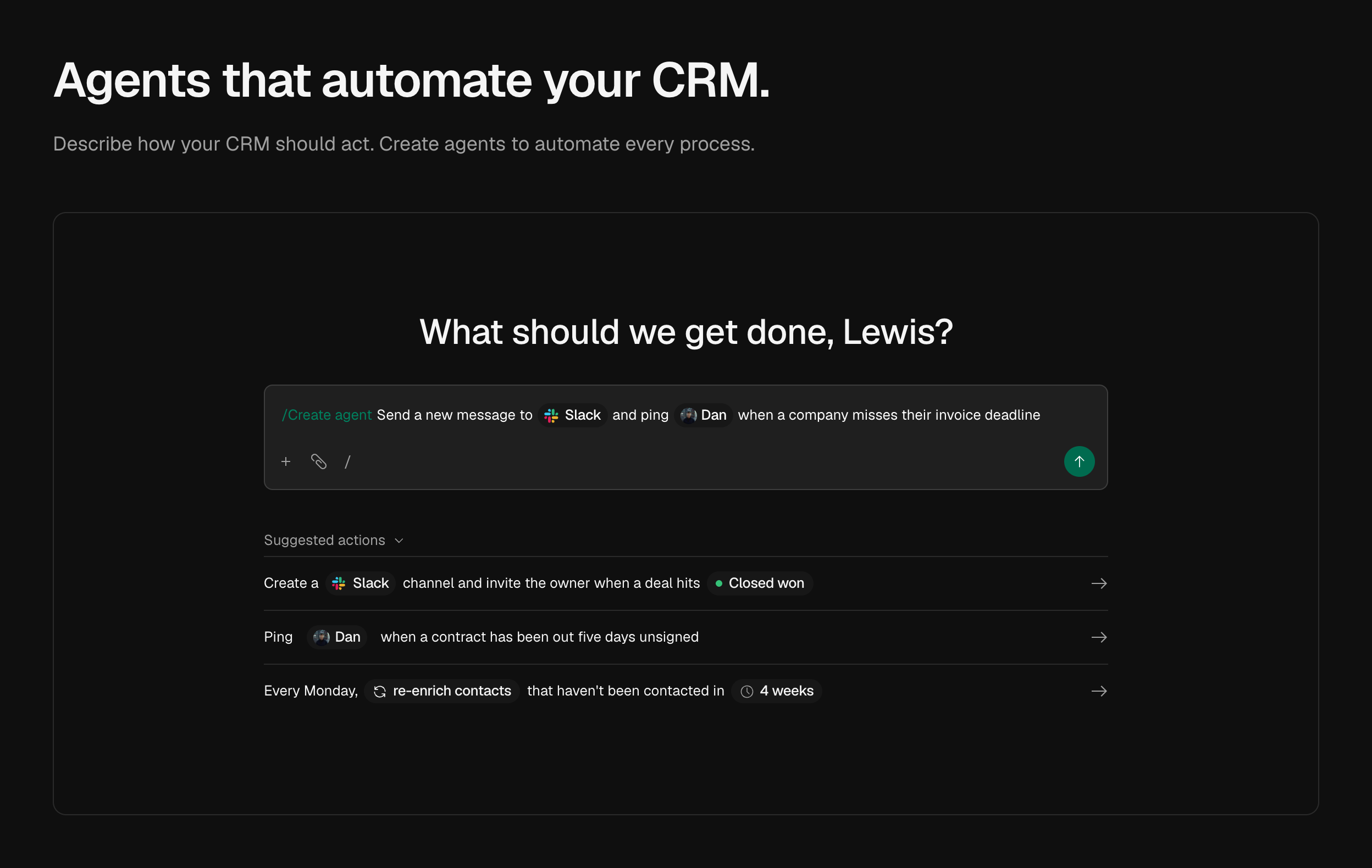
This is built the other way round. The agent is not a feature of the CRM; the CRM is where the agent keeps its notes. It runs on its own deployment, on its own schedule, against its own work queue. It decides what to look at next, books its own follow-ups, spends a research budget, and stops when the budget runs out. Nothing about it is request-response: close the browser and it keeps going.
The rule the agent itself never breaks: nothing about a person is guessed. No tool
accepts a confidence score, because a model asked to grade its own certainty will, and
it will be wrong in the direction that makes it look useful. Tools report what they
observed — crm.signature-block, github.account-identity — and a ledger prices the
evidence. Strong evidence writes to the record. Weak evidence becomes a suggestion a
human settles. A confidently wrong fact about a customer is worse than a blank field,
because nobody can tell it is wrong.
Screenshots
|
|
The agent
apps/agent is its own deployment, built on
eve — Vercel's filesystem-first framework for durable agents.
A tool is a file, a skill is a markdown file, a schedule is a file, and the runtime
handles the durable part: sessions that survive a redeploy, work that resumes where it
stopped.
| 18 authored tools | read_crm_history, search_crm, identify_contact, research_person, enrich_company, record_fact, schedule_recheck… |
| 4 skills | evidence.md, identity-matching.md, data-boundaries.md, writing-a-brief.md — prose the agent reads, versioned like code |
| 1 schedule | dispatch.ts, which decides nothing. It leases what is due and starts a session per row. |
| A sandbox | bash, grep, glob and a /workspace, with deny-all egress |
It runs itself. lib/tasks.ts is the work queue: claimDue leases rows with
FOR UPDATE SKIP LOCKED, so two dispatchers take disjoint work and a run that dies
frees its row when the lease expires. Anything that looks like "every N minutes, the
oldest ten contacts" belongs in a task's dueAt, not in a cron expression. When the
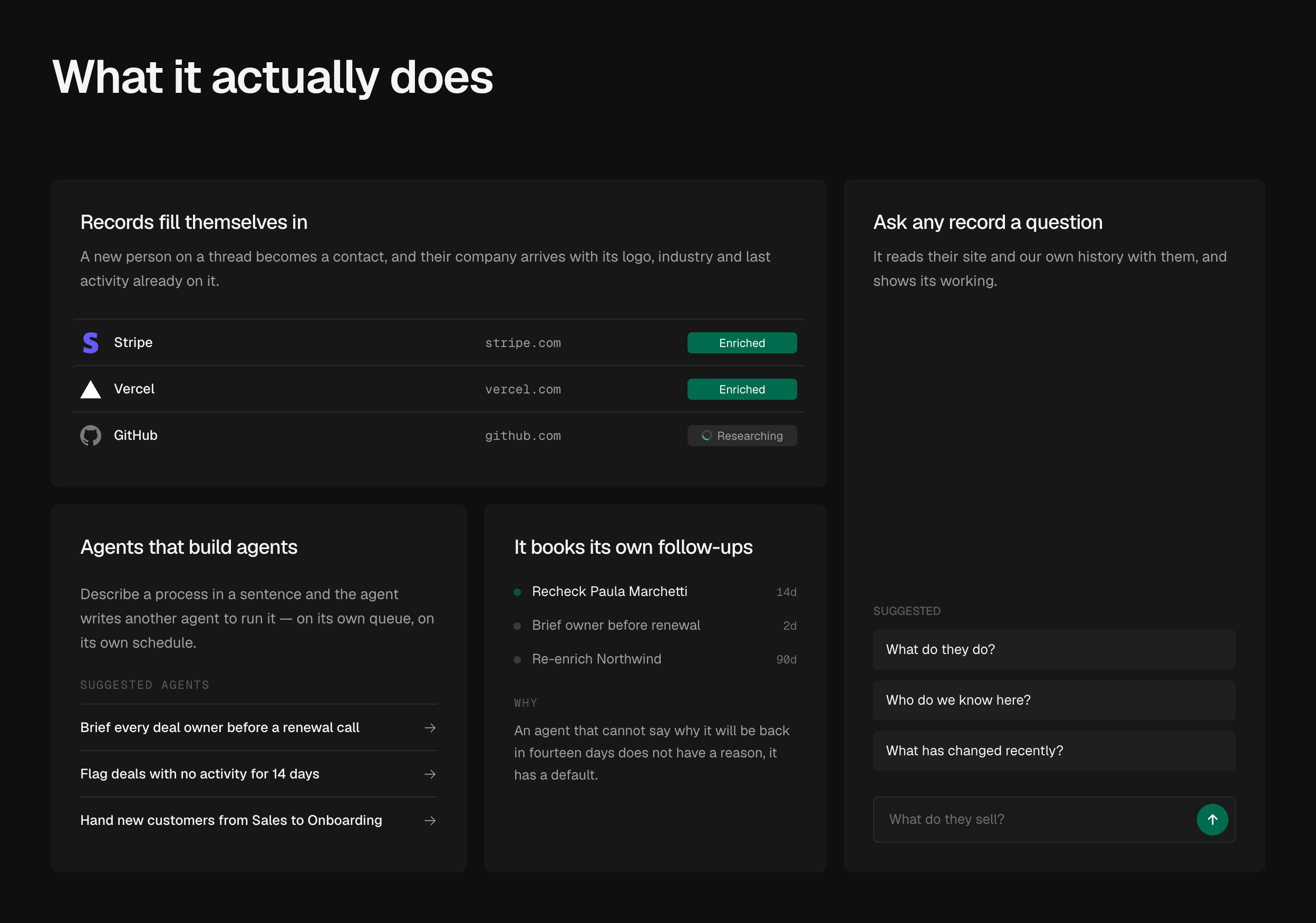
agent wants another look at somebody it calls schedule_recheck and says why — and
the reason is shown to the rep, because an agent that cannot say why it will be back
in fourteen days does not have a reason, it has a default.
Every outside source is optional, and it is designed to run with none of them.
With no API keys at all it still works: read_crm_history reads your own threads,
meetings and signature blocks, which is free and is the best evidence there is — no
data vendor can sell you a reply from the person's own address. Each key opens one
more place to look. It is told at the start of every session which ones this install
has, so it plans around what it actually has rather than discovering the gaps one
failed call at a time, and it prints the list at startup:
[agent] off  Web research (PERPLEXITY_API_KEY)
[agent] on   Company brand data (Settings → General)
[agent] on   LinkedIn (Settings → General)
Company brand data and LinkedIn are both Context, and both come from the same key. The first is the logo, the colours, the industry and the real name behind a domain, which is the difference between an account that arrives as itself and one that arrives as a grey square with its initials in it. The second reads a person back from a LinkedIn URL already on their record — their real name, current title, employer and every earlier role — which is what settles who an address belongs to. It is the one key that is asked for rather than configured: it lives in a row, the onboarding asks for it, and Settings → General changes it afterwards, because a self-hoster's admin cannot redeploy to set an environment variable.
The sandbox has no network and no database. Turning it on is what gives the model
a shell — the difference between a tool-caller and something that can keep a dossier,
diff this month's profile against last month's, and grep a thread for a signature
block. deny-all egress costs nothing, because web_fetch runs in the app runtime
and web_search at the model provider. What it removes is the only path by which a
customer's email body could leave through a shell command. The other half of that rule
is an absence: the sandbox is never given DATABASE_URL. A shell with credentials
and egress is exfiltration-shaped even in an internal tool; a shell with neither is a
text processor.
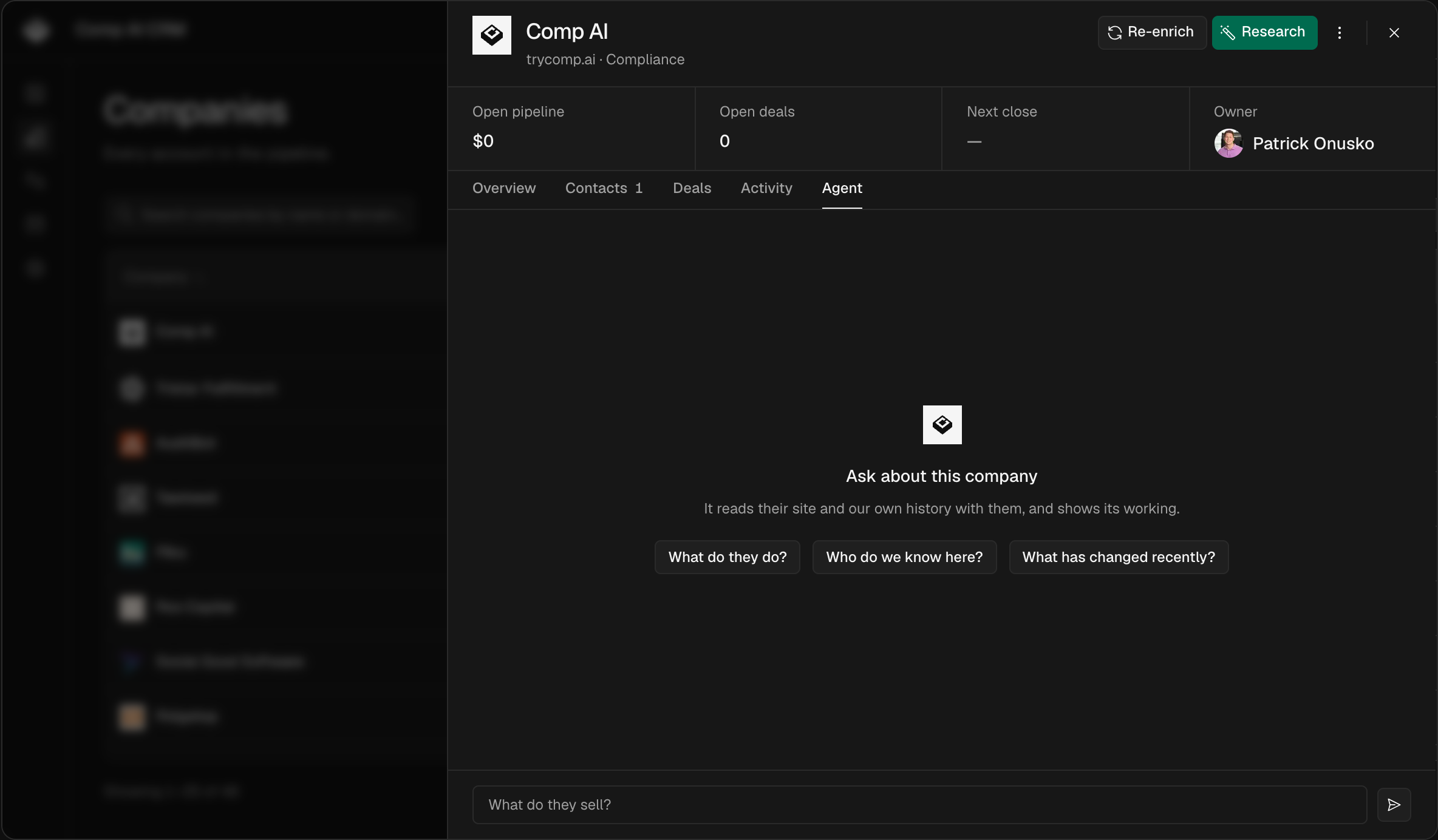
You can talk to it, and watch it work. Every contact, company and deal has an
Agent tab — the steps as it takes them, the leads it throws away and why, and its
questions answered in place when it cannot decide between two people. Conversations
are durable and survive a reload; the record travels in a signed token rather than
being bolted onto the front of your message. Set AGENT_BRIDGE_SECRET to the same
value in both processes to turn it on. Without it the tab reports that it is not
configured, and the agent carries on running its own schedule.
docs/agent.md is the full write-up.
The stack
A Turborepo monorepo on Bun, deployed on Vercel.
| Agent | eve — durable sessions, tools, skills, schedules, sandboxes |
| Model | Vercel AI Gateway — no provider SDK, and OIDC on Vercel means no key to manage |
| Sandbox | Vercel Sandbox in production, Docker or microsandbox locally |
| Front end | Next.js App Router · shadcn/ui · nuqs for URL state |
| API | NestJS with nestjs-trpc — HTTP, auth, tRPC, mailbox sync |
| Data | Prisma · Postgres (Neon) · optional Redis (Upstash) |
| Auth | Better Auth — Google, Microsoft, or your own IdP; one allow-list |
| Files | Vercel Blob — mirrors profile pictures so they survive the source going away |
| Tooling | Biome · TypeScript everywhere |
The app talks to the API over tRPC, and the router type is generated from the NestJS routers — so the front end is type-safe from the Prisma row to the table cell. List state (filters, sort, page) lives in the URL, so copying the address bar reproduces the view.
Layout
| Path | |
|---|---|
apps/agent |
The research agent — tools, skills, schedules, sandbox |
apps/app |
Next.js front end · :3000 |
apps/api |
NestJS API — HTTP, |