


Cozystack is a free, open source cloud infrastructure management project written in Go and released under Apache-2.0. It has 2,227 GitHub stars, 201 forks and 757 open issues, and was last pushed 6 hours ago. On this registry it ranks #36 of 43 tracked projects in Cloud Infrastructure Management, with 5 head-to-head comparisons available. It gained 5 stars over the last 6 tracked days.

What is Cozystack?

What it is

Cozystack is a free cloud platform and framework for building clouds inside the Kubernetes ecosystem. It is a CNCF Sandbox Level project originally built and sponsored by Ænix, and it is written in Go under the Apache-2.0 license. The project turns a group of servers into an intelligent infrastructure system that exposes a simple REST API for creating and managing cloud services.

The concrete problem it solves is the operational burden of building and running cloud services on bare metal. Instead of manually coordinating virtual machines, Kubernetes clusters, databases, load balancers, and caching services, an operator can use Cozystack as a common control plane. The platform is intended for building a public cloud, a private cloud, or a Kubernetes distribution for bare metal, and it can also provide a cost-effective development environment.

Key capabilities

  • It provides a REST API for spawning Kubernetes clusters, Database-as-a-Service, virtual machines, load balancers, HTTP caching services, and other services.
  • It uses Kubernetes as the underlying platform and lists Cluster API, KubeVirt, KVM, and Talos among its topics.
  • It supports public cloud backends, private cloud platforms, and bare-metal Kubernetes distribution use cases.
  • It supports a self-hosted model for organizations that need to operate their own cloud infrastructure.
  • It is a CNCF Sandbox project and is distributed under the Apache-2.0 license.
  • It provides a user interface, as shown by the project documentation screenshot.
  • It supports community contribution through GitHub Issues, design proposals, and GitHub Discussions.

Who uses it and how

  • Public cloud operators can use Cozystack as a backend for offering cloud services to users.
  • Private cloud teams can use it as a platform for building an internal cloud with an Infrastructure-as-Code approach.
  • Bare-metal administrators can use Cozystack as a Kubernetes distribution for running clusters on physical servers.
  • Development teams can use it to provide a cost-effective development environment.
  • Contributors can report bugs in GitHub Issues, propose architectural changes through design proposals, and discuss ideas in GitHub Discussions.

Getting started

The README directs users to the Getting Started section on cozystack.io for a quick start and to the GitHub Releases section for available versions. Troubleshooting is handled through the operations troubleshooting guide on the project documentation site.

When to use it — and when not to

Cozystack is useful when an organization wants a free, self-hosted cloud platform inside the Kubernetes ecosystem and is prepared to operate the infrastructure itself. No paid products are listed, so direct replacement comparisons are not possible. The project is young, has many open issues, and points to external guides for setup and troubleshooting, which means early adopters may need to invest in evaluation and operational learning.

project readme (upstream, from github) — read inline

Cozystack Cozystack

Open Source Apache-2.0 License Support Active GitHub Release GitHub Commit OpenSSF Best Practices OpenSSF Scorecard

Cozystack

Cozystack is a free platform and framework for building clouds.

Cozystack is a CNCF Sandbox Level Project that was originally built and sponsored by Ænix.

With Cozystack, you can transform a bunch of servers into an intelligent system with a simple REST API for spawning Kubernetes clusters, Database-as-a-Service, virtual machines, load balancers, HTTP caching services, and other services with ease.

Use Cozystack to build your own cloud or provide a cost-effective development environment.
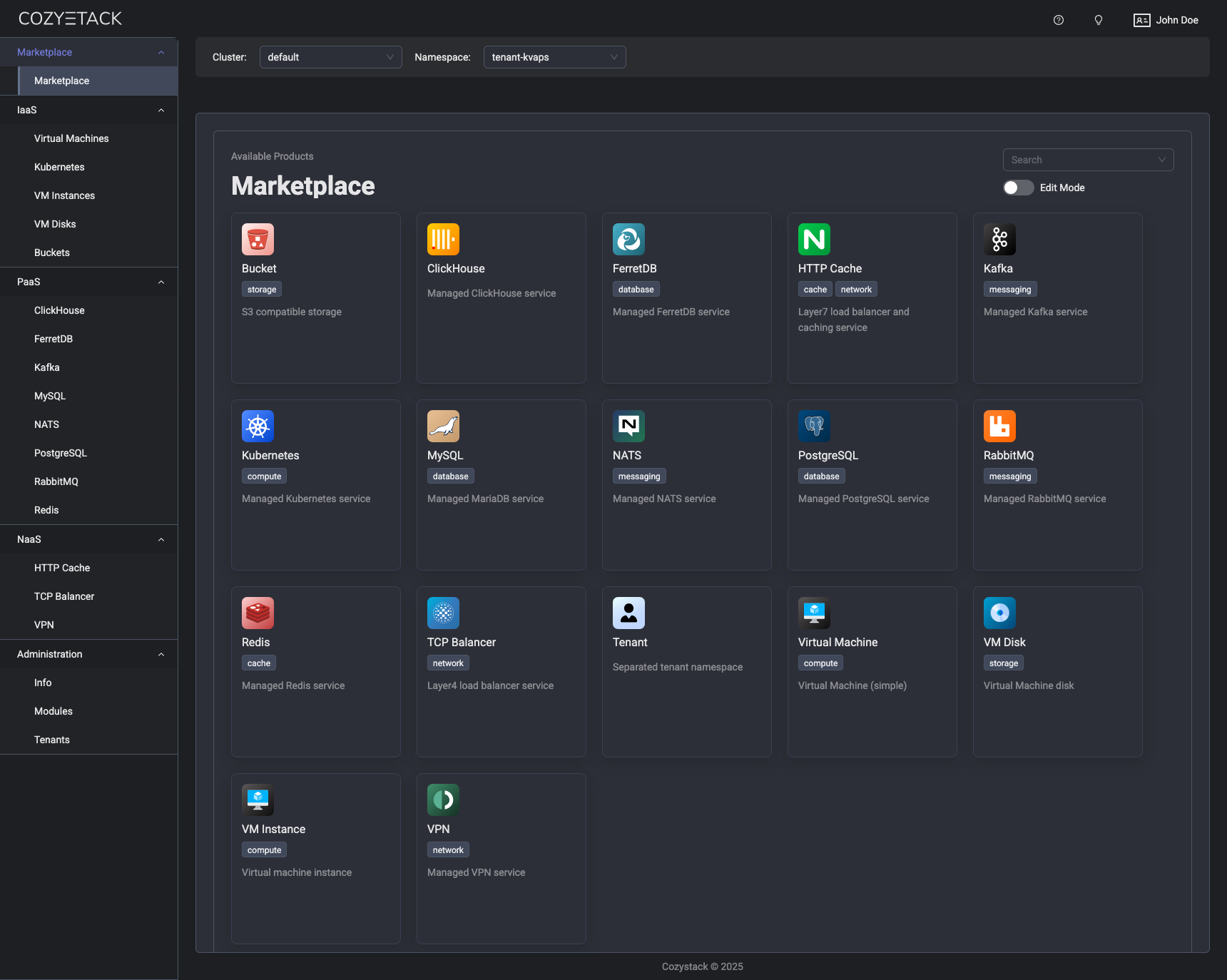
Cozystack user interface

Use-Cases

Documentation

The documentation is located on the cozystack.io website.

Read the Getting Started section for a quick start.

If you encounter any difficulties, start with the troubleshooting guide and work your way through the process that we've outlined.

Versioning

Versioning adheres to the Semantic Versioning principles.
A full list of the available releases is available in the GitHub repository's Release section.

Contributions

Contributions are highly appreciated and very welcomed!

In case of bugs, please check if the issue has already been opened by checking the GitHub Issues section. If it isn't, you can open a new one. A detailed report will help us replicate it, assess it, and work on a fix.

You can express your intention to on the fix on your own. Commits are used to generate the changelog, and their author will be referenced in it.

If you have a concrete feature request, open an issue. For a cross-cutting or architectural change, open a design proposal in the community repo. For questions or early ideas, use GitHub Discussions. See CONTRIBUTING.md for the full routing.

Community

You are welcome to join our Telegram group and come to our weekly community meetings. Add them to your Google Calendar or iCal for convenience.

License

Cozystack is licensed under Apache 2.0.
The code is provided as-is with no warranties.

Commercial Support

A list of companies providing commercial support for this project can be found on official site.

Frequently asked questions

Is Cozystack free to use?

Cozystack is open source under the Apache-2.0 licence. There is no licence fee and no seat count — you can self-host it or, where the project offers one, pay a vendor for a managed version instead.

What does Cozystack do?

Turn bare metal into intelligent cloud infrastructure

What is Cozystack written in?

Cozystack is primarily written in Go. Its source is publicly available at https://github.com/cozystack/cozystack, and it has 2,227 GitHub stars.