
Thanks to the sponsors:





☁️ Cosmos is the most secure and easy way to self-host a Home Server. It acts as a secure gateway to your application, as well as a server manager. It aims to solve the increasingly worrying problem of vulnerable self-hosted applications and personal servers.



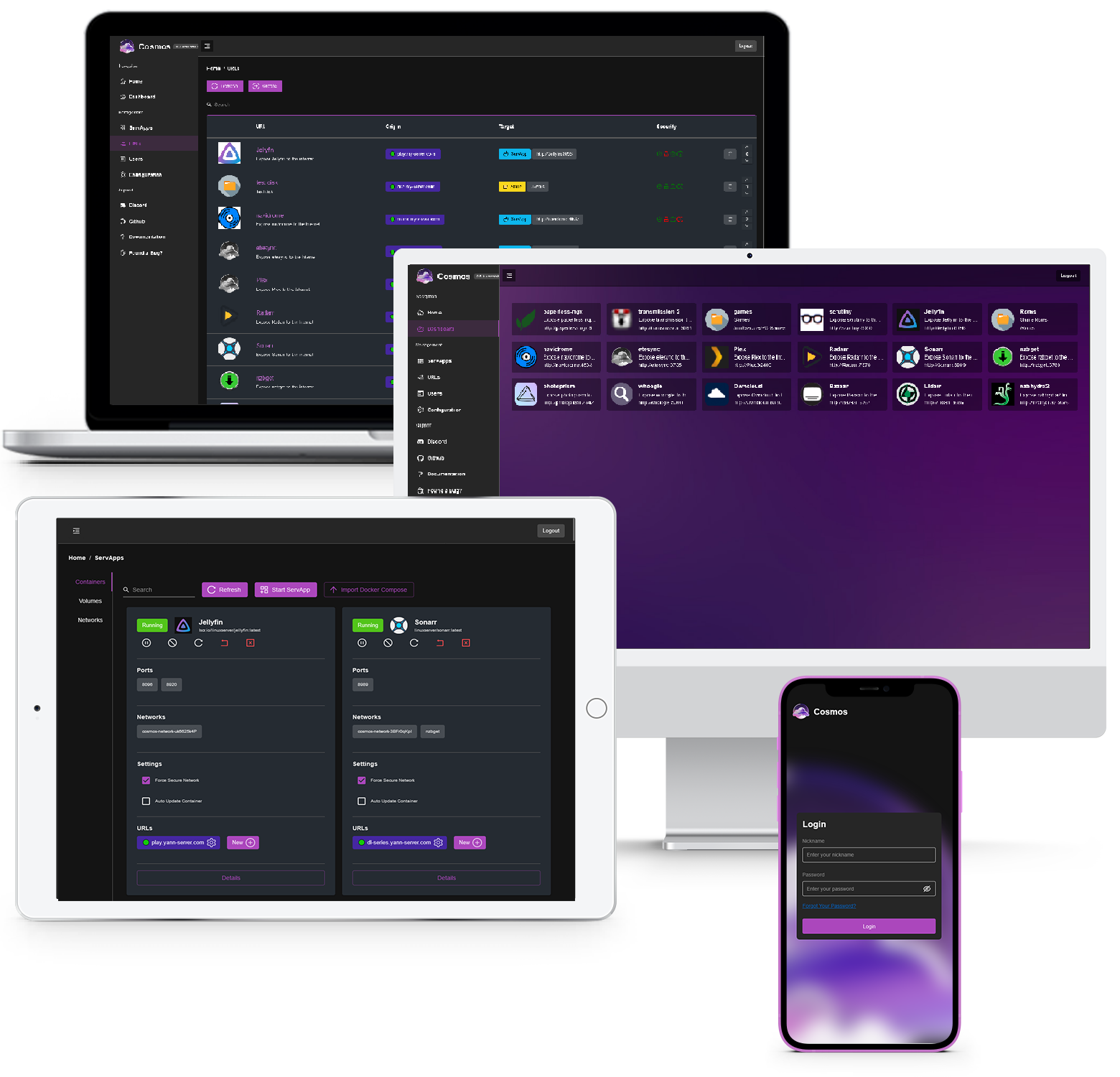
Whether you have a server, a NAS, or a Raspberry Pi with applications such as Plex, HomeAssistant or even a blog, Cosmos is the perfect solution to run and secure them all. Simply install Cosmos on your server and connect to your applications through it to enjoy built-in security and robustness for all your services, right out of the box.
Cosmos is:
- App Store 📦📱 To easily install and manage your applications, with simple installers, automatic updates and security checks. This works alongside manual installation methods, such as importing docker-compose files, or the docker CLI
- Storage Manager 📂🔐 To easily manage your disks, including Parity Disks and MergerFS
- Network Storages 📡📂 Based on RClone, To easily manage your network storages, including accessing remote ones (ex. Dropbox) or share NFS / FTP / ... from the UI, protected by the smart shield
- Reverse-Proxy 🔄🔗 Targeting containers, other servers, or serving static folders / SPA with automatic HTTPS, and a nice UI
- Authentication Server 🔐👤 With strong security, multi-factor authentication and multiple strategies (OpenId, forward headers, HTML)
- Customizable Homepage 🏠🖼 To access all your applications from a single place, with a beautiful and customizable UI
- Container manager 🐋🔧 To easily manage your containers and their settings, keep them up to date as well as audit their security. Includes docker-compose support!
- VPN 🌐🔒 To securely access your applications from anywhere, without having to open ports on your router.
- Backups 📦🔒 To easily backup your applications, with incremental backups, encryption, and remote backups. Using Restic under the hood
- Monitoring 📈📊 Fully persisting and real-time monitoring with customizable alerts and notifications, so you can be notified of any issue.
- Identity Provider 👦👩 To easily manage your users, invite your friends and family to your applications without awkardly sharing credentials. Let them request a password change with an email rather than having you unlock their account manually!
- SmartShield technology 🧠🛡 Automatically secure your applications without manual adjustments (see below for more details). Includes anti-bot and anti-DDOS strategies. Now includes TCP protection (FTP, SSH, Games, ...)
- CRON 🕒🔧 To easily schedule tasks on the server or inside containers
It has been built to be:
- Easy to use 🚀👍 to install and use, with a simple web UI to manage your applications from any device
- Powerful 🧠🔥 Being easy does not mean being dumb: while Cosmos is easy to use, it is also powerful and flexible, you can even use it from the terminal if you want to!
- User-friendly 🧑🎨 For both new and experienced users: easily integrates into your existing home server, the already existing applications you have, and the new ones you want to install
- Secure 🔒🔑 Connect to all your applications with the same account, including strong security, multi-factor authentication and OpenId. Cosmos encrypt your data and protect your privacy. Security by design, and not as an afterthought
- Anti-Bot 🤖❌ Collection of tools to prevent bots from accessing your applications, such as common bot detection, IP based detection, and more
- Anti-DDOS 🔥⛔️ Additional protections such as variable timeouts/throttling, IP rate limiting and geo-blacklisting
- Modular 🧩📦 to easily add new features and integrations, but also run only the features you need (for example No docker, no Databases, or no HTTPS)
And a lot more planned features are coming!
What are the differences with other alternatives?
Cosmos has a few key differences with other alternatives such as YunoHost, Unraid, etc...
| Feature | Cosmos | Unraid | Yunohost | CasaOS | Cloudron |
|---|---|---|---|---|---|
| Reverse Proxy | ✅ | ❌ | ✅ | ❌ | ~ * |
| Container Management | ✅ | ~ * | ❌ | ~ * | ❌ |
| Automatic HTTPS | ✅ | ❌ | ❌ | ❌ | ✅ |
| Multi-users | ✅ | ✅ | ✅ | ❌ | ✅ |
| 2FA | ✅ | ❌ | ❌ | ❌ | ✅ |
| OpenID/SSO | ✅ | ❌ | ❌ | ❌ | ~ * |
| App Store | ✅ | ✅ | ✅ | ✅ | ✅ |
| Docker Compose support | ✅ | ✅ | ❌ | ✅ | ✅ |
| File manager | ❌ | ✅ | ❌ | ✅ | ❌ |
| Anti-bot / anti-DDOS | ✅ | ❌ | ❌ | ❌ | ❌ |
| VPN | ✅ | ~ ** | ❌ | ❌ | ❌ |
| Monitoring (w/ historical data & alerts readme truncated — read the full docs on github Frequently asked questionsIs Cosmos Server free to use?Cosmos Server is open source. There is no licence fee and no seat count — you can self-host it or, where the project offers one, pay a vendor for a managed version instead. What does Cosmos Server do?Self-hosted cloud platform with automated security What is Cosmos Server written in?Cosmos Server is primarily written in Go. Its source is publicly available at https://github.com/azukaar/cosmos-server, and it has 6,158 GitHub stars. |