
|

|
codeburn is a free, open source monitoring & observability project written in TypeScript and released under MIT. It has 11,063 GitHub stars, 839 forks and 39 open issues, and was last pushed 10 hours ago. On this registry it ranks #41 of 97 tracked projects in Monitoring & Observability, with 5 head-to-head comparisons available. It gained 25 stars over the last 3 tracked days.
What is codeburn?
What it is
CodeBurn is a free, open-source, local-first tool that tracks AI coding token usage and cost across 41 tools and agents, including Claude Code, Cursor, Codex, Gemini, and Grok. It is written in TypeScript, licensed under MIT, and lives in the developer-tools and observability ecosystem as a command-line utility with optional desktop surfaces. Every surface reads the session files that the supported tools already write to disk, so CodeBurn acts as one source of truth rather than a separate collection layer.
The concrete problem it solves is billing opacity. Developers pay for Claude, Codex, Cursor, and a stack of other AI tools, and the bill reports only a total. It never shows that half of the spend went to conversation instead of code, or that an expensive model burned budget on work a cheaper model would have handled in one shot. CodeBurn breaks down every token and dollar by task, model, tool, and project, and it does so without a wrapper, a proxy, or API keys, so nothing leaves the machine. Pricing data comes from LiteLLM and is refreshed daily.
Key capabilities
- Breaks down token usage and cost by model, project, task, and tool across 41 supported AI tools and agents.
- Reads session files already present on disk, with no proxy, wrapper, or API key required.
- Provides an interactive terminal dashboard via
npx codeburn, defaulting to today or the last seven days when today has no usage. - Prints a copy-pasteable
codeburn overviewsummary with totals, per-tool and top-model breakdowns, highest-value days, top projects, and a per-day table. - Scans sessions and the
~/.claude/setup for waste patterns throughcodeburn optimize, with JSON output available. - Offers a macOS menubar app, a Windows tray app, and a GNOME Shell extension for Linux.
- Pulls pricing from LiteLLM, refreshed daily, and exposes an MCP surface.
Who uses it and how
- Developers running Claude Code, Codex, Cursor, or Gemini who want per-project and per-task cost attribution rather than a monthly total.
- Teams pasting
codeburn overview --no-coloroutput into pull requests, Slack, or reports, since color drops automatically when output is not a terminal. - Users auditing model choice, using
codeburn optimizeto find sessions where an expensive model handled work a cheaper one could one-shot. - macOS and Windows users keeping spend permanently visible in the menu bar or system tray.
- Linux users on GNOME who want the same spend view in the top panel.
Getting started
Run npx codeburn for the interactive dashboard with no install, or install permanently with npm install -g codeburn, bunx codeburn, pnpm dlx codeburn, or brew install codeburn on macOS. Node.js 22.13 or later and at least one supported tool with session data on disk are required; `better-sqlite3
project readme (upstream, from github) — read inline
See where your AI spend goes.




If CodeBurn shows you something your bill never did, star the repo so other developers find it, and consider sponsoring to keep 41 integrations honest.
Desktop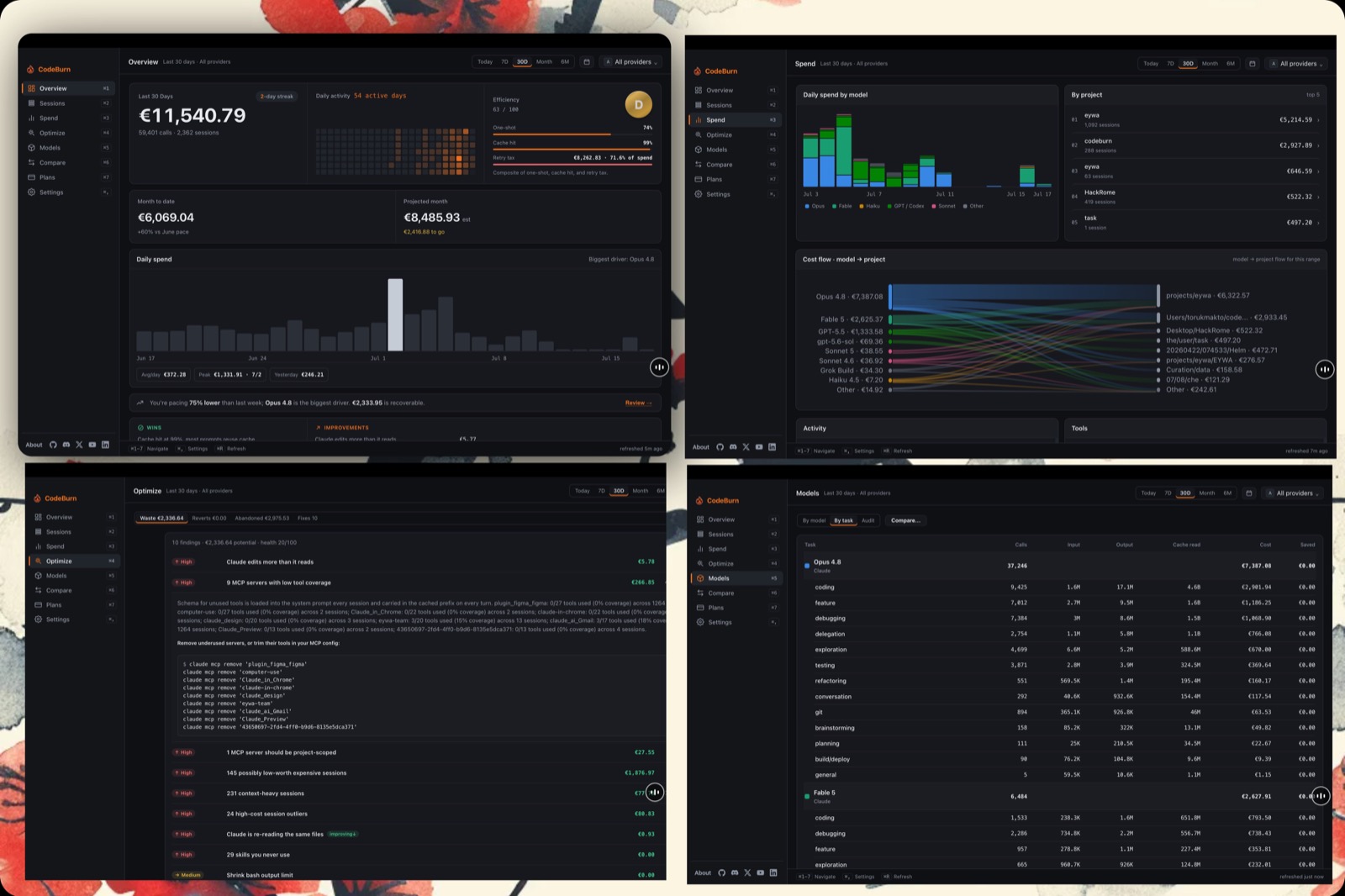 





|
Web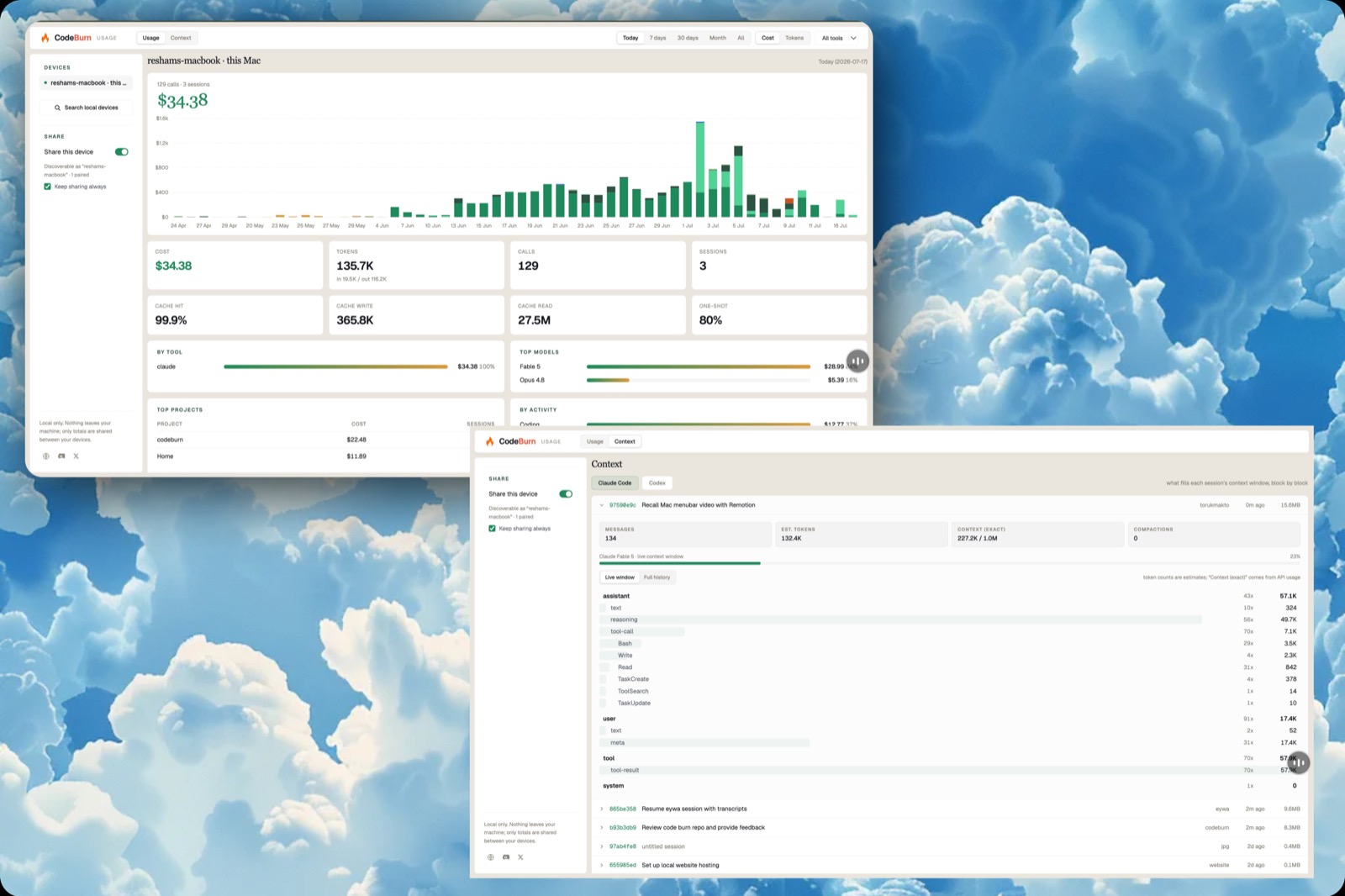 npx codeburn web
|
Terminal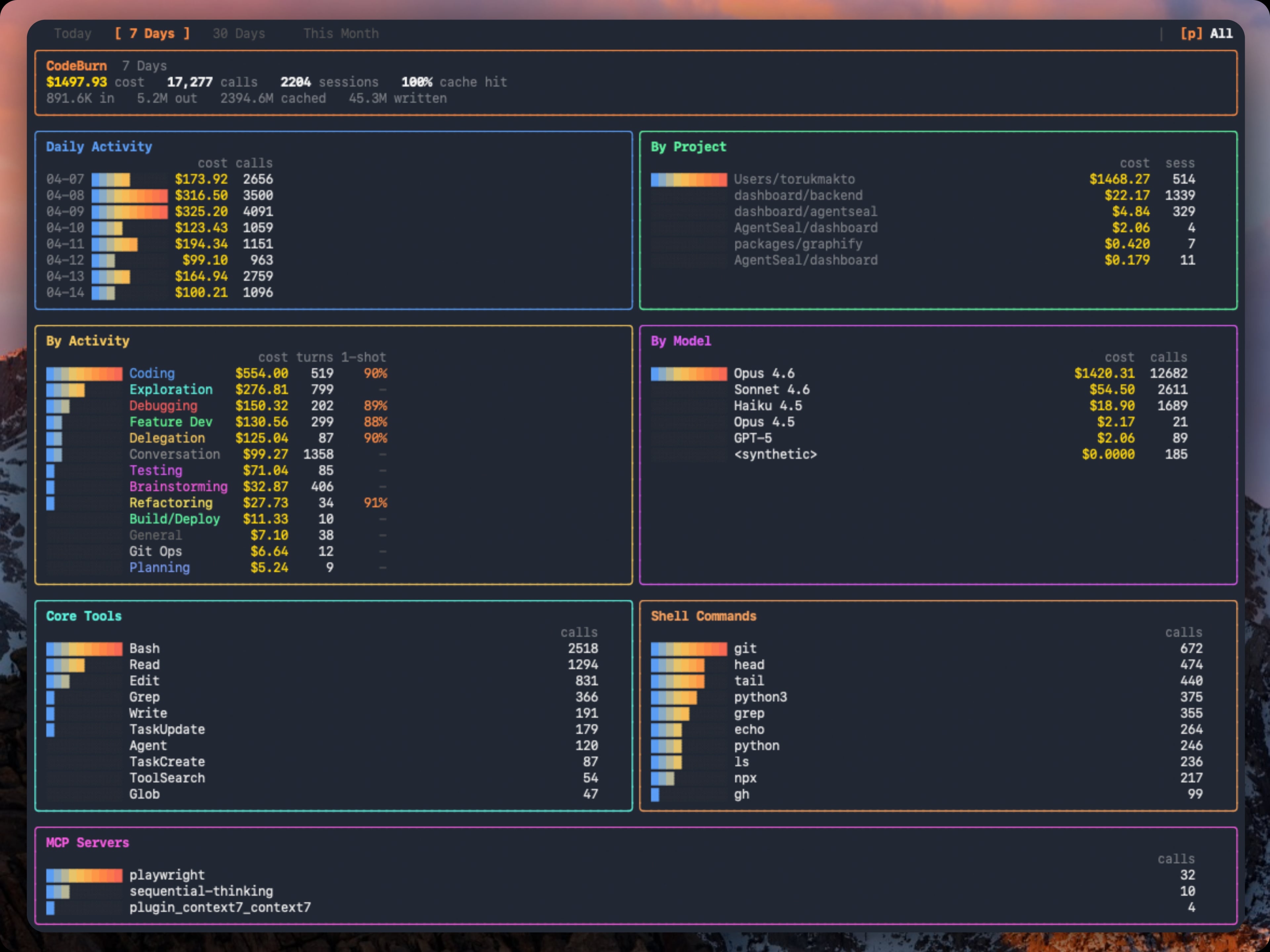 npx codeburn
|
Menubar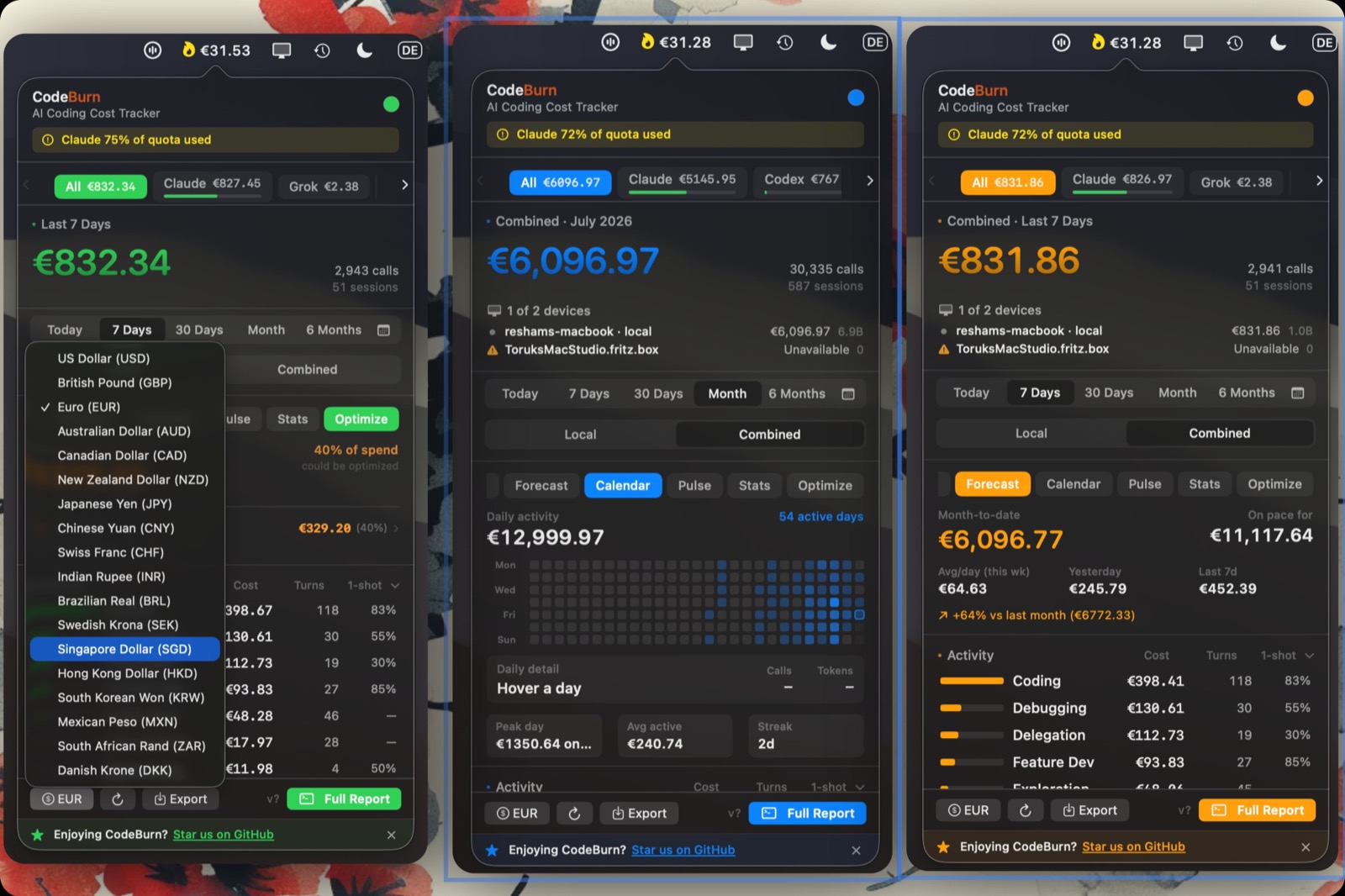 codeburn menubar
-F97316?logo=windows&logoColor=white)
|
Capacity Dock · macOS menubar and Windows tray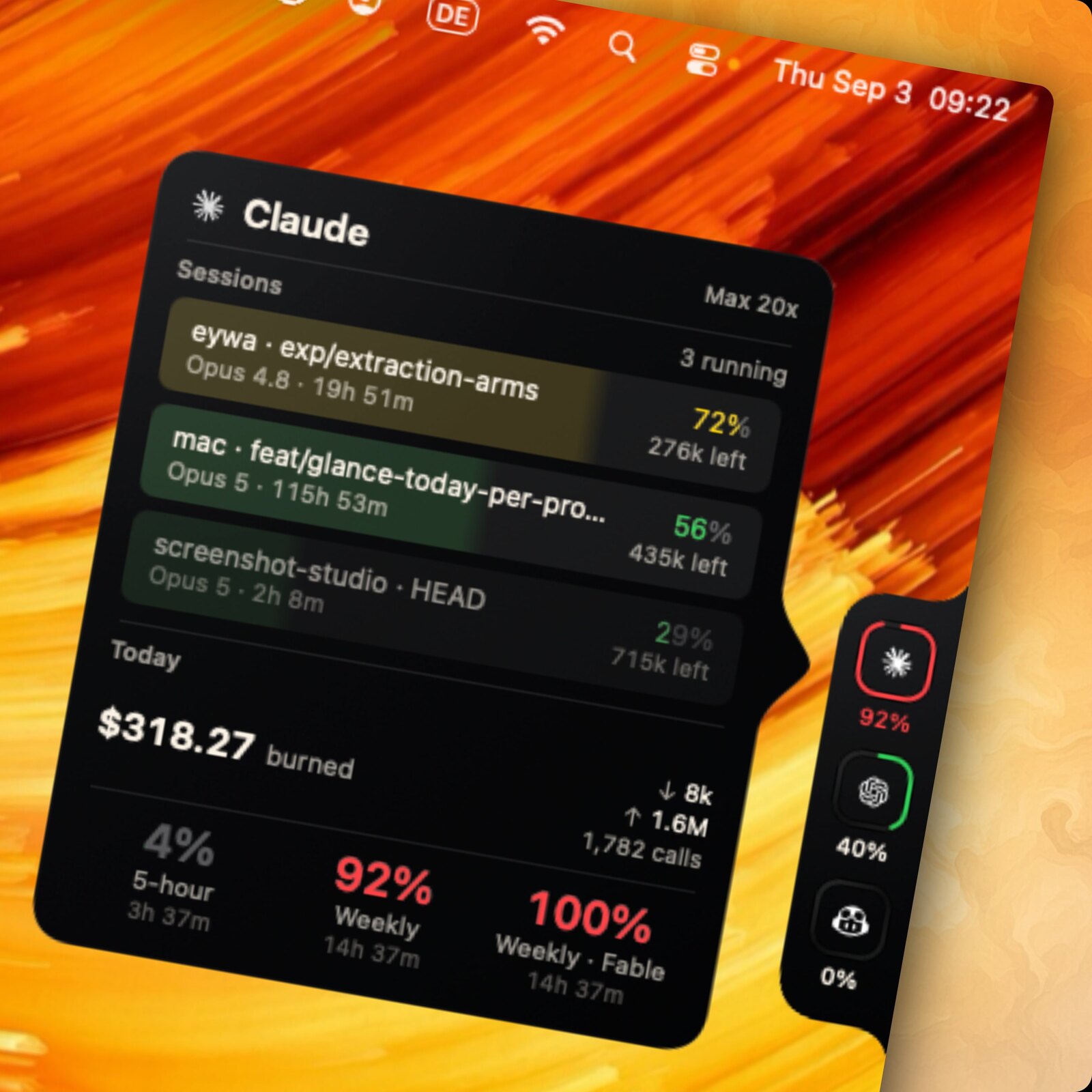 codeburn menubar
|
|
One source of truth: every surface reads the session files already on your disk.
CodeBurn is a free, open-source, local-first tool that tracks AI coding token usage and cost across 41 tools and agents (Claude Code, Cursor, Codex, Gemini, Grok and more), broken down by model, project, and task.
You pay for Claude, Codex, Cursor, and a stack of other AI tools. The bill tells you the total. It never tells you that half of it went to conversation instead of code, or that an expensive model burned your budget on work a cheaper one would have one-shot.
CodeBurn does. It reads the session files your tools already write to disk and breaks down every token and dollar by task, model, tool, and project, across 41 AI tools.
Everything runs locally. No wrapper, no proxy, no API keys, nothing leaves your machine. Pricing comes from LiteLLM, refreshed daily. The optional desktop app can send an anonymous, bucketed usage report if you say yes to it; see Telemetry.
Website · Quick start · Find waste · Apply fixes · Guard · Compare models · Track what shipped · MCP · Supported tools · Commands · Features · How it reads data · Telemetry
Quick start
Run it instantly, no install needed:
npx codeburn
That opens the interactive dashboard (today by default, or the last 7 days when today has no usage yet). Arrow keys switch periods, q quits. That is the 30-second version. You now know where your AI budget goes.
Install it for a permanent codeburn command:
npm install -g codeburn
Also runs via bunx codeburn or pnpm dlx codeburn, or brew install codeburn on macOS.
Menu bar app for macOS, with your spend always in the menu bar:
codeburn menubar
The same command installs the tray app on Windows; see Windows. On Linux, a GNOME Shell extension gives it in the top panel; see Linux (GNOME).
Requires Node.js 22.13+ and at least one supported tool with session data on disk. For Cursor and OpenCode, better-sqlite3 installs automatically.
Your month at a glance
codeburn overview                                    # this month, clean tables
codeburn overview --no-color                         # plain text, ready to paste
codeburn overview --from 2026-06-01 --to 2026-06-15  # any date range
codeburn overview -p all                             # last 6 months
codeburn overview -p lifetime                        # full history (uncapped)
codeburn overview --provider claude                  # one tool only
codeburn overview prints a copy-pasteable summary of where your AI spend went: totals (cost, tokens, cache hit), a breakdown by tool and by top
readme truncated — read the full docs on github
Frequently asked questions
Is codeburn free to use?
codeburn is open source under the MIT licence. There is no licence fee and no seat count — you can self-host it or, where the project offers one, pay a vendor for a managed version instead.
What does codeburn do?
Free, local tool to track AI coding token usage and cost across 37 tools and agents (Claude Code, Cursor, Codex, Gemini and more), by model, project, and task.
What is codeburn written in?
codeburn is primarily written in TypeScript. Its source is publicly available at https://github.com/getagentseal/codeburn, and it has 11,063 GitHub stars.