





Code-Graph-RAG
Code-Graph-RAG parses a multi-language codebase with Tree-sitter, builds a knowledge graph of its structure in Memgraph, and lets you query, edit, and optimise that code in plain English. It works across a monorepo of mixed languages under one unified graph schema.
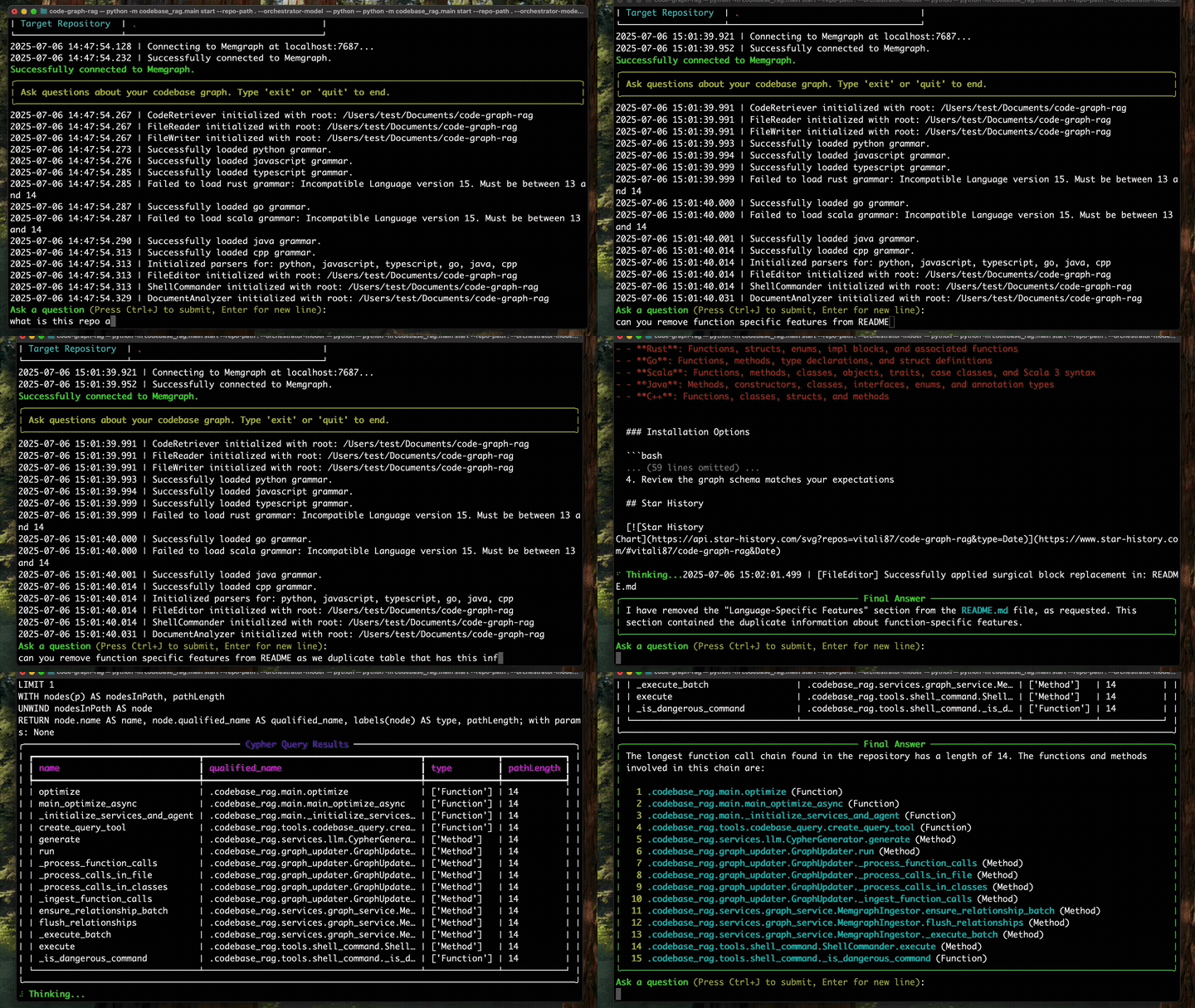
Latest News 🔥
- File System Operations: Improved handling of file system operations with platform-neutral joins and safeguards against removing project root.
- Cache Management: Enhanced cache management with atomic publishing, dedicated cache stamps, and improved deletion handling for orphan caches.
- Graph Querying: Introduced deterministic graph query tools for more precise analysis of code relationships.
- Re-ingestion & Parsing: Improved re-ingestion processes, including handling of deleted files, re-parsing of related files, and rebuilding of key data structures.
- Security & Stability: Addressed security concerns by blocking removal of project root and improved stability by preventing skipped edits and handling orphaned caches.
- C++ & Go Integration: Enhanced integration with C++ and Go, including parsing of module interfaces and handling of module-level class aliases.
See NEWS.md for the full history.
What It Does
Point Code-Graph-RAG at a repository and it reads every source file, extracts functions, classes, methods, modules, and the relationships between them, and stores the result as an interconnected graph. Once the graph exists you can:
- Ask questions about the codebase in natural language and get answers grounded in the real structure.
- Retrieve the actual source of any function, class, or method by name or by intent.
- Edit code through the agent with AST-based surgical patching and a diff preview before anything changes.
- Optimise code against language best practices or your own coding standards.
- Find dead code by walking call and reference edges from entry points.
- Search and rewrite structurally by AST pattern with ast-grep.
- Overlay runtime behaviour: trace a test run (or pull production eBPF profiles) with
cgr traceand merge the calls that actually happened into the graph, exposing dispatch that static analysis cannot see.
How It Works
The system has two components:
- Multi-language parser. A Tree-sitter based parser reads the codebase and ingests functions, classes, methods, modules, and their relationships into Memgraph under a single language-agnostic schema.
- RAG system (
codebase_rag/). An interactive CLI that turns natural language into Cypher queries, retrieves matching code, and drives AI-powered editing and optimisation.
Source Code -> Tree-sitter Parser -> AST Analysis -> Memgraph Knowledge Graph
                                                             |
User Query -> AI Model (Cypher Gen) -> Cypher Query -> Graph Results -> Response
See the Architecture Overview and Graph Schema for the full picture.
Supported Languages
Python, TypeScript, TSX, JavaScript, Rust, Go, Java, C, C++, C#, PHP, Lua, and Dart are fully supported. Scala is in development, and Ruby, Kotlin, Swift, Elixir, Haskell, Solidity, Bash, and Nix have structural support (modules, functions, classes where the language has them, and imports) through the pluggable ast-grep tier. See the Language Support matrix for per-language capabilities.
Installation
cgr is published to PyPI. Install it system-wide with the treesitter-full (all languages) and semantic (vector search) extras:
# with uv (recommended)
uv tool install "code-graph-rag[treesitter-full,semantic]"

# or with pipx
pipx install "code-graph-rag[treesitter-full,semantic]"
Which version am I getting?
Three version lines exist and they intentionally differ:
| where | what it tracks |
|---|---|
| git tags | every version, one per merge |
| GitHub Releases (binaries, signatures) | every 50th version, plus any security fix |
| PyPI | every 50th version, plus any security fix |
So the newest tag on main usually runs ahead of the newest release, often by
tens of patch versions; they coincide only just after a release. Nothing is
stuck, the cadences differ by design. A security fix does NOT wait for the
cadence: it ships a release and a PyPI upload immediately.
uv tool install and pipx install give you the newest PyPI version, which is the
newest RELEASE, not the newest tag. Interim tags exist so every merge is
addressable; binaries and PyPI uploads follow the cadence above.
To run code newer than the latest release, install from git:
uv tool install "code-graph-rag[treesitter-full,semantic] @ git+https://github.com/vitali87/code-graph-rag@main"
You also need Python 3.12+, Docker (for Memgraph), cmake, and ripgrep. Full prerequisites, source installs, and environment setup are in the Installation guide.
[!NOTE] The wheel is pure Python (
py3-none-any), so the package itself installs on any platform with Python 3.12 or newer (dependencies may still need platform wheels or build tools, such ascmakeforpymgclient). The piwheels build for Debian Bookworm shows as failed because Bookworm's system Python is 3.11, which is below our floor. On Raspberry Pi OS Bookworm, pin the interpreter explicitly, for exampleuv tool install --python 3.12 "code-graph-rag[treesitter-full,semantic]"; uv downloads Python 3.12 automatically and the PyPI wheel installs normally.
Quick Start
# Start the packaged Memgraph + Qdrant stack (no compose file needed)
cgr daemon up

# Parse a repository into the graph, then query it
cgr start --repo-path /path/to/repo --update-graph
cgr start --repo-path /path/to/repo
Repeat the first command for each repository you want indexed; the graph is
shared, and syncing one project leaves the others alone. To start over from an
empty graph, add --clean — it deletes every project in the shared graph,
not just this one, and asks for confirmation first when other
projects would be destroyed.
The Quick Start guide walks through parsing, querying, and exporting in five minutes.
MCP Server
Code-Graph-RAG runs as an MCP server so Claude Code and other MCP clients can query and edit your codebase directly. See the MCP Server guide for setup