Apache CloudStack




- Who Uses CloudStack?
- Demo
- Getting Started
- Getting Source Repository
- Documentation
- News and Events
- Getting Involved and Contributing
- Reporting Security Vulnerabilities
- License
- Notice of Cryptographic Software
- Star History
- Contributors
Apache CloudStack is open source software designed to deploy and manage large networks of virtual machines, as a highly available, highly scalable Infrastructure as a Service (IaaS) cloud computing platform. CloudStack is used by a number of service providers to offer public cloud services, and by many companies to provide an on-premises (private) cloud offering, or as part of a hybrid cloud solution.
CloudStack is a turnkey solution that includes the entire "stack" of features most organizations want with an IaaS cloud: compute orchestration, Network-as-a-Service, user and account management, a full and open native API, resource accounting, and a first-class User Interface (UI).
CloudStack currently supports the most popular hypervisors: VMware vSphere, KVM, XenServer, XenProject and Hyper-V as well as OVM and LXC containers.
Users can manage their cloud with an easy to use Web interface, command line tools, and/or a full-featured query based API.
For more information on Apache CloudStack, please visit the website
Who Uses CloudStack?
There are more than 150 known organizations using Apache CloudStack (or a commercial distribution of CloudStack). Our users include many major service providers running CloudStack to offer public cloud services, product vendors who incorporate or integrate with CloudStack in their own products, organizations who have used CloudStack to build their own private clouds, and systems integrators that offer CloudStack related services.
See our case studies highlighting successful deployments of Apache CloudStack.
See the up-to-date list of current users.
If you are using CloudStack in your organization and your company is not listed above, please complete our brief adoption survey. We're happy to keep your company name anonymous if you require.
Demo
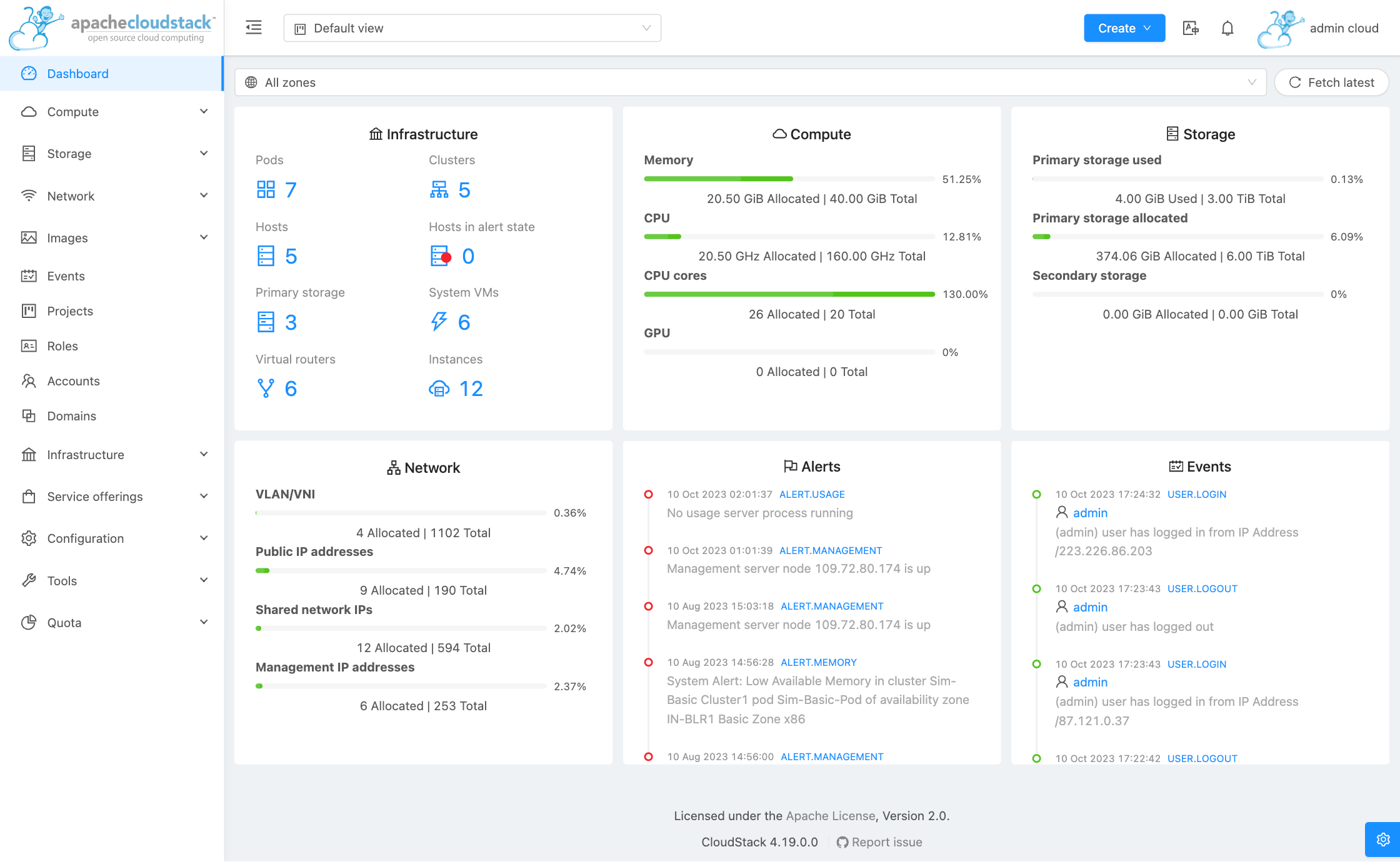
See the project user-interface QA website that runs CloudStack against simulator hypervisor: https://qa.cloudstack.cloud/simulator/ (admin:password)
Getting Started
- Download a released version
- Build from source with the instructions in the INSTALL.md file.
Getting Source Repository
Apache CloudStack project uses Git. The official Git repository is at:
https://gitbox.apache.org/repos/asf/cloudstack.git
And a mirror is hosted on GitHub:
https://github.com/apache/cloudstack
The GitHub mirror is strictly read only and provides convenience to users and developers to explore the code and for the community to accept contributions via GitHub pull requests.
Documentation
- Project Documentation
- Release notes
- Developer wiki
- Design documents
- API documentation
- How to contribute
News and Events
Getting Involved and Contributing
Interested in helping out with Apache CloudStack? Great! We welcome participation from anybody willing to work The Apache Way and make a contribution. Note that you do not have to be a developer in order to contribute to Apache CloudStack. We need folks to help with documentation, translation, promotion etc. See our contribution page.
If you are a frequent contributors, you can request to be added as collaborators (see https://cwiki.apache.org/confluence/display/INFRA/Git+-+.asf.yaml+features#Git.asf.yamlfeatures-AssigningexternalcollaboratorswiththetriageroleonGitHub) to our GitHub repos. This allows you to use project GitHub with ability to report issue with tags, and be assigned to issues and PRs. This is done via the .asf.yaml file in this repo. You may do so by sharing your GitHub users ID or raise a GitHub issue.
If you're interested in learning more or participating in the Apache CloudStack project, the mailing lists are the best way to do that. While the project has several communications channels, the mailing lists are the most active and the official channels for making decisions about the project itself.
Mailing lists:
- Development Mailing List
- Users Mailing List
- Commits Mailing List
- Issues Mailing List
- Marketing Mailing List
Report and/or check bugs on GitHub and check our developer page for contributing code.
Reporting Security Vulnerabilities
If you've found an issue that you believe is a security vulnerability in a
released version of CloudStack, please report it to security@apache.org with
details about the vulnerability, how it might be exploited, and any additional
information that might be useful.
For more details, please visit our security page.
License
Licensed to the Apache Software Foundation (ASF) under one or more contributor license agreements. See the NOTICE file distributed with this work for additional information regarding copyright ownership. The ASF licenses this file to you under the Apache License, Version 2.0 (the "License"); you may not use this file except in compliance with the License. You may obtain a copy of the License at
http://www.apache.org/licenses/LICENSE-2.0
Unless required by applicable law or agreed to in writing, software distributed under the License is distributed on an "AS IS" BASIS, WITHOUT WARRANTIES OR CONDITIONS OF ANY KIND, either express or implied. See the License for the specific language governing permissions and limitations under the License.
Please see the LICENSE file included in the root directory of the source tree for extended license details.
Notice of Cryptographic Software
This distribution includes cryptographic software. The country in which you currently reside may have restrictions on the import, possession, use, and/or re-export to another country, of encryption software. BEFORE using any encryption software, please check your country's laws, regulations and policies concerning the import, possession, or use, and re-export of encryption software, to see if this is permitted. See The Wassenaar Arrangement for more information.
The U.S. Government Department of Commerce, Bureau of Industry and Security (BIS), has classified this software as Export Commodity Control Number (ECCN) 5D002.C.1, which includes information security software using or performing cryptographic functions with asymmetric algorithms. The form and manner of this Apache Software Foundation distribution makes it eligible for export under the License Exception ENC Technology Software Unrestricted (TSU) exception (see the BIS Export Administration Regulations, Section 740.13) for both object code and source code.
The following provides more details on the included cryptographic software:
- CloudStack makes use of JaSypt cryptographic libraries.
- CloudStack requires a MySQL-compatible database (MariaDB or MySQL), and uses native database encryption functionality.
- CloudStack makes use of the Bouncy Castle general-purpose encryption library.
- CloudStack can optionally interact with and control OpenSwan-based VPNs.
- CloudStack has a dependency on and makes use of JSch - a java SSH2 implementation.