Platform for managing multi-cloud, hybrid-cloud, and on-premises Kubernetes clusters, with nodepools that mix cloud providers and your own bare-metal or co-located servers


Intro video
Vision of Claudie
The purpose of Claudie is to become the final Kubernetes engine you'll ever need. It builds clusters that leverage features and costs across on-premises datacenters and multiple cloud vendors, all from a single InputManifest. A Kubernetes that you won't ever need to migrate away from.
Typical use cases
Claudie has been built as an answer to the following Kubernetes challenges.
- Cost savings
- Data locality & compliance (e.g. GDPR)
- Managed Kubernetes for providers that do not offer it
- Cloud bursting
- Service interconnect
- On-premises & hybrid integration of existing bare-metal or co-located servers as nodepools
- Integration of GPU nodes into Kubernetes for AI workloads
Read in more details here.
Features
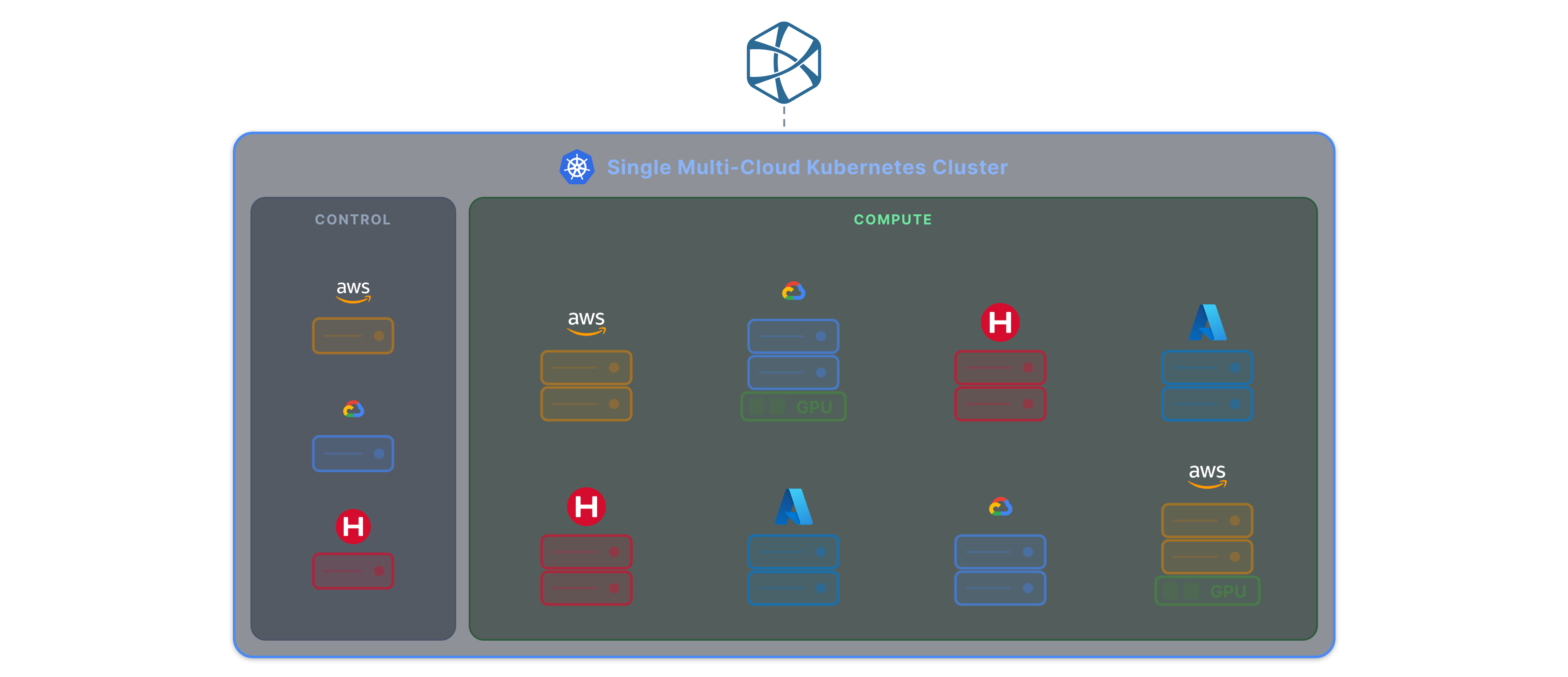
Manage multi-cloud, hybrid-cloud, and on-premises Kubernetes clusters
Create fully-featured Kubernetes clusters composed of multiple different public Cloud providers and your own on-premises data centers in an easy and secure manner. Simply insert credentials to your cloud projects, define your cluster, and watch how the infra spawns right in front of you.
Management via IaC
Declaratively define your infrastructure with a simple, easy to understand YAML syntax. See example manifest.
Fast scale-up/scale-down of your infrastructure
To scale-up or scale-down, simply change a few lines in the input manifest and Claudie will take care of the rest in the matter of minutes.
Loadbalancing
Claudie has its own managed load-balancing solution, which you can use for Ingresses, the Kubernetes API server, or generally anything. Check out our LB docs.
Persistent storage volumes
Claudie comes pre-configured with a storage solution, with ready-to-use Storage Classes. See Storage docs to learn more.
Get started using Claudie
Prerequisites
Before you begin, please make sure you have the following prerequisites installed and set up:
Claudie needs to be installed on an existing Kubernetes cluster, referred to as the Management Cluster, which it uses to manage the clusters it provisions. For testing, you can use ephemeral clusters like Minikube or Kind. However, for production environments, we recommend using a more resilient solution since Claudie maintains the state of the infrastructure it creates.
Claudie requires the installation of cert-manager in your Management Cluster. To install cert-manager, use the following command:
kubectl apply -f https://github.com/cert-manager/cert-manager/releases/download/v1.19.3/cert-manager.yaml
Supported providers
| Supported Provider | Node Pools | DNS | DNS healthchecks | GPU | Spot |
|---|---|---|---|---|---|
| AWS | :heavy_check_mark: | :heavy_check_mark: | :heavy_check_mark: | :heavy_check_mark: | :heavy_check_mark: |
| Azure | :heavy_check_mark: | :heavy_check_mark: | :heavy_check_mark: | :heavy_check_mark: | :heavy_check_mark: |
| GCP | :heavy_check_mark: | :heavy_check_mark: | :heavy_check_mark: | :heavy_check_mark: | :heavy_check_mark: |
| OCI | :heavy_check_mark: | :heavy_check_mark: | :heavy_check_mark: | :heavy_check_mark: | :heavy_check_mark: |
| Exoscale | :heavy_check_mark: | :heavy_check_mark: | N/A | :heavy_check_mark: | N/A |
| Hetzner | :heavy_check_mark: | :heavy_check_mark: | N/A | :heavy_check_mark: | N/A |
| CloudRift | :heavy_check_mark: | N/A | N/A | :heavy_check_mark: | N/A |
| Verda | :heavy_check_mark: | N/A | N/A | :heavy_check_mark: | :heavy_check_mark: |
| Cloudflare | N/A | :heavy_check_mark: | :heavy_check_mark: | N/A | N/A |
| OVHcloud | :heavy_check_mark: | :heavy_check_mark: | N/A | :heavy_check_mark: | N/A |
| Openstack | :heavy_check_mark: | N/A | N/A | :heavy_check_mark: | N/A |
| On-Premises / Static nodes | :heavy_check_mark: | N/A | N/A | :heavy_check_mark: | N/A |
Note:
N/Aindicates that the given feature is not applicable for the provider.
For adding support for other cloud providers or on-premises environments, open an issue or propose a PR.
Install Claudie
Deploy Claudie to the Management Cluster:
kubectl apply -f https://github.com/berops/claudie/releases/latest/download/claudie.yamlTo further harden claudie, you may want to deploy our pre-defined network policies:
# for clusters using cilium as their CNI
kubectl apply -f https://github.com/berops/claudie/releases/latest/download/network-policy-cilium.yaml
# other kubectl apply -f https://github.com/berops/claudie/releases/latest/download/network-policy.yaml
Deploy your cluster
Create Kubernetes Secret resource for your provider configuration.
kubectl create secret generic example-aws-secret-1 \
  --namespace= \
  --from-literal=accesskey='' \
  --from-literal=secretkey=''
Check the supported providers for input manifest examples. For an input manifest spanning all supported hyperscalers checkout out this example.
Deploy InputManifest resource which Claudie uses to create infrastructu