claude-mem is a free, open source ai development platforms project written in TypeScript and released under Apache-2.0. It has 94,125 GitHub stars, 8,305 forks and 186 open issues, and was last pushed 4 hours ago. On this registry it ranks #6 of 61 tracked projects in AI Development Platforms, with 5 head-to-head comparisons available. It gained 161 stars over the last 3 tracked days.
What is claude-mem?
claude-mem is an Apache-2.0 TypeScript memory layer for AI coding agents that captures what an agent did during a session, compresses it with AI, and injects the relevant parts back into future sessions, built for developers running Claude Code, OpenClaw, Codex, Gemini, Hermes, Copilot, OpenCode and similar tools.
What it is
claude-mem is a persistent context plugin that sits alongside an agent's own memory rather than replacing it. The README frames the split plainly: the agent remembers the user, while claude-mem remembers what the bot did, what was decided, and what to do next. Those notes are written to disk during a session and returned to the agent when a new session starts. The project lives in the Claude Code plugin ecosystem and the broader agent-tooling space, distributed as the claude-mem package on npm while the README announces a rename to Grok Mem. The package name is unchanged.
The concrete problem it solves is session amnesia. Agents are stateless between runs, so decisions, bug fixes and open threads are lost the moment a session ends. claude-mem replaces manual re-briefing and hand-written context files with automatic capture, AI compression, and layered retrieval that surfaces only the parts relevant to the current task. Storage and recall are backed by ChromaDB, and integration runs through the Claude Agent SDK.
Key capabilities
Persistent memory that survives across sessions, so context from earlier work appears automatically in new ones.
Progressive disclosure of memory, retrieving context in layers with token cost visibility rather than dumping everything into the prompt.
Skill-based search through the mem-search skill, letting an agent query its own project history on demand.
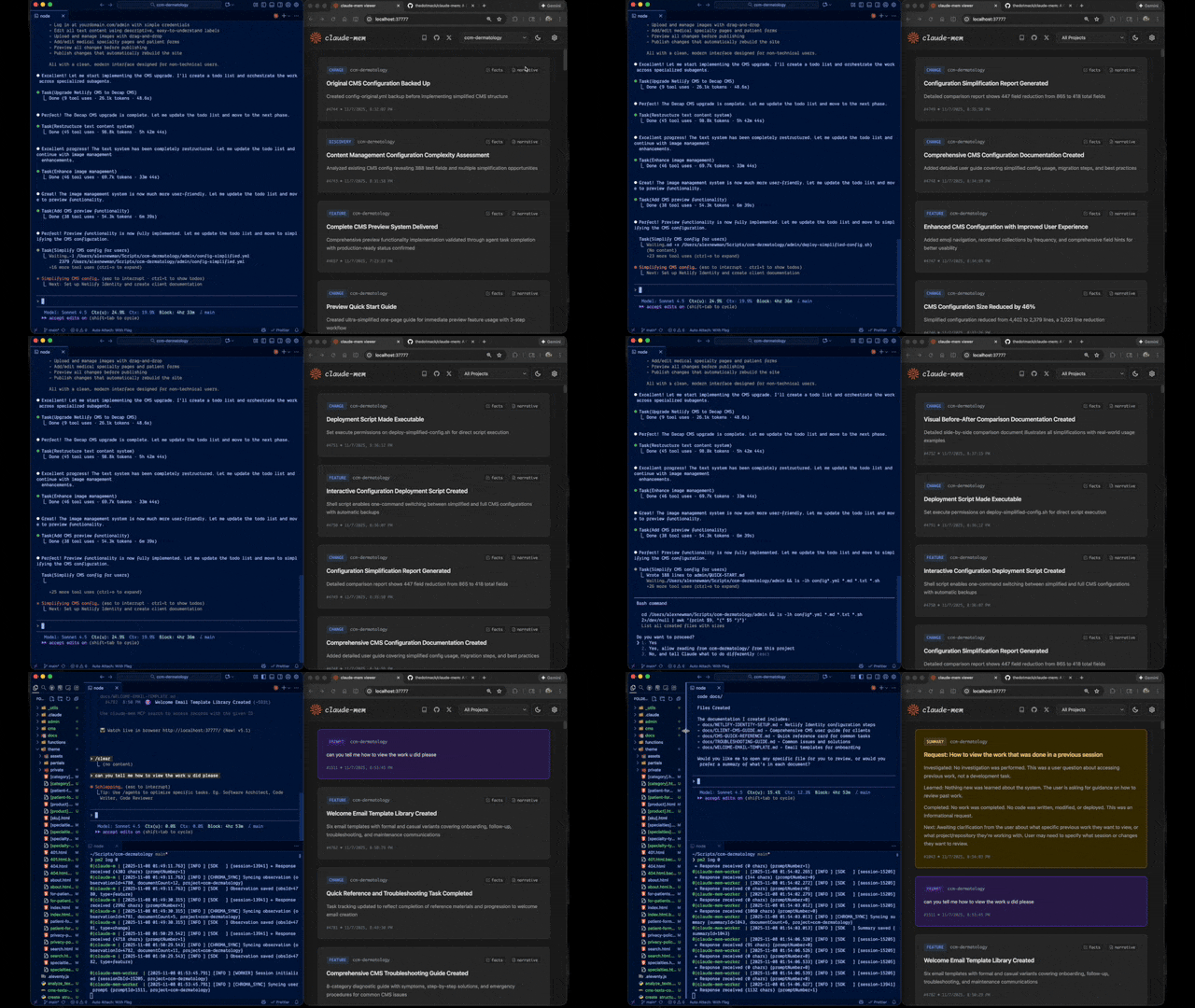
A Web Viewer UI serving a real-time memory stream at the worker URL printed on startup.
A Claude Desktop skill for searching stored memory from Claude Desktop conversations.
Privacy control that excludes sensitive content from capture using dedicated exclusion tags.
Provider choice at install time: the hosted claude-mem observer, a personal OpenRouter or Gemini key, or the user's existing Anthropic plan.
Who uses it and how
Claude Code users install through the plugin marketplace with /plugin marketplace add thedotmack/claude-mem and /plugin install claude-mem, then restart the editor.
OpenClaw gateway operators run a single curl -fsSL https://install.cmem.ai/openclaw.sh | bash command, which handles dependencies, plugin setup, provider configuration and worker startup, with optional real-time observation feeds to Telegram, Discord, Slack and similar channels.
Grok Bot deployments rely on chat log watching, because that host exposes no hooks; the default provider is hosted CMEM Pro and the local observer is opt-in via --provider host.
CI and other non-interactive shells complete installation without any account interaction by passing an explicit --provider flag or setting CLAUDE_MEM_ONLINE_OPTIN=false.
The awareness push pilot appends needle observations such as decision, bugfix, security_alert and sensitive as dated lines into a bot's memory/log/YYYY-MM.md, without touching profile.md, user memory or project memory.
Getting started
Install with npx claude-mem install, optionally adding --ide opencode, --ide antigravity or --ide grok-bot for those hosts, or use the /plugin commands inside Claude Code. Note that npm install -g claude-mem installs the SDK and library only, without registering plugin hooks or setting up the worker service.
How it compares
This registry lists no competing memory products to compare against, and the tools named in the claude-mem facts are the agents it plugs into rather than rivals, so it stands alone here as a memory layer for them. Its Apache-2.0 licence and npm distribution make the code inspectable and self-hostable regardless of which provider is chosen.
When to use it — and when not to
Adopting it means running a background worker service and choosing a memory provider: the hosted observer, which is free for the first 30 days and then falls back to the user's Anthropic plan unless subscribed, or a self-supplied OpenRouter or Gemini key or a local observer. Anyone who cannot run that worker, or who wants zero account interaction by default, should prefer explicit provider flags or skip the hosted path entirely. Two caveats are worth weighing: the README is currently dominated by a rebrand notice, so documentation of the underlying behaviour is thin, and the project carries 186 open issues against a very large user base.
project readme (upstream, from github) — read inline
Claude-Mem is now Grok Mem. The package is still claude-mem.
Grok Mem is how Grok Bots remember the work. Grok already remembers you. Grok Mem remembers what the bot did, what we decided, what to do next. Those notes come back in the next chat.
Grok Bot has no host hooks, so we watch the chat log files. Default is CMEM Pro, the hosted memory. Local observer is opt-in: --provider host. Installing this plugin does not install Cursor.
Awareness push pilot (LFG + Orifice): needle observations (decision, bugfix, security_alert, sensitive) are appended as dated - YYYY-MM-DD [awareness] … lines into that bot's memory/log/YYYY-MM.md. Grok Bot already re-reads the log from disk. This does not write profile.md, user-memory, or project memory. Disable with CLAUDE_MEM_GROK_BOT_AWARENESS_ENABLED=false.
Install with a single command:
npx claude-mem install
The installer sets everything up first, then asks you to sign in to claude-mem in your browser (email magic link — no card required). Signing in provisions a memory key for your account and unlocks the claude-mem observer: memory that runs off-plan, free for your first 30 days, so you get up to 100% more usage from your plan. When the free trial ends, memory automatically falls back to your Anthropic plan unless you subscribe. After sign-in you pick your memory provider — the claude-mem observer, your own OpenRouter or Gemini key, or your Anthropic plan.
Prefer to skip the sign-in? Pass an explicit --provider flag, set CLAUDE_MEM_ONLINE_OPTIN=false, or run in CI/non-interactive shells — the installer completes without any account interaction.
Restart Claude Code. Context from previous sessions will automatically appear in new sessions.
Note: Claude-Mem is also published on npm, but npm install -g claude-mem installs the SDK/library only — it does not register the plugin hooks or set up the worker service. Always install via npx claude-mem install or the /plugin commands above.
🦞 OpenClaw Gateway
Install claude-mem as a persistent memory plugin on OpenClaw gateways with a single command:
The installer handles dependencies, plugin setup, AI provider configuration, worker startup, and optional real-time observation feeds to Telegram, Discord, Slack, and more. See the OpenClaw Integration Guide for details.
Key Features:
🧠 Persistent Memory - Context survives across sessions
claude-mem is open source under the Apache-2.0 licence. There is no licence fee and no seat count — you can self-host it or, where the project offers one, pay a vendor for a managed version instead.
What does claude-mem do?
Persistent Context Across Sessions for Every Agent – Captures everything your agent does during sessions, compresses it with AI, and injects relevant context b
What is claude-mem written in?
claude-mem is primarily written in TypeScript. Its source is publicly available at https://github.com/thedotmack/claude-mem, and it has 94,125 GitHub stars.