🆕 Looking for persistent memory for Claude Code? Check out memsearch Claude Code plugin — a markdown-first memory system that gives your AI agent long-term memory across sessions.
Your entire codebase as Claude's context









Claude Context is an MCP plugin that adds semantic code search to Claude Code and other AI coding agents, giving them deep context from your entire codebase.
🧠 Your Entire Codebase as Context: Claude Context uses semantic search to find all relevant code from millions of lines. No multi-round discovery needed. It brings results straight into the Claude's context.
💰 Cost-Effective for Large Codebases: Instead of loading entire directories into Claude for every request, which can be very expensive, Claude Context efficiently stores your codebase in a vector database and only uses related code in context to keep your costs manageable.
🚀 Demo

Model Context Protocol (MCP) allows you to integrate Claude Context with your favorite AI coding assistants, e.g. Claude Code.
Quick Start
Prerequisites
Get a free vector database on Zilliz Cloud 👈
Claude Context needs a vector database. You can sign up on Zilliz Cloud to get an API key.
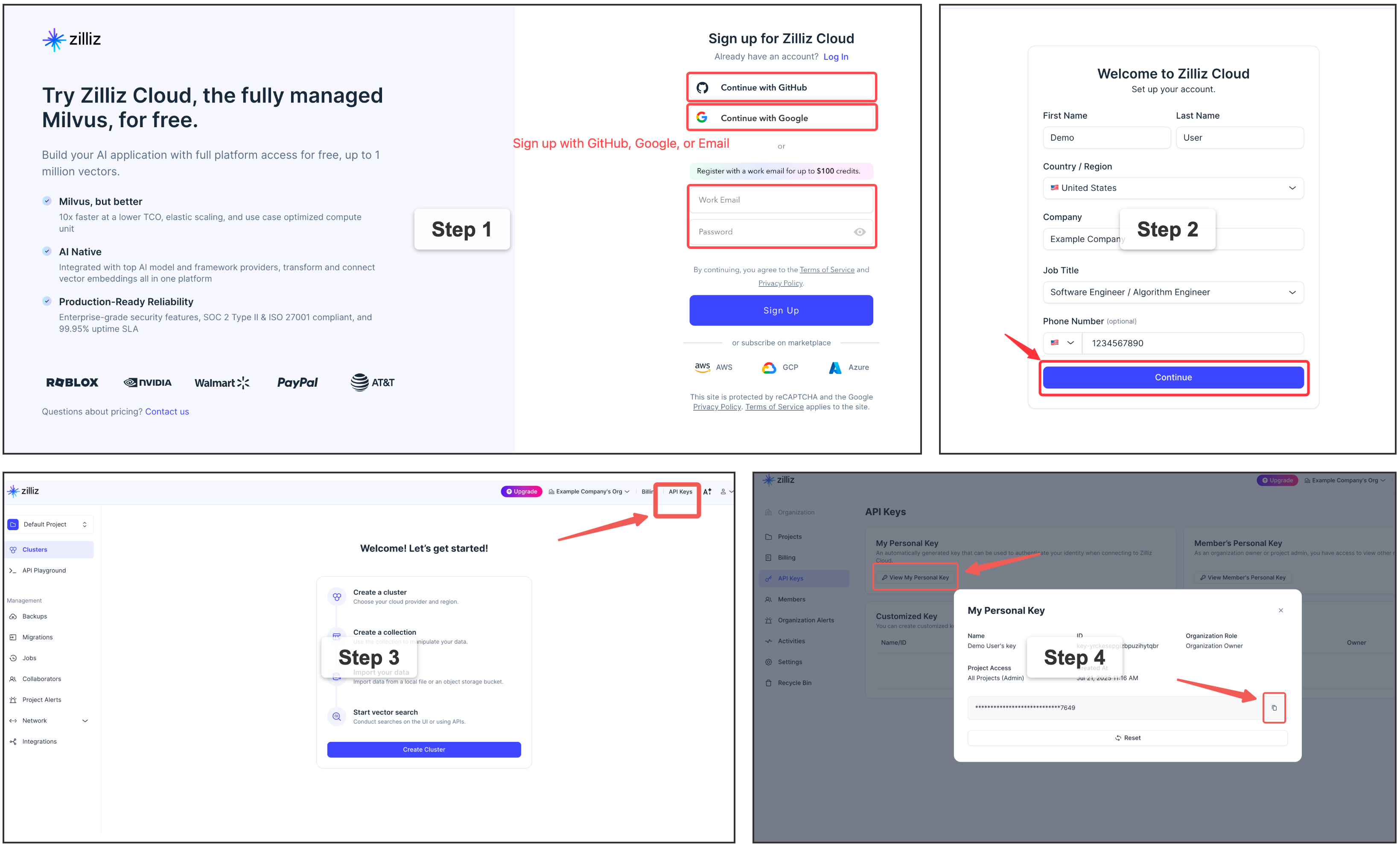
Copy your Personal Key to replace your-zilliz-cloud-api-key in the configuration examples.
Get OpenAI API Key for embedding model
You need an OpenAI API key for the embedding model. You can get one by signing up at OpenAI.
Your API key will look like this: it always starts with sk-.
Copy your key and use it in the configuration examples below as your-openai-api-key.
Configure MCP for Claude Code
System Requirements:
- Node.js >= 20.0.0
Configuration
Use the command line interface to add the Claude Context MCP server:
claude mcp add claude-context \
  -e OPENAI_API_KEY=sk-your-openai-api-key \
  -e MILVUS_ADDRESS=your-zilliz-cloud-public-endpoint \
  -e MILVUS_TOKEN=your-zilliz-cloud-api-key \
  -- npx @zilliz/claude-context-mcp@latest
See the Claude Code MCP documentation for more details about MCP server management.
Other MCP Client Configurations
OpenAI Codex CLI
Codex CLI uses TOML configuration files:
Create or edit the
~/.codex/config.tomlfile.Add the following configuration:
# IMPORTANT: the top-level key is `mcp_servers` rather than `mcpServers`.
[mcp_servers.claude-context]
command = "npx"
args = ["@zilliz/claude-context-mcp@latest"]
env = { "OPENAI_API_KEY" = "your-openai-api-key", "MILVUS_TOKEN" = "your-zilliz-cloud-api-key" }
# Optional: override the default 10s startup timeout
startup_timeout_ms = 20000
- Save the file and restart Codex CLI to apply the changes.
Gemini CLI
Gemini CLI requires manual configuration through a JSON file:
- Create or edit the
~/.gemini/settings.jsonfile. - Add the following configuration:
{
  "mcpServers": {
    "claude-context": {
      "command": "npx",
      "args": ["@zilliz/claude-context-mcp@latest"],
      "env": {
        "OPENAI_API_KEY": "your-openai-api-key",
        "MILVUS_TOKEN": "your-zilliz-cloud-api-key"
      }
    }
  }
}
- Save the file and restart Gemini CLI to apply the changes.
Qwen Code
Create or edit the ~/.qwen/settings.json file and add the following configuration:
{
  "mcpServers": {
    "claude-context": {
      "command": "npx",
      "args": ["@zilliz/claude-context-mcp@latest"],
      "env": {
        "OPENAI_API_KEY": "your-openai-api-key",
        "MILVUS_ADDRESS": "your-zilliz-cloud-public-endpoint",
        "MILVUS_TOKEN": "your-zilliz-cloud-api-key"
      }
    }
  }
}
Cursor
Go to: Settings -> Cursor Settings -> MCP -> Add new global MCP server
Pasting the following configuration into your Cursor ~/.cursor/mcp.json file is the recommended approach. You may also install in a specific project by creating .cursor/mcp.json in your project folder. See Cursor MCP docs for more info.
{
  "mcpServers": {
    "claude-context": {
      "command": "npx",
      "args": ["-y", "@zilliz/claude-context-mcp@latest"],
      "env": {
        "OPENAI_API_KEY": "your-openai-api-key",
        "MILVUS_ADDRESS": "your-zilliz-cloud-public-endpoint",
        "MILVUS_TOKEN": "your-zilliz-cloud-api-key"
      }
    }
  }
}
Void
Go to: Settings -> MCP -> Add MCP Server
Add the following configuration to your Void MCP settings:
{
  "mcpServers": {
    "code-context": {
      "command": "npx",
      "args": ["-y", "@zilliz/claude-context-mcp@latest"],
      "env": {
        "OPENAI_API_KEY": "your-openai-api-key",
        "MILVUS_ADDRESS": "your-zilliz-cloud-public-endpoint",
        "MILVUS_TOKEN": "your-zilliz-cloud-api-key"
      }
    }
  }
}
Claude Desktop
Add to your Claude Desktop configuration:
{
  "mcpServers": {
    "claude-context": {
      "command": "npx",
      "args": ["@zilliz/claude-context-mcp@latest"],
      "env": {
        "OPENAI_API_KEY": "your-openai-api-key",
        "MILVUS_ADDRESS": "your-zilliz-cloud-public-endpoint",
        "MILVUS_TOKEN": "your-zilliz-cloud-api-key"
      }
    }
  }
}
Windsurf
Windsurf supports MCP configuration through a JSON file. Add the following configuration to your Windsurf MCP settings:
{
  "mcpServers": {
    "claude-context": {
      "command": "npx",
      "args": ["-y", "@zilliz/claude-context-mcp@latest"],
      "env": {
        "OPENAI_API_KEY": "your-openai-api-key",
        "MILVUS_ADDRESS": "your-zilliz-cloud-public-endpoint",
        "MILVUS_TOKEN": "your-zilliz-cloud-api-key"
      }
    }
  }
}
VS Code
The Claude Context MCP server can be used with VS Code through MCP-compatible extensions. Add the following configuration to your VS Code MCP settings:
{
  "mcpServers": {
    "claude-context": {
      "command": "npx",
      "args": ["-y", "@zilliz/claude-context-mcp@latest"],
      "env": {
        "OPENAI_API_KEY": "your-openai-api-key",
        "MILVUS_ADDRESS": "your-zilliz-cloud-public-endpoint",
        "MILVUS_TOKEN": "your-zilliz-cloud-api-key"
      }
    }
  }
}
Cherry Studio
Cherry Studio allows for visual MCP server configuration through its settings interface. While it doesn't directly support manual JSON conf