Claude Ads
Claude-first, portable paid-media operations for agencies, consultants, and in-house performance teams.
Claude Ads turns authorized exports or account reads into source-grounded audits, plans, creative workflows, experiments, monitoring, and reports. It is read-only by default. Live changes stay disabled until the exact platform and operation pass approval, idempotency, verification, audit, and rollback gates.
[!NOTE] Claude Ads ships from two homes: the public release at
AgriciDaniel/claude-ads(MIT, no membership required) and the community mirror atAI-Marketing-Hub/claude-ads, where AI Marketing Hub Pro members get early access and direct collaboration.
What it does
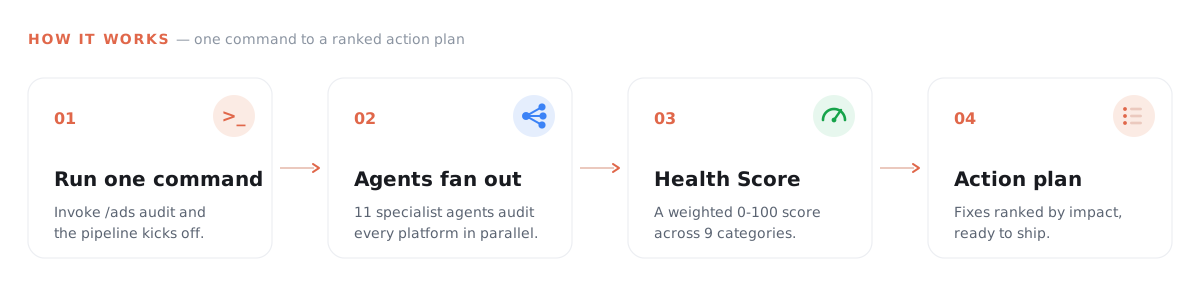
- Audits paid-media accounts with dated evidence and explicit confidence.
- Plans campaigns, channels, budgets, measurement, and experiments.
- Creates copy, image, video, and product-photo briefs and assets.
- Monitors pacing, delivery, tracking, fatigue, policy, and performance.
- Produces versioned JSON, then renders Markdown, HTML, and optional PDF.
- Drafts safe account changes without applying them by default.
- Reports missing data, stale sources, contradictions, and partial failures.
Platforms
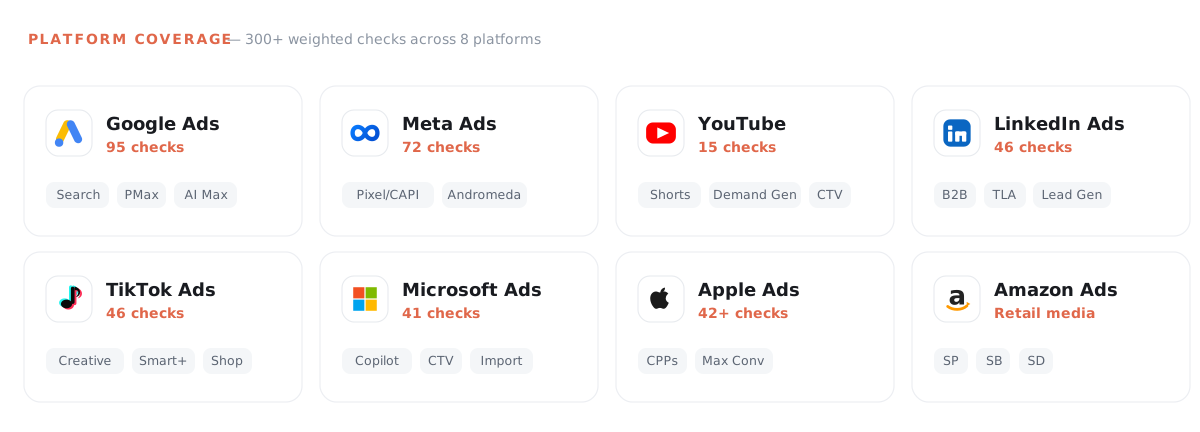
| Segment | Platforms |
|---|---|
| Search, video, and social | Google Ads, Meta Ads, YouTube Ads, LinkedIn Ads, TikTok Ads, Microsoft Advertising, Reddit Ads, Snapchat Ads, X Ads |
| Commerce and retail media | Apple Ads, Amazon Ads, Pinterest Ads |
Each platform has a focused skill, audit worker, control reference, capability declaration, and testable routing surface. The capability manifest is the authoritative record for live reads and writes.
Commands
Standalone installs use /ads. Claude Code plugins are namespaced and use
/claude-ads:ads. Both load the same ads/SKILL.md contract.
| Command | Outcome |
|---|---|
/ads setup |
Create the client, account, KPI, privacy, and guardrail profile |
/ads audit [all|platform|scope] |
Run a complete or scoped evidence-backed audit |
/ads plan |
Build channel, campaign, budget, competitor, and measurement plans |
/ads create |
Produce copy, image, video, or product-photo assets |
/ads launch --draft |
Draft a campaign mutation plan without changing the account |
/ads monitor |
Review pacing, delivery, tracking, fatigue, policy, and performance |
/ads optimize --draft |
Draft evidence-backed optimization changes |
/ads experiment |
Design or read out a controlled test |
/ads report |
Render a validated JSON run bundle |
/ads research refresh |
Refresh platform, policy, API, benchmark, and ecosystem evidence |
/ads validate |
Validate contracts, runs, capabilities, maturity, or release readiness |
/ads status, /ads next |
Show current status and the highest-priority blocker |
Platform shortcuts such as /ads google, /ads meta, /ads amazon, and
/ads reddit route to the matching platform audit.
Demo
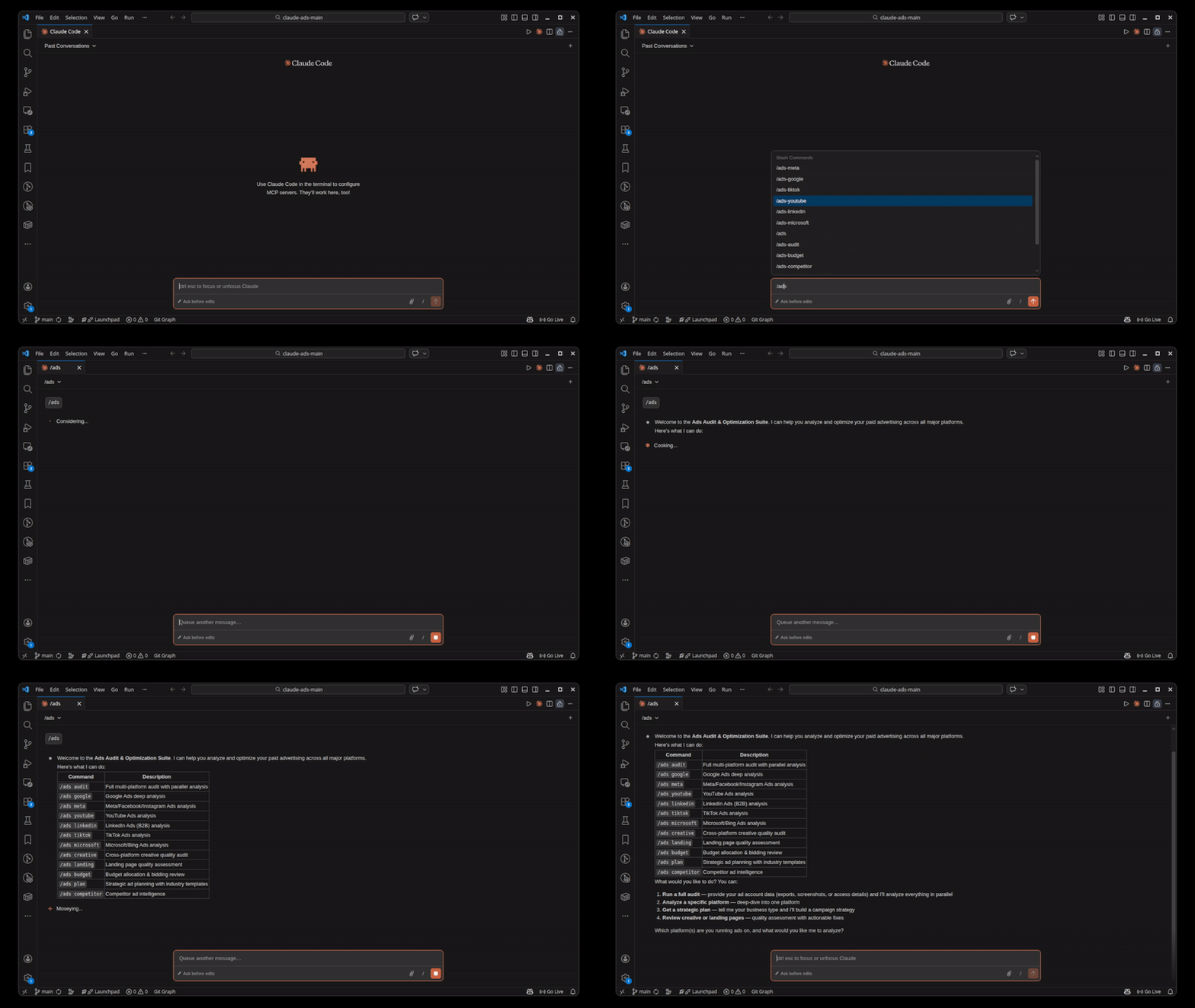
The GIF shows the original command-discovery experience. The v2 command table above and the platform table are current and authoritative.
Installation
Claude Code is the canonical runtime. Codex, Gemini, Cursor, Windsurf, Goose, and compatible Agent Skills hosts can consume the same skill files where their runtime supports them.
Prefer the host's native plugin flow or a tagged release archive with a verified SHA-256 checksum. Never pipe a remote installer directly to a shell.
For Claude Code, the native plugin flow is:
/plugin marketplace add agricidaniel/claude-ads
/plugin install claude-ads@ai-marketing-hub-claude-ads
If you added this marketplace before v2.0.0, Claude Code still holds it under
the stale local alias agricidaniel-claude-ads. Remove that alias, then re-add
and install:
/plugin marketplace remove agricidaniel-claude-ads
/plugin marketplace add agricidaniel/claude-ads
/plugin install claude-ads@ai-marketing-hub-claude-ads
Or install from a local clone of the public repository:
git clone https://github.com/AgriciDaniel/claude-ads.git
cd claude-ads
bash install.sh --source=local
Select another standalone host explicitly:
bash install.sh --target=codex --source=local
bash install.sh --target=gemini --source=local --no-deps
PowerShell uses the same managed ownership model:
git clone https://github.com/AgriciDaniel/claude-ads.git
Set-Location claude-ads
.\install.ps1 -Source local
Managed dependencies support CPython 3.11 and 3.12 on the declared Linux,
macOS, and Windows wheel matrix. Unsupported interpreters fail before the
destination changes. Use --no-deps or -NoDeps for a skill-only install.
Browser capture requires an operator-installed Playwright browser payload. PDF rendering requires the host's WeasyPrint and Pango system libraries. These are documented in the external runtime dependency manifest.
Uninstall only manifest-owned files:
bash uninstall.sh --target=claude
The PowerShell equivalent is uninstall.ps1.
Architecture
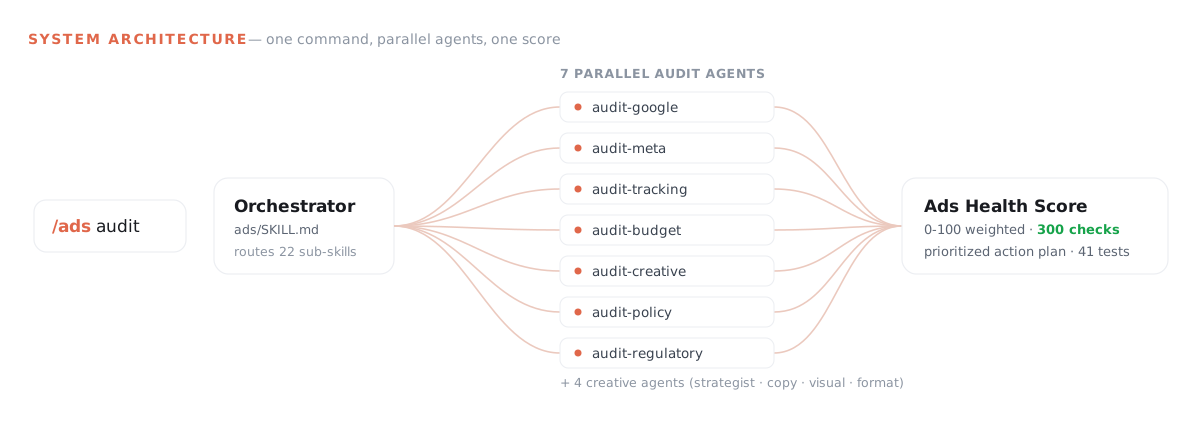
One conductor owns scope, policy, aggregation, and final artifacts. Workers analyze bounded slices and return schema-valid findings. Required-worker failure makes the run partial. It is never silently presented as a complete audit.
The canonical result is versioned JSON. Markdown, HTML, and PDF are renderings of the same validated run bundle.
Scoring and evidence
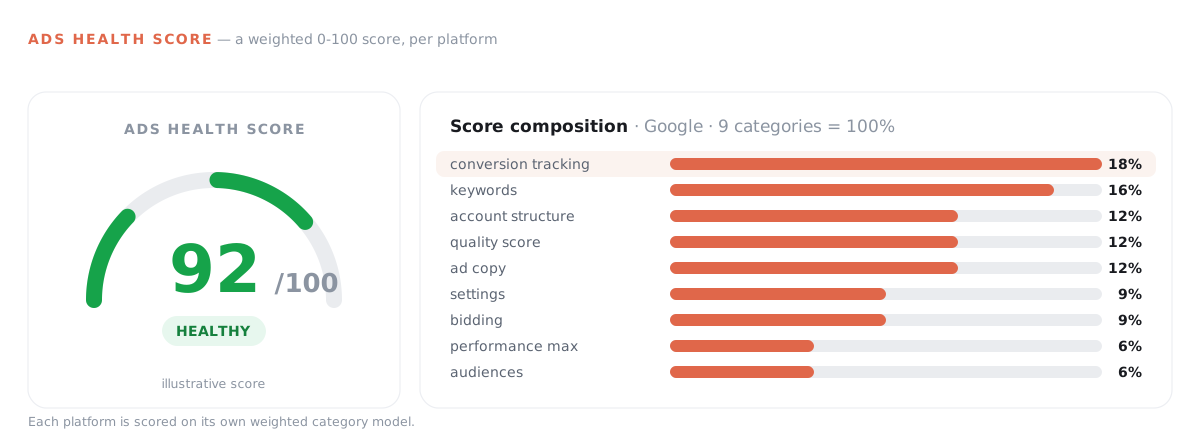
Controls use pass, fail, unknown, or not_applicable.
- Health, evidence coverage, regulatory exposure, and opportunities stay separate.
- Unknown controls reduce evidence coverage without changing known health.
- Coverage of 80% or more is graded, 60 to 79% is provisional, and below 60% is insufficient evidence.
- Optional, beta, premium, unavailable, and ineligible features stay unscored.
- A disabled or unapproved platform profile produces no health score.
- A failed platform is excluded from portfolio scoring and makes the run partial.
See the scoring reference and production
implementation in claude_ads_core/scoring.py.
Account safety
All adapters are read-only by default. Applying a change requires:
- A tested and enabled capability for the exact operation.
- Explicit account and object IDs.
- A human-readable before and after diff with blast radius.
- Owner approval within account-defined ceilings.
- An idempotency key, audit destination, rollback, and verification window.
- Verification that remote state still matches the mutation precondition.
Missing ceilings mean no write. Permanent deletion is not supported in v2. Credentials belong in environment variables, an OS keychain, or an approved secret manager. They never belong in the repository, profiles, reports, or logs.
Evidence and release controls
The public-safe control-plane/ records product boundaries, dated sources,
claims, capabilities, safety rules, privacy rules, ecosystem decisions, and
release requirements.
- No source means no current platform claim.
- No implementation, fixture, and test means no capability claim.
- No approval and rollback means no account mutation.
- No independent verification means no release.
See the release requirements and publishing policy.
Development
Create a virtual environment and run the complete suite:
python3.12 -m venv .venv
.venv/bin/python -m pip install --no-deps -e .
.venv/bin/python -m pip install --require-hashes --only-binary=:all: -r requirements.lock
.venv/bin/python -m pip install --require-hashes --only-binary=:all: -r requirements-dev.lock
.venv/bin/python -m pip install --require-hashes --only-binary=:all: -r .git