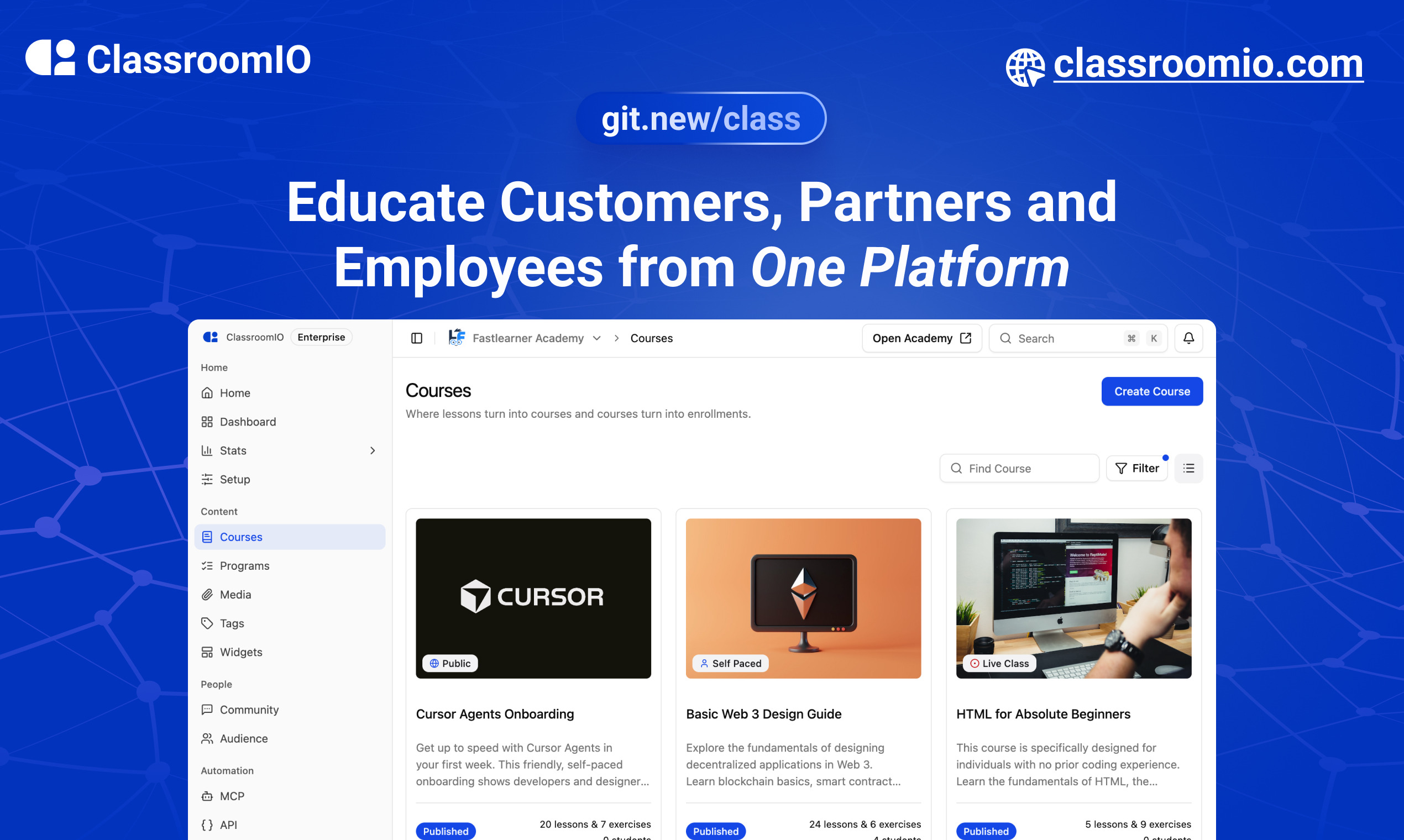
ClassroomIO.com
The Open Source Learning Management System for Companies
Website | Join Discord community
✨ About ClassroomIO.com
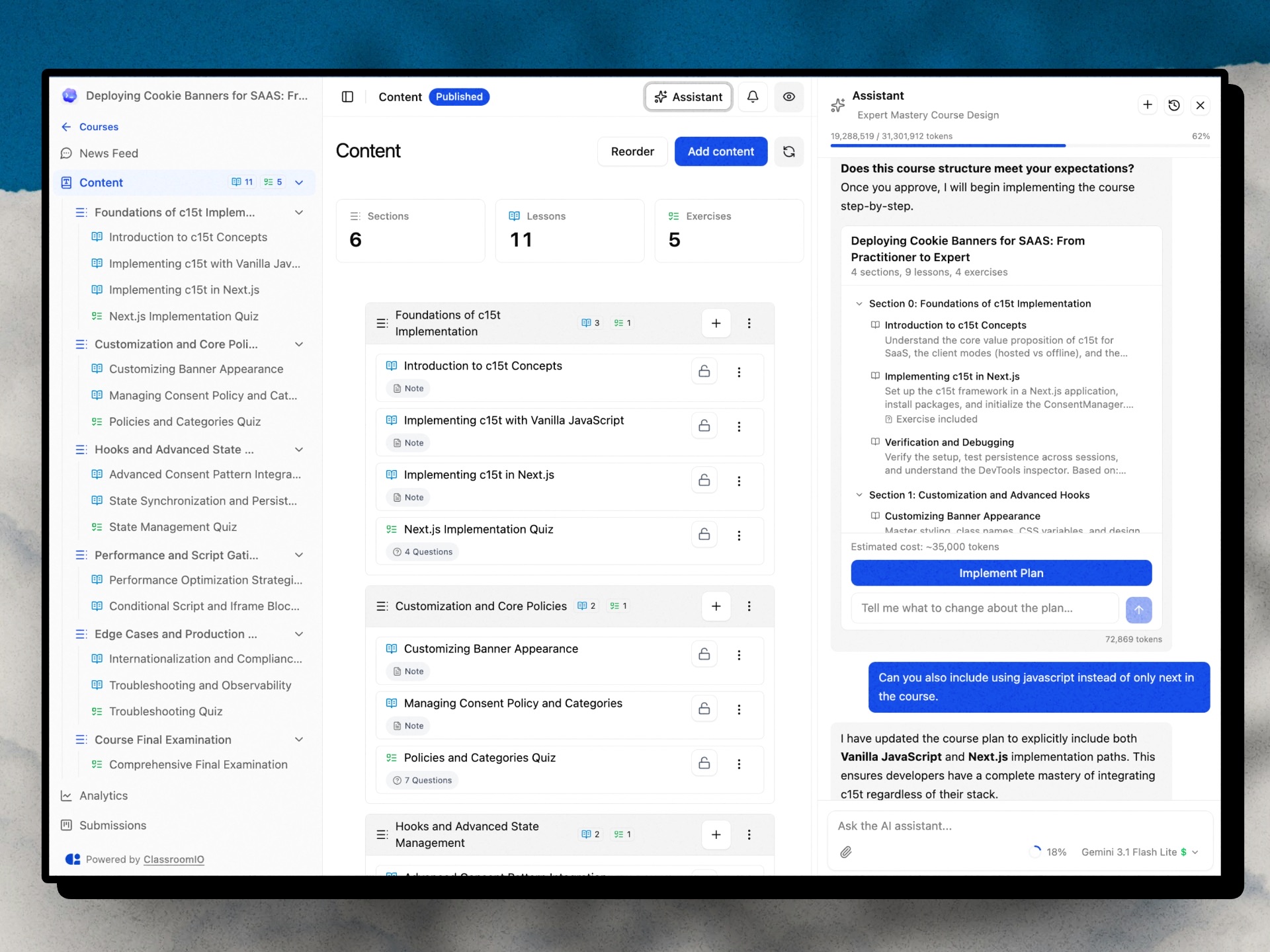
ClassroomIO is an open source LMS for companies. Run compliance/employee training, customer education, and partner certification cohorts — all from one platform. Self-host it on your own infrastructure or use the cloud version.
Who It's For
| Use Case | What You Get |
|---|---|
| Compliance Training | Deadline tracking, renewals & retake intervals, grace periods, waivers, certificates with custom IDs |
| Customer Education | Branded academy portal, cohorts (cohorts with goals), AI lesson tutor, multilingual content |
| Partner Training | Partner workspaces, branded certificates, custom domains, embeddable widgets, multilingual support |
Key Features
Course & Content
- Course management — unlimited courses, lessons, exercises, grading, and certificates
- Cohorts — group courses into cohorts with goals, team management, and progress tracking
- AI Course Builder — generate outlines, lesson content, and assignments (Gemini, GPT-4o, Claude)
- AI Lesson Tutor — in-lesson AI assistant that helps learners as they study
Compliance & Certification
- Compliance tracking — status, deadlines, grace periods, renewals, and waivers
- Certificates — issue branded certificates with custom IDs
Learner & Org Experience
- Multi-org & multi-teacher — invite teachers, assign courses, manage multiple organizations
- Student dashboard — learners access all courses, assignments, and progress in one place
- Multilingual — deliver content in 10+ languages
Integrations & Developer Tools
- REST API + Webhooks — enroll users, trigger automations, receive events (
certificate.issued,enrollment.completed, and more) - MCP server —
@classroomio/mcpon npm for AI-native integrations - Embeddable widget — embed your course catalog on any website
Platform
- Fully open source — self-host the entire stack on your own servers
For what's coming next, see the public roadmap.
Built With
Get a Demo
You can book a quick 15 min demo to see if ClassroomIO is a good fit for you

Getting Started
To get a local copy up and running, please follow these simple steps.
Prerequisites
Here is what you need to be able to run ClassroomIO.com
- Node.js (Version: >=20.19.3) — required
- pnpm (v10) — required; the package scripts call
pnpmdirectly, so npm/yarn are not substitutes - Docker — required; runs Postgres + Redis (no local install of those needed)
Project Structure
This repo is a monorepo that consists of these primary apps:
website: The landing page of ClassroomIO hosted hereapi: The api service that handles PDF, video processing, Emailing and Notifications.dashboard: The web application that runs the learning management system hosted here.docs: Official documentation of ClassroomIO hosted here
The repository also contains shared packages under packages/ (for example packages/db, packages/utils, and packages/ui).
Development
Local Setup
Before you start: make sure pnpm and Docker are installed (see Prerequisites). New to the project? Read
DEV_SETUP_NOTES.mdfirst — it's a full step-by-step walkthrough with a troubleshooting reference for the errors you're likely to hit.
Fork the repo, then clone it:
git clone https://github.com/classroomio/classroomio.gitGo to project folder:
cd classroomioSet up Node (using
nvm):nvm useYou first might need to install the specific version and then use it:
nvm install && nvm useYou can install nvm from here.
Install dependencies:
pnpm iSet up your
.envfiles:Each app reads its own
.env. Inapps/api,apps/jobsandapps/dashboard, duplicate.env.exampleto.envand fill the values below (host ports). The secret values are placeholders — generate each one withopenssl rand -hex 32rather than copying the example text. The twoPRIVATE_SERVER_KEYvalues must match — they authenticate the dashboard's server-to-server calls to the API, so generate it once and paste the same value into both files.apps/api/.env:DATABASE_URL="postgresql://postgres:postgres@localhost:5432/classroomio" REDIS_URL="redis://localhost:6379" PUBLIC_SERVER_URL="http://localhost:3002" TRUSTED_ORIGINS="http://localhost:5173" # the dashboard dev origin BETTER_AUTH_SECRET="" PRIVATE_SERVER_KEY="" # generate once; use the SAME value in the dashboard DASHBOARD_ORIGIN="http://localhost:5173" # optional; used for invite/email links back to the dashboardapps/jobs/.env: The jobs service handles background tasks (emails, media processing, analytics rollups, etc.).Recommended setup (simplest):
cd apps/jobs ln -s ../../apps/api/.env .envapps/dashboard/.env:PUBLIC_SERVER_URL="http://localhost:3002" PRIVATE_SERVER_URL="http://localhost:3002" # used by the SSR auth proxy — required, or login returns "API upstream not configured" PRIVATE_SERVER_KEY="" # must match the API (paste the value generated above) PUBLIC_IS_SELFHOSTED=falseRunning the background workers? Also create
apps/jobs/.env(e.g.cp apps/api/.env apps/jobs/.env); it needsREDIS_URL. Thepackages/db/.envused by the DB scripts is set up in step 6.Optional for self-hosted Enterprise-only features (SSO, token-auth, no-tracking): set
LICENSE_KEYinapps/api/.env.Optional upload size limits: set matching
UPLOAD_MAX_*_MBvalues in bothapps/api/.envandapps/dashboard/.env(seeapps/api/.env.example). Defaults are 5 MB documents, 2 MB assignment files, 800 MB videos.
Start local infrastructure for API (Postgres + Redis) and seed the DB:
docker compose -f docker-compose.yaml up -d postgres redis cp packages/db/.env.example packages/db/.env # one-time (Windows: Copy-Item) pnpm --filter @cio/db db:setup:seed- Connect with
DATABASE_URL=postgresql://postgres:postgres@localhost:5432/classroomio - Connect with
REDIS_URL=redis://localhost:6379 db:setup:seedcreates the schema and seeds demo data once Postgres is up. The db scripts run with their own working directory, so they readDATABASE_URLfrompackages/db/.env(notapps/api/.env).
- Connect with
(Optional) Start MinIO locally for object storage (media/documents):
docker compose -f docker-compose.yaml --profile minio up -d minio minio-init- Console Web UI: http://localhost:9001 (user/pass default
minioadmin/minioadmin). Open in browser and select Object Browser to view buckets and uploaded files. - S3 endpoint: http://localhost:9000
- Buckets created by
minio-init:videos,documents,media - Browser presigned uploads work out of the box: Compose passes
MINIO_API_CORS_ALLOW_ORIGIN(default*) from the root.envto the MinIO container — set it there if you need to restrict origins. - Add to
apps/api/.envwhen using MinIO locally:OBJECT_STORAGE_ENDPOINT=http://localhost:9000OBJECT_STORAGE_PUBLIC_ENDPOINT=http://localhost:9000OBJECT_STORAGE_ACCESS_KEY_ID=minioadminOBJECT_STORAGE_SECRET_ACCESS_KEY=minioadmin- `OBJECT_STORAGE_FORCE_PATH_
- Console Web UI: http://localhost:9001 (user/pass default