English | 简体中文
CherryUSB




CherryUSB is a tiny and beautiful, high performance and portable USB host and device stack for embedded system with USB IP.

Why choose CherryUSB
Easy to Learn USB
To facilitate user learning of USB fundamentals, enumeration, driver loading, and IP drivers, the written code has the following advantages:
- Streamlined code with simple logic and no complex C language syntax
- Tree-structured programming with progressive code layers
- Templated and simplified Class drivers and porting drivers
- Clear API categorization (Device: initialization, class registration, command callbacks, data transmission; Host: initialization, class discovery, data transmission)
Easy to Use USB
To facilitate user interaction with USB interfaces, considering users’ familiarity with UART and DMA, the designed data transmission interface has the following advantages:
- Equivalent to using UART TX DMA/UART RX DMA
- No length restrictions on transmission/reception; users don’t need to worry about USB packetization (porting drivers handle packetization)
Easy to Achieve USB Performance
Considering USB performance requirements to reach theoretical USB hardware bandwidth, the designed data transmission interface has the following advantages:
- Porting drivers directly interface with registers without abstraction layer encapsulation
- Memory zero copy
- DMA mode used when IP supports DMA (DMA provides hardware packetization functionality)
- No length restrictions, facilitating hardware DMA interfacing and maximizing DMA advantages
- Packetization handled in interrupt context
Performance show:https://cherryusb.cherry-embedded.org/show/
Directory Structure
| Directory | Description |
|---|---|
| class | usb class driver |
| common | usb spec macros and utils |
| core | usb core implementation |
| demo | usb device and host demo |
| osal | os wrapper |
| platform | class support for other os |
| docs | doc for guiding |
| port | usb dcd and hcd porting |
| tools | tool url |
Device Stack Overview
CherryUSB Device Stack provides a unified framework of functions for standard device requests, CLASS requests, VENDOR requests and custom special requests. The object-oriented and chained approach allows the user to quickly get started with composite devices without having to worry about the underlying logic. At the same time, a standard dcd porting interface has been standardised for adapting different USB IPs to achieve ip-oriented programming.
CherryUSB Device Stack has the following functions:
- Support USB2.0 full and high speed(USB3.0 super speed TODO)
- Support endpoint irq callback register by users, let users do whatever they wants in endpoint irq callback.
- Support Composite Device
- Support Communication Device Class (CDC_ACM, CDC_ECM)
- Support Human Interface Device (HID)
- Support Mass Storage Class (MSC)
- Support USB VIDEO CLASS (UVC1.0, UVC1.5)
- Support USB AUDIO CLASS (UAC1.0, UAC2.0)
- Support Remote NDIS (RNDIS)
- Support Device Firmware Upgrade CLASS (DFU)
- Support USB MIDI CLASS (MIDI)
- Support Media Transfer Protocol (MTP)
- Support Test and Measurement Class (TMC)
- Support WINUSB1.0, WINUSB2.0, WEBUSB, BOS
- Support Vendor display (xfz1986_usb_graphic_driver)
- Support Vendor class
- Support UF2
- Support Android Debug Bridge (Only support shell)
- Support multi device with the same USB IP
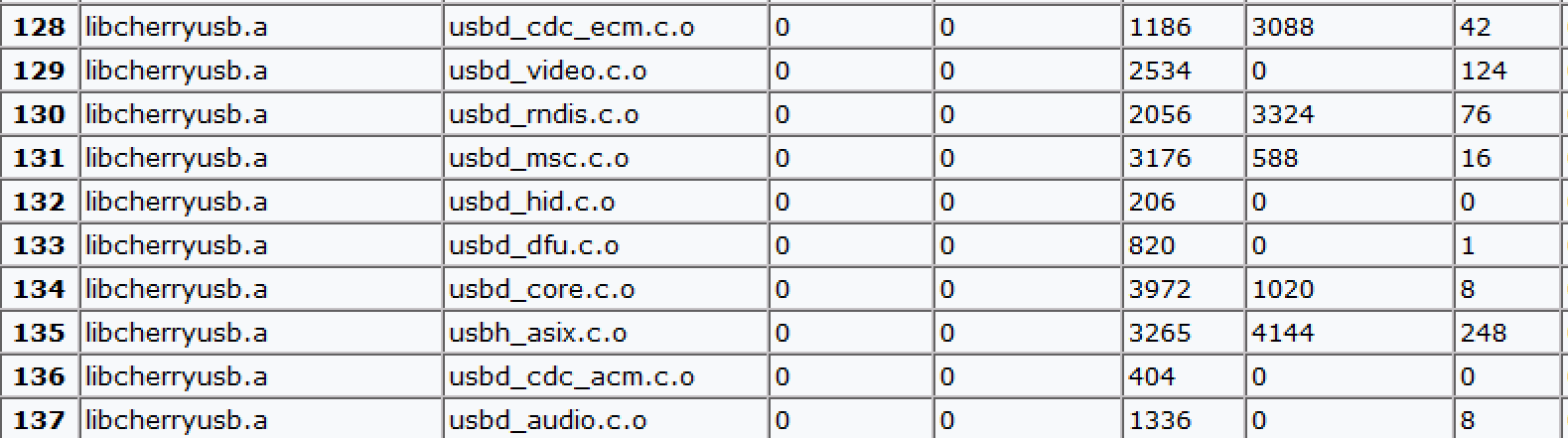
CherryUSB Device Stack resource usage (GCC 10.2 with -O2, disable log):
| file | FLASH (Byte) | No Cache RAM (Byte) | RAM (Byte) | Heap (Byte) |
|---|---|---|---|---|
| usbd_core.c | ~4000 | (512(default) + 320) * bus | 8 | 0 |
| usbd_cdc_acm.c | ~400 | 0 | 0 | 0 |
| usbd_msc.c | ~3200 | (128 + 512(default)) * bus | 16 * bus | 0 |
| usbd_hid.c | ~200 | 0 | 0 | 0 |
| usbd_audio.c | ~1300 | 0 | 8 * bus | 0 |
| usbd_video.c | ~2500 | 0 | 124 * bus | 0 |
| usbd_rndis.c | ~2000 | 2 * 1580(default)+156+8 | 76 | 0 |
| usbd_cdc_ecm.c | ~1500 | 2 * 1514(default)+16 | 42 | 0 |
| usbd_mtp.c | ~9000 | 2048(default)+128 | sizeof(struct mtp_object) * n | 0 |
| usbd_dfu.c | ~800 | 0 | 1 | 0 |
Host Stack Overview
The CherryUSB Host Stack has a standard enumeration implementation for devices mounted on root hubs and external hubs, and a standard interface for different Classes to indicate what the Class driver needs to do after enumeration and after disconnection. A standard hcd porting interface has also been standardised for adapting different USB IPs for IP-oriented programming. Finally, the host stack is managed using os, and provides osal to make a adaptation for different os.
CherryUSB Host Stack has the following functions:
- Support low speed, full speed, high speed and super speed devices
- Automatic loading of supported Class drivers
- Support blocking transfers and asynchronous transfers
- Support Composite Device
- Multi-level HUB support, expandable up to 7 levels(Testing hub with 10 ports works well,only support dwc2/ehci/xhci/rp2040)
- Support Communication Device Class (CDC_ACM, CDC_ECM, CDC_NCM)
- Support Human Interface Device (HID)
- Support Mass Storage Class (MSC)
- Support USB Video CLASS (UVC1.0, UVC1.5)
- Support USB Audio CLASS (UAC1.0)
- Support Remote NDIS (RNDIS)
- Support Device Firmware Upgrade CLASS (DFU)
- Support USB Bluetooth class (support nimble and zephyr bluetooth stack, support CLASS:0xE0 or vendor class like cdc acm)
- Support Vendor Serial Class(CH34X、CP210X、PL2303、FTDI、GSM)
- Support Vendor network Class(RTL8152、AX88772)
- Support USB modeswitch
- Support Android Open Accessory
- Support multi host with the same USB IP
The CherryUSB Host stack also provides the lsusb function, which allows you to view information about all mounted devices, including those on external hubs, with the help of a shell plugin.
CherryUSB Host Stack resource usage (GCC 10.2 with -O2, disable log):
| file | FLASH (Byte) | No Cache RAM (Byte) | RAM (Byte) | Heap (Byte) |
|---|---|---|---|---|
| usbh_core.c | ~4000 | (512(default) + 8 * (1+x) *n) * bus | sizeof(struct usbh_hub) * bus | raw_config_desc |
| usbh_hub.c | ~3000 | (32 + 4 * (1+x)) * bus | 12 + sizeof(struct usbh_hub) * x | 0 |
| usbh_msc.c | ~1500 | 128 * x | 4 + sizeof(struct usbh_msc) * x | 0 |
| usbh_hid.c | ~2000 | 64 * x | 4 + sizeof(struct usbh_hid) * x | 0 |
| usbh_video.c | ~2500 | 128 * x | 4 + sizeof(struct usbh_video) * x | 0 |
| usbh_audio.c | ~4000 | 128 * x | 4 + sizeof(struct usbh_audio) * x | 0 |
| usbh_rndis.c | ~3000 | 512 + 2 * 2048(default) | sizeof(struct usbh_rndis) * 1 | 0 |
| usbh_cdc_ecm.c | ~1500 | 2 * 1514 + 16 | sizeof(struct usbh_cdc_ecm) * 1 | 0 |
| usbh_cdc_ncm.c | ~2000 | 2 * 2048(default) + 16 + 32 | sizeof(struct usbh_cdc_ncm) * 1 | 0 |
| usbh_bluetooth.c | ~1000 | 2 * 2048(default) | sizeof(struct usbh_bluetooth) * 1 | 0 |
| usbh_asix.c | ~3500 | 2 * 2048(default) + 16 |