
cherry is a free, open source gaming project written in Go and released under MIT. It has 818 GitHub stars, 142 forks and 2 open issues, and was last pushed 1 months ago. On this registry it ranks #45 of 46 tracked projects in Gaming, with 5 head-to-head comparisons available.

What is cherry?

Cherry is a Go game server framework built on the Actor Model for teams building MMO, SLG, and RPG backends that need to scale to millions of players across distributed nodes.

What it is

Cherry is a distributed game server framework written in Golang that organises game logic around the Actor Model: every Actor runs on its own goroutine and processes messages serially from independent FIFO queues for local client requests, cross-node remote calls, and system events. It lives in the Go game-server ecosystem and assembles into a running service through a chained Builder API — Register, SetSerializer, AddActors, Startup — with a defined lifecycle of Register → Set → Init → OnAfterInit → OnBeforeStop → OnStop, stopping components in reverse registration order.

The concrete problem it solves is the plumbing a multiplayer backend otherwise has to build by hand: clustered node discovery, cross-node RPC, session handling for connected clients, protocol framing, and garbage-collection pressure under high message volume. It replaces that scattered assembly with pluggable connectors (TCP, WebSocket, HTTP server and client), NATS-backed transport for remote calls, NATS or etcd for membership discovery, and object-pooled messaging that passes messages within a process without serialization at all. Its protocol layer includes a Pomelo-compatible frame (type(1b) + length(3b) + data) alongside a lighter Simple format (id(4b) + dataLen(4b) + data).

Key capabilities

  • Three switchable discovery backends selected from the profile: default for single-process development, nats for master/slave heartbeat discovery, and etcd using lease + watch for multi-node production.
  • Cross-node RPC over NATS with synchronous and asynchronous invocation and configurable timeouts, plus discovery APIs such as Map(), ListByType("game"), Random("gate"), UpdateSetting(), and OnAddMember / OnRemoveMember callbacks.
  • Four built-in connectors — TCP, WebSocket, HTTP Server, and HTTP Client — with a protocol parser and session management layer that handles agent Actors on frontend nodes.
  • Zero-allocation message passing via a sync.Pool message pool with reference counting, Protobuf as the default serializer with JSON also supported, and automatic ClusterPacket encoding for cross-node messages.
  • Actor-level features including child Actors that share their parent's lifecycle and route through it, plus timers and scheduled tasks that execute on the Actor's own goroutine.
  • An Extend library of 21 utility packages, including a layered time_wheel scheduler, snowflake for distributed unique IDs, nuid, compress, crypto, gob, mapstructure, and a cached regex.
  • Lifecycle hooks driven by SIGINT, SIGQUIT, and SIGTERM for graceful shutdown, with tiered error codes covering sessions (10+) and RPC failures (20+).

Who uses it and how

  • Backend teams shipping MMO, SLG, or RPG titles that need multiple node types — frontend gate nodes receiving client connections and backend game nodes behind them — clustered together.
  • Studios moving off Pomelo, since the built-in Pomelo wire format keeps existing multi-platform client SDKs working against the new server.
  • Operators running multi-node production deployments on NATS or etcd discovery, where members join and leave at runtime and settings are broadcast automatically to all nodes.
  • Developers working single-process in local development, using the default discovery mode and a profile file such as etc/profile/dev.json with no cluster infrastructure.
  • Teams concerned with GC behaviour at scale, using the object-pooled message path and Protobuf serialization to reduce allocation under sustained message load.

Getting started

Install with go get github.com/cherry-game/cherry (Go 1.24+ is required), then start an app with cherry.Configure("etc/profile/dev.json", "game-1", true, cherry.Cluster).Startup(); full documentation is available at https://cherry-game.github.io.

How it compares

Cherry sits alongside Pomelo and Pitaya as a choice for Node developers who want the same cluster-and-connector model implemented in Go, and its Pomelo-compatible framing is the clearest bridge between them. Among the tools named in its own topic list it is the one built explicitly on Go's Actor Model with per-actor goroutines and NATS/etcd discovery, rather than on a different runtime or transport.

When to use it — and when not

A team adopting Cherry must be prepared to operate NATS (and, if chosen, an etcd instance) alongside their game nodes, and to manage profile configuration and node IDs across the cluster. It is a poor fit for teams that only need a single-process server, that are already committed to a non-Go stack, or that depend heavily on English-language documentation, since the README is largely Chinese with the English version in a separate README.en.md. Note also that etcd discovery is delivered from a separate repository rather than the main module.

project readme (upstream, from github) — read inline

🍒 欢迎使用 cherry!

cherry logo cherry license go version cherry tag

🌐 English Documentation

  • 高性能分布式的 Golang 游戏服务器框架
  • 采用 Golang + Actor Model 构建,具备高性能、可伸缩等特性
  • 简单易学,让开发者更专注于游戏业务开发

📦 安装

go get github.com/cherry-game/cherry

需要 Go 1.24+。

🚀 快速开始

package main

import (
    cherry "github.com/cherry-game/cherry"
)

func main() {
    app := cherry.Configure(
        "etc/profile/dev.json", // profile 路径
        "game-1",               // 节点 ID
        true,                   // 是否前端节点(接收客户端连接)
        cherry.Cluster,         // 集群模式
    )
    app.Startup()
}

🗺️ 架构
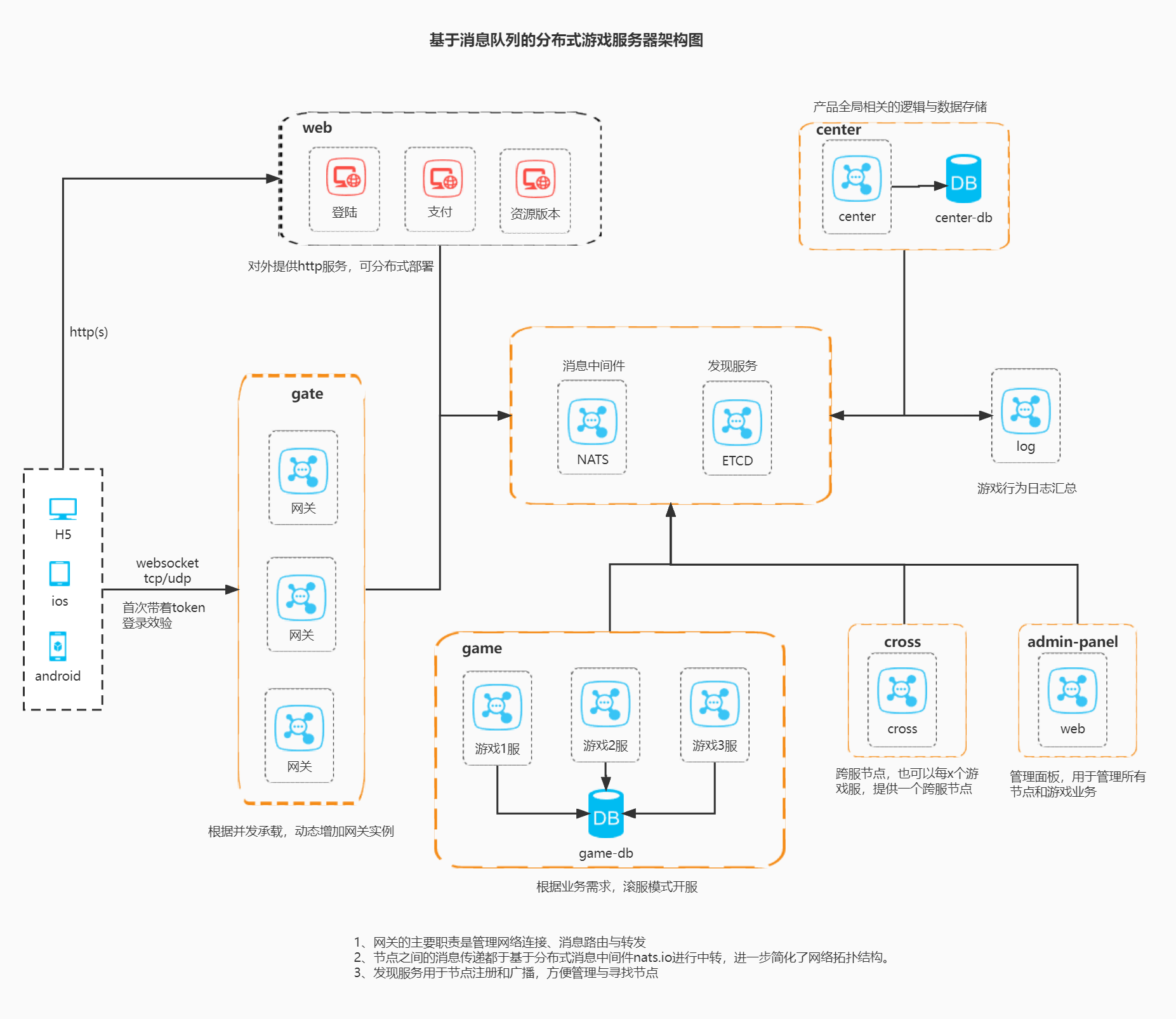
game-server-architecture

模块 路径 职责
应用装配 cherry.go → application.go 组件注册、生命周期、启动
Actor 执行 net/actor/ 每 Actor 独立 goroutine,串行 mailbox,本地/远程/事件分发
集群通信 net/cluster/ + net/nats/ + net/discovery/ 跨节点 RPC,NATS 传输,成员发现
前端接入 net/parser/ + net/connector/ 协议解码,会话管理,agent Actor,WebSocket/TCP

🌟 核心功能

AppBuilder 与生命周期

通过 Builder API 将组件链式装配为运行中的服务:

cherry.Configure("etc/profile/dev.json", "game-1", true, cherry.Cluster).
    Register(myComponent).
    SetSerializer(cherryFacade.NewProtobuf()).
    AddActors(myActor).
    Startup()

生命周期保证:

Register → Set → Init → OnAfterInit → (运行中) → OnBeforeStop → OnStop

组件按注册的逆序停止。通过 SIGINT / SIGQUIT / SIGTERM 信号触发优雅关闭。

Actor 模型

每个 Actor 运行于独立 goroutine,逻辑串行处理。三种独立队列按 FIFO 原则消费:

队列 来源 用途
Local 客户端 → Actor 处理玩家请求
Remote Actor → Actor(跨节点) 服务间 RPC
Event 系统事件 解耦通知
type MyActor struct {
    capp.ActorLogger
}

func (p *MyActor) OnInit() {
    p.Local().Register("myHandler", p.handle)
    p.Remote().Register("myRemote", p.remote)
    p.EventRegister("eventName", p.onEvent)
}

func (p *MyActor) handle(session *cproto.Session, req *pb.MyReq) {
    p.Response(session, &pb.MyResp{Value: "ok"})
}

子 Actor — Actor 可创建子 Actor,消息由父 Actor 路由转发,子 Actor 与父 Actor 共享生命周期。

Actor Timer — 直接在 Actor 上注册定时器和定时任务,保证在 Actor 的 goroutine 上执行。

集群 & 注册发现

三种发现后端,通过 profile 配置切换:

模式 配置值 适用场景
default 从 profile 配置读取 单进程开发/测试
nats NATS 主从心跳发现 多节点生产环境
etcd etcd lease + watch 多节点生产环境(独立仓库)
discovery := app.Discovery()

// 成员查询
all := discovery.Map()
games := discovery.ListByType("game")
member, ok := discovery.Random("gate")

// Settings 同步(自动广播到所有节点)
discovery.UpdateSetting("region", "us-east")

// 成员变更回调
discovery.OnAddMember(func(m IMember) {
    // 新节点加入
})
discovery.OnRemoveMember(func(m IMember) {
    // 节点离开
})

基于 NATS 实现跨节点 RPC 调用,支持同步/异步方式,可配置超时时间。

连接器 & 协议

内置连接器:

  • TCP — 原生 Socket
  • WebSocket — 浏览器客户端
  • HTTP Server — REST API
  • HTTP Client — 对外请求

两种协议格式:

协议 格式 适用场景
Pomelo type(1b) + length(3b) + data 兼容 pomelo 各平台客户端
Simple id(4b) + dataLen(4b) + data 自定义轻量协议

消息 & 序列化

基于对象池的零分配消息传递:

msg := cherryFacade.GetMessage()
msg.Source = "game-1.player-100"
msg.Target = "map-1.aoi"
msg.FuncName = "enter"
msg.Args = myPayload
  • sync.Pool 消息池 + 引用计数,减少 GC 压力
  • 默认 Protobuf 序列化,同时支持 JSON
  • 同进程消息免序列化直传;跨节点消息通过 ClusterPacket 自动编解码

Extend 工具库

框架内置 21 个工具包:

分类 包
时间 time_wheel(分层时间轮),time(辅助函数、时间偏移、时间旅行)
ID 生成 snowflake(分布式唯一 ID),nuid
数据处理 compress(zlib),crypto(MD5、CRC32、Base64),gob,json
集合 map,slice,queue,string
基础设施 file,http/client,net,sync(限流器)
反射 reflect,mapstructure,regex(带缓存)
编码 base58
// 时间轮 — 调度器、超时、延迟执行
tw := cherryTimeWheel.NewTimeWheel(time.Millisecond*10, 20)
tw.AfterFunc(time.Second, func() { /* ... */ })

// Snowflake 唯一 ID
node, _ := cherrySnowflake.NewNode(1)
id := node.Generate()

错误码

框架内置分层错误码:

if code.IsFail(errCode) {
    p.ResponseCode(session, errCode)
    return
}

预定义错误码:OK(0),会话错误(10+),RPC 错误(20+),Actor 错误(24+)。

日志

基于 uber-go/zap 封装:

  • 结构化日志,支持键值对输出
  • 多文件输出 + 日志切割
  • 可配置日志级别和堆栈跟踪级别
  • 控制台与文件可同时输出

🧰 扩展组件

已开放组件

组件 说明
data-config 策划配表读取管理,支持多种加载方式及数据查询
etcd 基于 etcd 的集群注册发现
gin 集成 gin 实现 HTTP server,支持中间件
gorm MySQL 数据库访问,支持多数据库配置
mongo MongoDB 访问,支持多数据库配置
cron 基于 robfig/cron 的定时任务

仓库地址:cherry-game/components

待开放组件

DB 写队列、gopher-lua 脚本、限流组件等

📖 示例

单节点精简版聊天室

适合新手熟悉项目,具备以下特性:

  • 基于网页客户端,构建 HTTP 服务器
  • 采用 WebSocket 作为连接器
  • 使用 JSON 作为通信格式
  • 实现创建房间、发送消息、广播消息等功能

源码位置:examples/demo_chat

多节点分布式游戏示例

适合作为基础框架构建游戏服务端,特性如下:

  • 基于 H5 构建客户端
  • 搭建 Web 服、网关服、中心服、游戏服等节点
  • 实现区服列表、多 SDK 帐号体系、帐号注册、登录、创建角色等功能

源码位置:examples/demo_cluster

准备步骤详见:环境安装与配置

🎮 游戏客户端 SDK

兼容 pomelo 协议的客户端均可接入 Cherry。

协议格式:协议结构图、pomelo wiki 协议格式

💬 讨论与交流

🙏 致谢

  • pomelo — 初代 Node.js 游戏服务端框架
  • pitaya — Go 游戏服务端框架

Frequently asked questions

Is cherry free to use?

cherry is open source under the MIT licence. There is no licence fee and no seat count — you can self-host it or, where the project offers one, pay a vendor for a managed version instead.

What does cherry do?

🍒 Cherry — Go game server framework powered by Actor Model. Serial goroutine per actor, NATS/etcd discovery, pluggable connectors (TCP/WS/HTTP), protobuf & obj

What is cherry written in?

cherry is primarily written in Go. Its source is publicly available at https://github.com/cherry-game/cherry, and it has 818 GitHub stars.