Chainloop



What is it?
Chainloop is an open-source evidence store for your Software Supply Chain attestations, Software Bill of Materials (SBOMs), VEX, SARIF, QA reports, and more. With Chainloop, Security, Compliance, and Risk management teams can define security and compliance policies, what evidence and artifacts they want to receive, and where to store them. On the other hand, developers are shielded from all this complexity by being given simple instructions on what to provide when instrumenting their CI/CD pipelines.
To learn more about the project motivation please look at our documentation.
How does it work?
Compliant Single Source of Truth
Craft and store attestation metadata and artifacts via a single integration point regardless of your CI/CD provider choice.
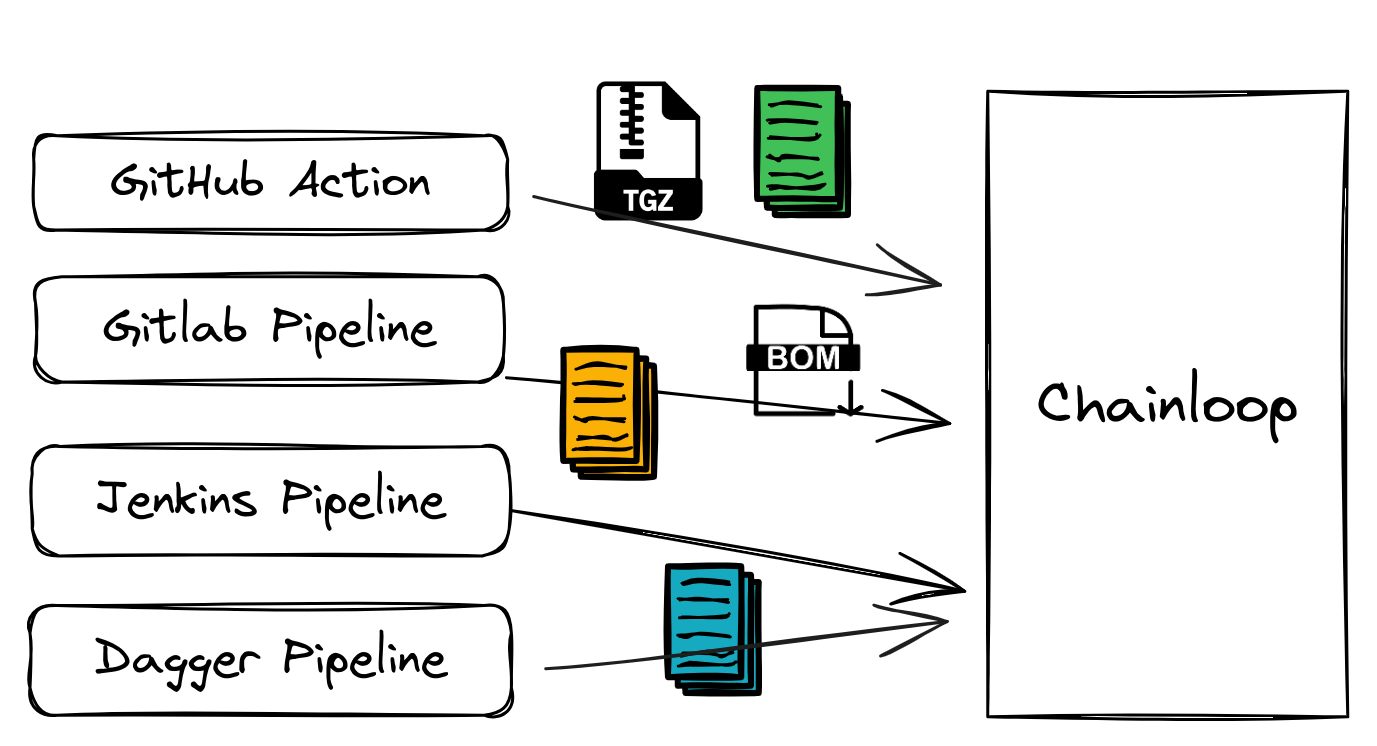
The result is having a SLSA level 3 compliant single Source of truth for metadata, artifacts and attestations built on OSS standards such as Sigstore, in-toto, SLSA and OCI.
Chainloop also makes sure the crafting of artifacts and attestation follows best practices and meets the requirements declared in their associated Workflow Contract.
Declarative, contract-based attestation
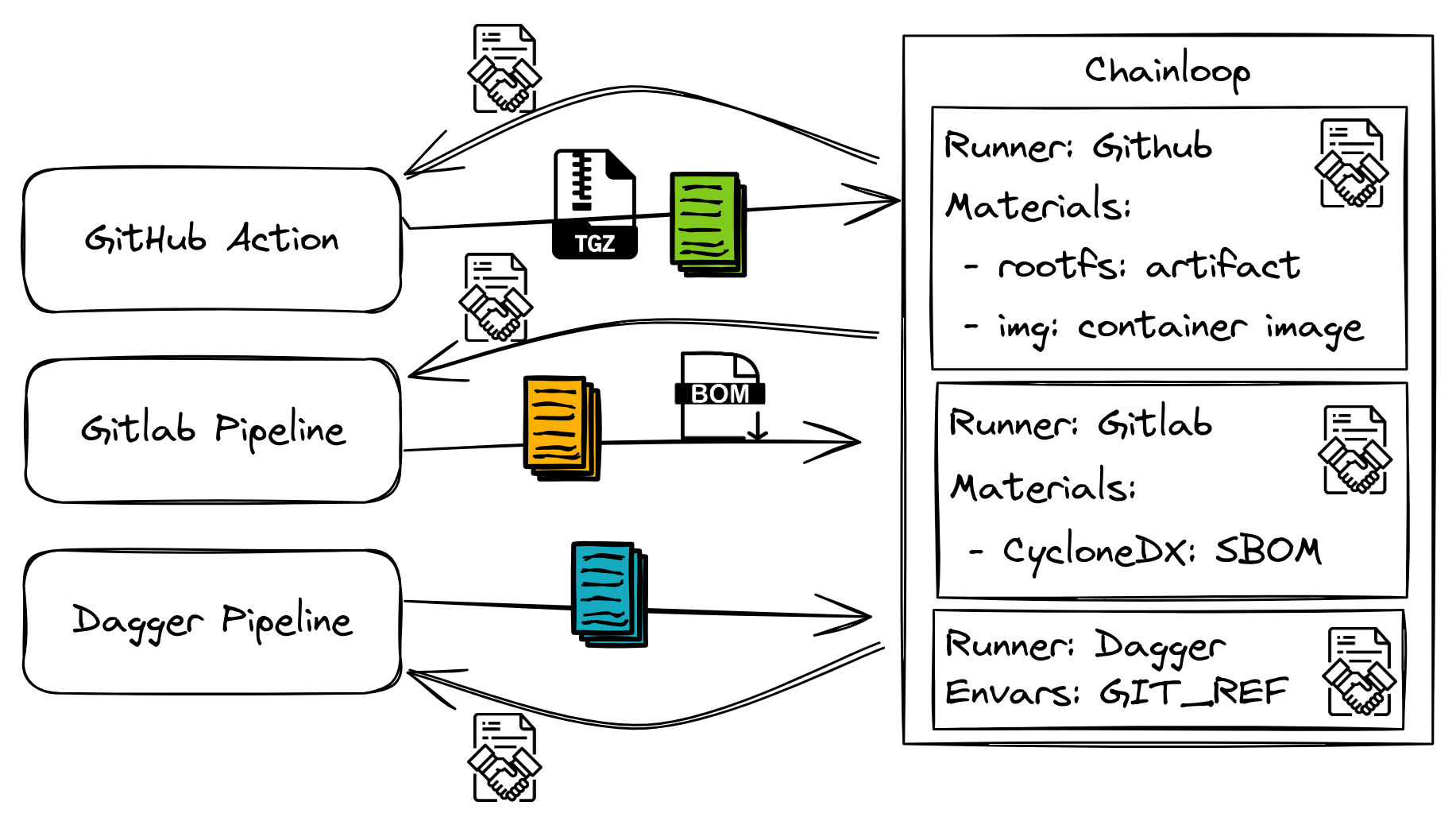
One key aspect is that in Chainloop, CI/CD integrations are declared via Workflow Contracts.
A Workflow Contract gives Compliance and Security teams full control over what kind of data (build info, materials) must be received as part of the attestation and the environment where these workflows must be executed at. This enables an easy, and maintainable, way of propagating and enforcing requirements downstream to your organization.
You can think of it as an API for your organization's Software Supply Chain that both parties, development and Compliance and Security teams can use to interact effectively.
Policy as code
Compliance and Security teams can craft Rego policies, and attach them to workflow contracts. Those policies will be automatically evaluated, and their results will be added to the attestation before signing and storage.
We meet you where you are with third-party integrations
Operators can set up third-party integrations such as Dependency-Track, or Guac for SBOM analysis or a storage backend such as an OCI registry, or cloud blob storage to place the received artifacts, pieces of evidence and attestation metadata.
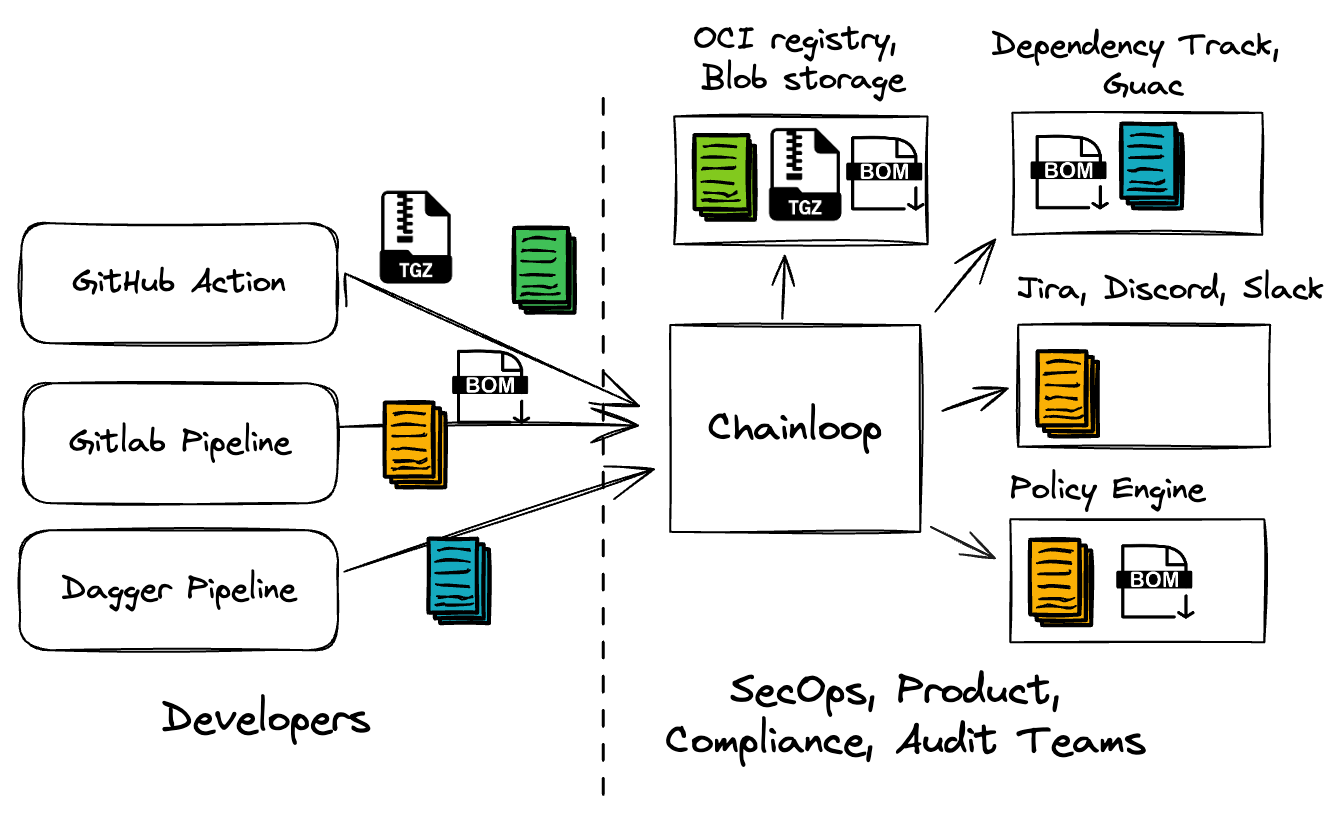
Compliance and Security teams can mix and match with different integrations while not requiring developers to make any changes on their side!
To learn more and to find the list of available integrations, check our integrations page.
Role-tailored experience
Chainloop makes sure to clearly define the responsibilities, experience and functional scope of the two main personas, Compliance/Security and Development teams.
Compliance and Security teams are the ones in charge of defining the Workflow Contracts, crafting policies, setting up third-party integrations, or having access to the control plane where all the Software Supply Chain Security bells and whistles are exposed.
Development teams on the other hand, just need to integrate Chainloop's jargon-free crafting tool and follow the steps via a familiar DevExp to make sure they comply with the Workflow Contract defined by the SecOps team. No need to learn in-toto, signing, SLSA, OCI, APIs, nada :)
Supported Pieces of Evidence / Materials
During the attestation process, you can attach different pieces of evidence and artifacts that will get uploaded to the Content Addressable Storage (if applicable) and referenced in a signed in-toto attestation.
Chainloop supports the collection of the following list of evidence types. For the full list please refer to this page
- Key-Value metadata pairs
- Container Image Reference
- Artifact Type: It represents a software artifact.
- CycloneDX SBOM
- SPDX SBOM
- JUnit
- OpenVEX
- CSAF VEX
- SARIF
- Helm Chart
- Custom Evidence Type: Custom piece of evidence that doesn't fit in any other category, for instance, an approval report in json format, etc.
- Attestation: existing Chainloop attestations.
- CSAF Informational Advisory
- CSAF Security Advisory
- CSAF Security Incident Report
- Gitlab Security report
- ZAP DAST
- BlackDuck SCA
- PrismaCloud Twistcli Scan
- GitHub Advanced Security Code Scan
- GitHub Advanced Security Secret Scan
- GitHub Advanced Security Dependency Scan
- JaCoCo XML Coverage Reports
- SLSA Provenance files
- Chainloop Runner Context: automatically collected runner metadata.
- Chainloop Pull Request Info: pull/merge request metadata collected automatically during attestation.
- Gitleaks JSON Report
- Chainloop AI Agent Config: AI agent configuration collected automatically during attestation.
- Chainloop AI Coding Session: AI coding session telemetry collected during attestation.
- OpenAPI Specification
- AsyncAPI Specification
- GraphQL SDL Schema
- detect-secrets Baseline
- Sysinternals Sigcheck (CSV)
- Sysinternals AccessChk (text)
- CERT/CC dranzer Report
- OpenSSF Scorecard (JSON)
- radamsa Metadata Log
- radamsa Crashing Inputs: a single file or a
crashes/archive (tar.gz or zip). - TruffleHog JSONL Report
- Cobertura Coverage Report (XML)
- Checkmarx One JSON Report
- [Oversecured JSON Repo