Centrifugo is an open-source, language-agnostic real-time messaging server that delivers messages to online users over WebSocket, HTTP-streaming, Server-Sent Events, GRPC, and WebTransport, and it is built for teams that want user-facing PUB/SUB without writing and operating the transport layer themselves.
What it is
Centrifugo is a scalable real-time messaging server written in Go and licensed under Apache-2.0. It is a PUB/SUB server built on top of modern real-time transports, with the concept of channel subscriptions at its core, which makes it a user-facing PUB/SUB server rather than a raw message broker. A backend application communicates with Centrifugo over a simple HTTP or GRPC server API to publish messages into channels, while clients subscribe to those channels using one of the official SDKs or through a unidirectional approach that carries no SDK dependency. The project is language-agnostic by design, so it can sit beside any backend stack, and it deliberately decouples business logic from the real-time transport layer. In this registry it is filed under Infrastructure & Operations / Databases.
The concrete problem it solves is that making PUB/SUB production-ready is the hard part: it has to be efficient, flexible, and reachable from many different application environments. Instead of wiring custom WebSocket handling, subscription tracking, reconnection recovery, and permission checks into every product, a team runs Centrifugo once and lets its backend publish into channels. It replaces that self-built plumbing, and it is positioned as a self-hosted alternative to Pubnub, Pusher, Ably, socket.io, Phoenix.PubSub, and SignalR, so real-time features such as chat, live comments, multiplayer games, real-time data visualizations, collaborative tools, and AI streaming responses can be added without owning the transport machinery.
Key capabilities
- Efficient real-time transports: WebSocket, HTTP-streaming, Server-Sent Events (EventSource), GRPC, and WebTransport, which is marked experimental.
- Built-in scalability with Redis, Redis Cluster, or Redis-compatible storage such as AWS ElastiCache, Valkey, KeyDB, and DragonflyDB, plus PostgreSQL or Nats.
- Simple HTTP and GRPC server API so the application backend can publish into channels from any language.
- Asynchronous PostgreSQL and Kafka consumers that support transactional outbox and CDC patterns.
- Flexible connection authentication through JWT or proxy-like authentication, where Centrifugo issues a request to the backend.
- Rich subscription model covering stream (client-side and server-side), map, shared poll, and proxy subscription streams, with channel subscription multiplexing over a single connection.
- Hot message history in channels with automatic message recovery on reconnect and cache recovery mode, which delivers the latest publication immediately upon subscription.
- Delta compression in channels based on the Fossil algorithm, online channel presence with join and leave information, channel namespaces, and various channel permission strategies.
Who uses it and how
- Product teams adding chat, live comments, or collaborative editing to an existing application, where the backend keeps business logic and Centrifugo handles fan-out to connected clients.
- Game and simulation developers pushing real-time state to many concurrent connections, using Redis or Nats behind multiple Centrifugo nodes.
- Backends that need transactional outbox or CDC delivery, using the asynchronous PostgreSQL and Kafka consumers rather than publishing directly.
- Teams standardizing on one real-time server across several services and languages, since the HTTP and GRPC API and the official SDKs are language-agnostic.
- Operators who want to watch live connections and publish into channels during development through the embedded admin UI.
Getting started
The README quick start runs the centrifugo/centrifugo:latest Docker image, for example docker run -it --rm -p 8000:8000 centrifugo/centrifugo:latest centrifugo --client.insecure --admin.enabled --admin.insecure, then opens http://localhost:8000 for the admin UI. The insecure flags exist only for a frictionless local trial and must never be used in production; native binaries, Homebrew, and packages are covered in the installation instructions, followed by the quickstart tutorial for connecting a first client.
How it compares
Centrifugo is described as a self-hosted alternative to Pubnub, Pusher, and Ably, so the difference is licence and control rather than feature parity: those are hosted services, while Centrifugo is Apache-2.0 software that a team runs on its own infrastructure, which keeps message data inside that infrastructure and turns the cost model into self-operated infrastructure rather than a hosted subscription. Against socket.io, Phoenix.PubSub, and SignalR it is not a library bound to one runtime or framework but a standalone server with an HTTP and GRPC API, multiple transports, and Redis, PostgreSQL, or Nats based scaling.
When to use it — and when not to
A self-hoster must operate Centrifugo itself along with the scaling and history layer it is pointed at, which means Redis, Redis Cluster, or Redis-compatible storage, or PostgreSQL or Nats, and production connection authentication requires JWT or a proxy-like request to the backend. The quick start flags shown above disable authentication and are explicitly for local trial only, so anyone unwilling to configure real authentication and a shared broker should not pick it for production. The README excerpt available in this registry entry is truncated mid-sentence, and WebTransport is still experimental, so the installation and quickstart documentation at centrifugal.dev remains the authoritative source.
project readme (upstream, from github) — read inline
Centrifugo
Scalable real-time messaging server in a language-agnostic way.






Centrifugo is an open-source scalable real-time messaging server. It instantly delivers messages to application online users connected over supported transports (WebSocket, HTTP-streaming, Server-Sent Events (aka EventSource), GRPC, WebTransport). Centrifugo has the concept of channel subscriptions – so it's a user-facing PUB/SUB server.
Centrifugo is language-agnostic and can be used to build chat apps, live comments, multiplayer games, real-time data visualizations, collaborative tools, AI streaming responses, etc. in combination with any backend. It is well suited for modern architectures and allows decoupling the business logic from the real-time transport layer.
The core idea of Centrifugo is simple – it's a PUB/SUB server on top of modern real-time transports:
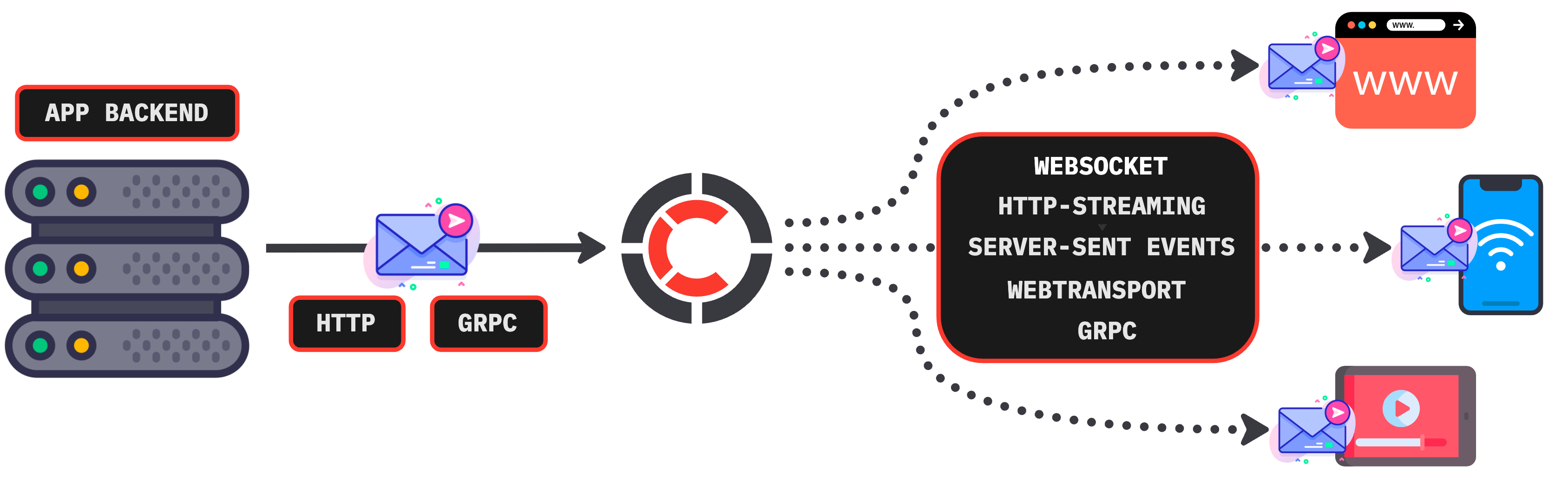
Your backend communicates with Centrifugo over a simple HTTP or GRPC API to publish messages into channels, while clients subscribe to those channels using one of the official SDKs (or the unidirectional approach with no SDK dependency).
Quick start
Spin up Centrifugo with its embedded admin UI using Docker:
docker run -it --rm -p 8000:8000 centrifugo/centrifugo:latest centrifugo \
  --client.insecure --admin.enabled --admin.insecure
# ^ insecure flags: for local trial only, never use in production
Then open http://localhost:8000 to reach the admin UI, where you can watch live connections and publish messages into channels. The insecure flags above remove authentication for a frictionless local trial only – never use them in production.
For native binaries, Homebrew, packages, and production configuration see the installation instructions, and follow the quickstart tutorial to connect your first client.
Why Centrifugo
The hard part is to make the PUB/SUB concept production-ready, efficient, flexible and available from different application environments. Centrifugo is a mature solution that already helped many projects with adding real-time features and scaling towards many concurrent connections. It provides a set of features not available in other open-source solutions in the area:
- Efficient real-time transports: WebSocket, HTTP-streaming, Server-Sent Events, GRPC, WebTransport (experimental)
- Built-in scalability with Redis (or Redis Cluster, or Redis-compatible storage – ex. AWS Elasticache, Valkey, KeyDB, DragonflyDB, etc), PostgreSQL or Nats.
- Simple HTTP and GRPC server API to communicate with Centrifugo from the app backend
- Asynchronous PostgreSQL and Kafka consumers to support transactional outbox and CDC patterns
- Flexible connection authentication mechanisms: JWT and proxy-like (via request from Centrifugo to the backend)
- Channel subscription multiplexing over a single connection
- Rich subscription model: stream (client-side and server-side), map, shared poll, and proxy subscription streams
- Various channel permission strategies, channel namespace concept
- Hot message history in channels, with automatic message recovery upon reconnect, cache recovery mode (deliver latest publication immediately upon subscription)
- Delta compression in channels based on Fossil algorithm
- Online channel presence information, with join/leave notifications
- A way to send RPC calls to the backend over the real-time connection
- Strict and effective client protocol wrapped by several official SDKs
- JSON and binary Protobuf message transfer, with optimized serialization and built-in batching
- Beautiful embedded admin web UI
- Great observability with lots of Prometheus metrics exposed and official Grafana dashboard
- And much more, visit Centrifugo documentation site
Client SDKs
Official SDKs wrap Centrifugo's bidirectional protocol and handle reconnects, subscription state, message recovery, and more across platforms:
For simple use cases Centrifugo also supports a unidirectional approach (WebSocket, SSE, HTTP-streaming, GRPC) that needs no SDK – any standard client for the transport works. See the transports overview and the client protocol spec for details.
Documentation
Community
Found a bug or have an idea? Open an issue.
Want to contribute? See CONTRIBUTING.md.
Backing
This repository is hosted by packagecloud.io.

Also thanks to JetBrains for supporting OSS (most of the code here written in Goland):