CCPM – The Project Manager Agent






Spec-driven development for AI agents – ship faster better using PRDs, GitHub issues, and multiple agents running in parallel.
Stop losing context. Stop blocking on tasks. Stop shipping bugs. CCPM gives your AI agent a structured PM brain: turn ideas into PRDs, PRDs into epics, epics into GitHub issues, and issues into production code — with full traceability at every step.
[!IMPORTANT] 📢 CCPM is now an AGENT SKILL! It works with any Agent Skills–compatible harness that supports skills: Claude Code, Codex, OpenCode, Factory, Amp, Cursor, and more.
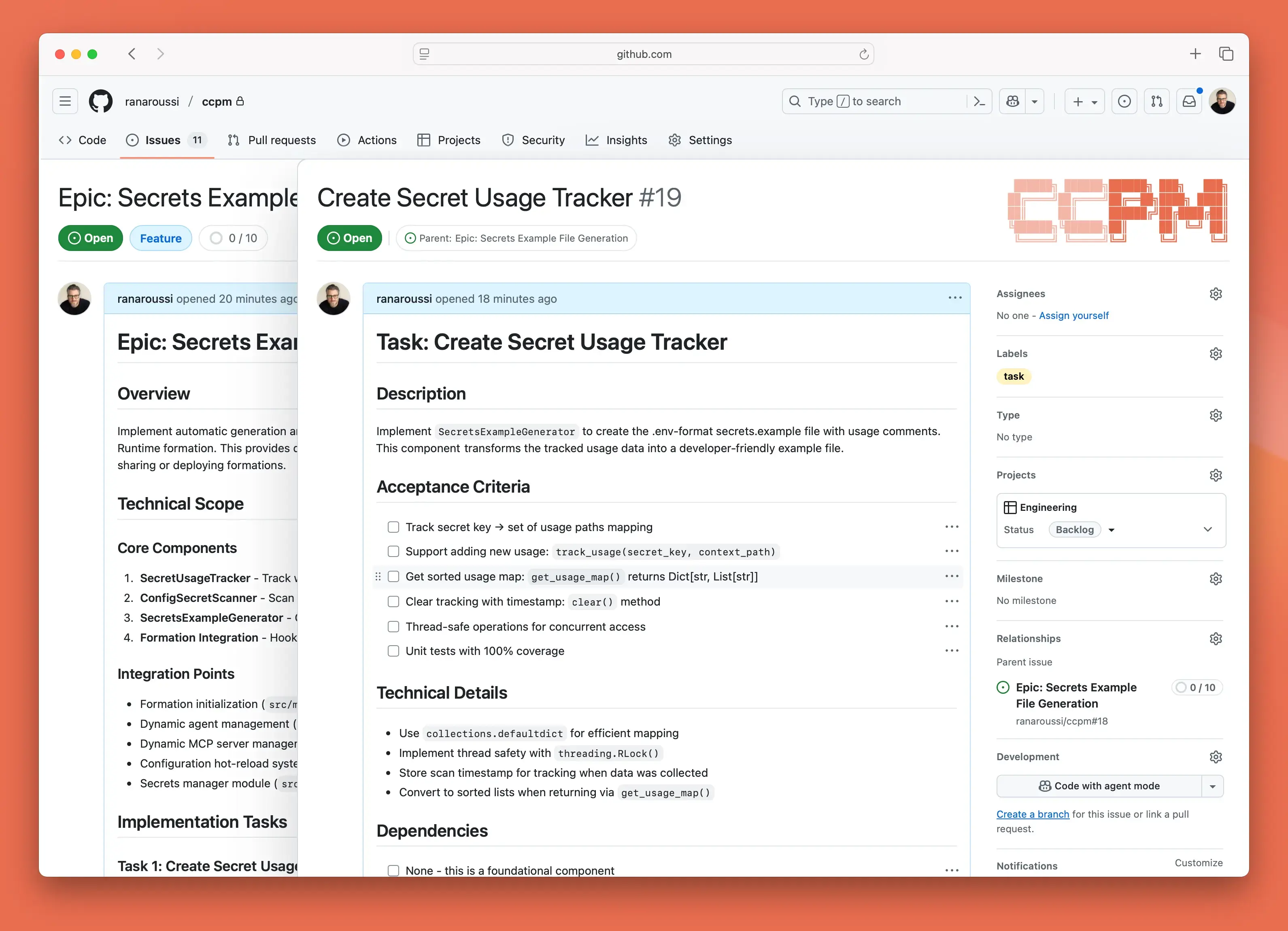
Table of Contents
- Background
- The Workflow
- What Makes This Different
- Why GitHub Issues
- Core Principle: No Vibe Coding
- The Parallel Execution System
- Key Features & Benefits
- Install
- Usage
- Workflow Phases
- Skill Structure
- Example Flow
- Proven Results
- Local vs Remote
- Technical Notes
- Who's Behind this Project
[!NOTE] Check out proof to get your agents capture visual proof of work of terminal output, browser interactions, and mobile simulator recordings.
Background
Every team struggles with the same problems:
- Context evaporates between sessions, forcing constant re-discovery
- Parallel work creates conflicts when multiple agents touch the same code
- Requirements drift as verbal decisions override written specs
- Progress becomes invisible until the very end
CCPM solves all of that.
The Workflow
graph LR
    A[PRD Creation] --> B[Epic Planning]
    B --> C[Task Decomposition]
    C --> D[GitHub Sync]
    D --> E[Parallel Execution]
See It In Action
"I want to build a notification system — where do we start?"
→ Guided brainstorming + PRD creation

"break down the notification-system epic"
→ Parallelizable task files with dependencies

"sync the notification-system epic to GitHub"
→ Epic issue + sub-issues + worktree

"start working on issue 42"
→ Parallel stream analysis + multiple agents launched

"what's our standup for today?"
→ Instant report from project files
What Makes This Different
| Traditional AI Development | CCPM |
|---|---|
| Context lost between sessions | Persistent context across all work |
| One agent, one task | Parallel agents on independent streams |
| Vibe coding from memory | Spec-driven with full traceability |
| Progress hidden in chat logs | Transparent audit trail in GitHub |
| Scattered status updates | Structured standup, blocked, next |
Why GitHub Issues
Most AI coding workflows operate in isolation — a single session with no shared state. CCPM uses GitHub Issues as the source of truth, which unlocks something fundamentally different:
Team collaboration — multiple agents (or humans) work on the same project simultaneously. Progress is visible in real-time through issue comments.
Seamless handoffs — an agent can start a task, a human can finish it, or vice versa. No "what did the AI do?" meetings.
Single source of truth — no separate databases or project management tools. Issue state is project state. Comments are the audit trail.
Works with what you have — no dependency on GitHub Projects. Integrates with existing labels, milestones, and PR workflows.
Core Principle: No Vibe Coding
Every line of code must trace back to a specification.
CCPM enforces a strict 5-phase discipline:
- 🧠 Brainstorm — think deeper than comfortable
- 📝 Document — write specs that leave nothing to interpretation
- 📐 Plan — architect with explicit technical decisions
- ⚡ Execute — build exactly what was specified
- 📊 Track — maintain transparent progress at every step
No shortcuts. No assumptions. No regrets.
The Parallel Execution System
Issues Aren't Atomic
Traditional thinking: one issue = one agent = one task
Reality: a single "Implement user authentication" issue is actually:
- Agent 1: Database tables and migrations
- Agent 2: Service layer and business logic
- Agent 3: API endpoints and middleware
- Agent 4: UI components and forms
- Agent 5: Test suites and documentation
All running simultaneously in the same worktree.
The Math of Velocity
| Approach | Agents working | Wall time |
|---|---|---|
| Traditional (serial) | 1 | 5x |
| CCPM (parallel streams) | 5 | 1x |
Context Stays Clean
Each agent handles its own context in isolation. Your main conversation becomes the conductor — it never drowns in implementation details. Agents read from .claude/epics/ and commit progress back through Git.
Key Features & Benefits
🧠 Context preservation — project state lives in files, not in your head or chat history. Start a session anywhere, any time.
⚡ Parallel execution — tasks marked parallel: true run concurrently across multiple agents without conflicts.
🔗 GitHub native — works with tools your team already uses. No dependency on the Projects API.
📊 Full traceability — every decision documented. PRD → Epic → Task → Issue → Code → Commit.
🤖 Deterministic ops run as scripts — status, standup, search, validate all run as bash scripts: fast, consistent, no LLM token cost.
🌐 Harness-agnostic — follows the agentskills.io open standard. Works with Factory, Claude Code, Amp, OpenCode, Codex, Cursor, and more.
Install
CCPM is a standard Agent Skill. Point your harness at skill/ccpm/ — that's it.
Clone the repo
git clone https://github.com/automazeio/ccpm.git
Factory / Droid
# Symlink into your skills directory
ln -s /path/to/ccpm/skill/ccpm ~/.factory/skills/ccpm
Claude Code
In your project root, add a skills/ directory and symlink or copy the skill:
ln -s /path/to/ccpm/skill/ccpm .claude/skills/ccpm
Any other Agent Skills–compatible harness
Point it at skill/ccpm/. It follows the agentskills.io standard and works out of the box.
Prerequisites
gitandghCLI (authenticated:gh auth login)- A GitHub repository for your project
Usage
CCPM activates automatically when your agent detects PM intent. Just talk naturally — no special syntax needed.
Natural language triggers
| What you say | What happens |
|---|---|
| "I want to build X" / "let's plan X" | Brainstorming + PRD creation |
| "parse the X PRD" / "create an epic for X" | PRD → technical epic |
| "break down the X epic" | Epic decomposition into tasks |
| "sync the X epic to GitHub" | Issues created, worktree set up |
| "start working on issue N" | Analysis + parallel agents launched |
| "standup" / "what's our status" | Bash script runs instantly |
| "what's next" / "what's blocked" | Priority queue from project files |
| "close issue N" | Local + GitHub updated |
| "merge the X epic" | Tests, merge, cleanup |
Workflow Phases
1. Plan — Capture requirements
"I want to build a notification system — push, email, and in-app"
CCPM conducts guided brainstorming before writing anything. It asks about the problem, users, success criteria, constraints, and what's out of scope — then creates a structured PRD at .claude/prds/.md.
When ready: "parse the notification-system PRD" → produces a technical epic at .claude/epics/notification-system/epic.md with architecture decisions, technical approach, and task preview.
2. Structure — Break it down
"break down the notification-system epic into tasks"
Each task gets a file with acceptance criteria, effort estimate, depends_on, parallel, and conflicts_with metadata. Tasks are intelligently batched for parallel creation. ≤10 tasks per epic by default.