
cartcut is a free, open source photo & video editors project written in TypeScript and released under MIT. It has 755 GitHub stars, 70 forks and 6 open issues, and was last pushed 16 hours ago. On this registry it ranks #43 of 44 tracked projects in Photo & Video Editors, with 5 head-to-head comparisons available.

What is cartcut?

CartCut is an MIT-licensed, TypeScript and Electron desktop video editor for AI agents, built on the belief that open source can beat commercial tools, and aimed at creators who want layer-based motion-graphics editing on their own machine.

What it is

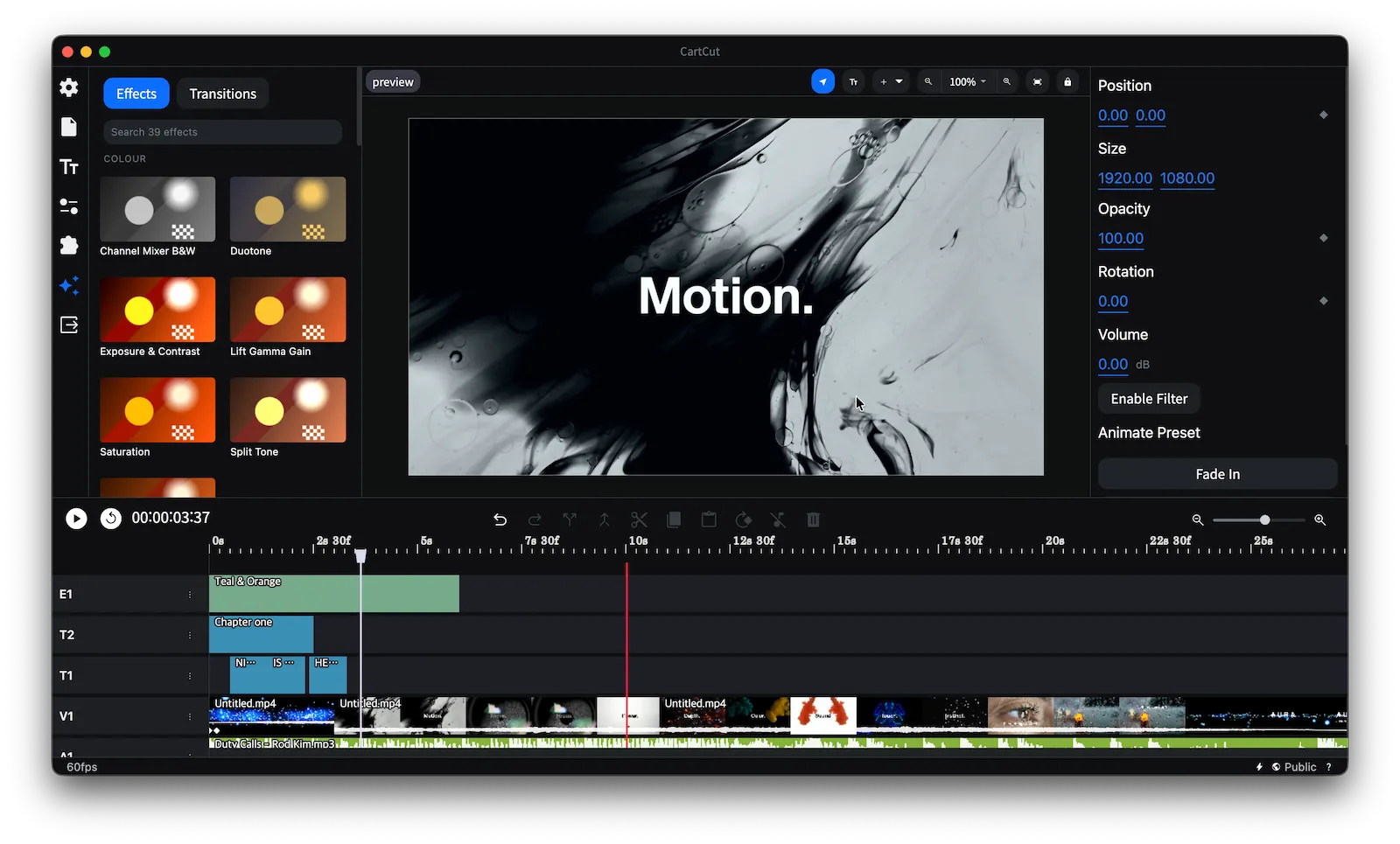
CartCut is a cross-platform video editor for motion effects and versatility, written in TypeScript with Electron and Lit and distributed as a macOS application. Alongside essential cut editing it provides animation, audio mixing, external library extensions, project management and text editing, and it renders through FFmpeg. Its defining structural choice is layer-based editing rather than the traditional track-based timeline, which makes it easier to apply several effects to a single asset. The repository carries 755 stars, 70 forks and 6 open issues, with the most recent push on 24 September 2026, and a limited web demo is published alongside the desktop build.

The concrete problem CartCut addresses is the friction of producing motion graphics. Its roadmap states the goal of letting creators achieve motion effects without relying on heavy commercial software such as After Effects. The second problem it targets is the gap between an AI agent's suggestions and the real timeline: CartCut exposes its live timeline over MCP, so Claude Code can edit the project currently open, cutting from a transcript, adding subtitles, trimming, restaging clips, and applying motion, transitions and effects. Those edits land in the editor's own undo history, so ⌘Z takes them back, which keeps a human in control of the timeline rather than a separate export.

Key capabilities

  • Layer-based editing with unlimited layers, so multiple effects can be applied to individual assets instead of being spread across tracks.
  • Cut editing for standard formats including mp4, mov, mp3 and wav, with audio mixing and fast rendering through FFmpeg.
  • Re-position, scale, opacity and rotation animation driven by keyframes, plus effects and transitions.
  • An MCP connection to Claude Code, installed through the plugin commands /plugin marketplace add cartesiancs/cartcut and /plugin install cartcut-editing@cartcut.
  • AI auto captioning through Whisper, chromakey, WebGL blur, shape drawing and text tools.
  • Screen recording and audio recording, with 8K, 4K and higher-resolution editing.
  • Projects saved and loaded as files, external extension support, multilingual support, and a cross-platform codebase built on Electron, Lit and TypeScript.

Who uses it and how

  • Motion-graphics creators who want keyframed effects without adopting a large commercial compositing suite.
  • Claude Code users who want an agent to work on an open project; the plugin asks for the CartCut MCP token once, copied from the lightning-bolt icon at the bottom right of the app.
  • macOS editors installing a signed and notarised build: npm run build:osx uploads to a draft GitHub release, publishing it triggers mirror-r2.yml to copy the release to Cloudflare R2, and the website's download button reads https://download.cartesiancs.com/cartcut/latest.json for the Apple Silicon and Intel .dmg URLs.
  • Developers running the app locally with npm run dev or npm run start against FFmpeg binaries they supply themselves.
  • Bilingual users, since the interface documents English and Korean.

Getting started

Install dependencies with npm install, download ffmpeg and ffprobe into ./bin inside the folder named for the target platform (darwin-arm64, darwin-x64 or win32-x64), grant permissions with chmod -R 777 bin, then run npm run dev or npm run start. macOS users who prefer not to build can instead download a .dmg from the project site.

How it compares

The roadmap positions CartCut against heavy commercial software such as After Effects for motion effects, and the difference on the facts is licence and control rather than feature parity. CartCut is MIT-licensed and open source, runs on the user's own machine with locally installed FFmpeg binaries, and keeps projects as files the user saves and loads, whereas After Effects is a commercial product. The trade is a narrower, self-supported toolchain in exchange for open licensing, self-hosting and data that stays local.

When to use it — and when not to

A self-hoster must supply and maintain the ffmpeg and ffprobe binaries in ./bin, run chmod -R 777 bin, and keep the Node dependencies current; macOS builds must be native, because an x86_64 binary runs on Apple Silicon through Rosetta 2 at roughly half the export speed and nothing in the app will say so. Anyone unwilling to manage that native toolchain, or expecting a fully packaged installer for every platform today, since the documented release workflow signs, notarises and mirrors macOS .dmg files, should look elsewhere. The README's licence section also stops mid-sentence, so readers should treat the repository's MIT metadata as the definitive statement.

project readme (upstream, from github) — read inline

banner

CartCut

The finest AI video editor
plot

Download for macOS   GitHub Repo stars   GitHub Repo stars   GitHub Release

English | 한국어

View Demo · Report Bugs · Download · Suggest Features

Video editing software designed for motion effects and versatility.

In addition to essential features like basic cut editing, animation, sound mixing, external library extensions, project management, and text editing, our software offers a wide range of powerful tools.

It also supports layer-based editing, which differs from traditional track-based editing. This approach makes it easier to apply multiple effects to individual assets, providing greater flexibility and creative control.

About The Project

You can check out a limited demo of the website at the following link.

Features

  • Cut Edit
  • Support for all standard formats (mp4, mov, mp3, wav...)
  • Audio mixing
  • Fast rendering with FFmpeg
  • Unlimited layers
  • Cross Platform
  • Re-position, Scale, Opacity, Rotation animation, Keyframe
  • Add Text
  • External Extension
  • Save&Load Project as File
  • Multilingual Support
  • 8k Edit & 4k Edit & more resolution
  • Screen Record & Audio Record
  • Chromakey
  • AI Auto Caption (whisper)
  • Blur Effect (WebGL)
  • Draw shape
  • Effects and Transitions
  • and more...

Editing with Claude Code

Cartcut exposes its live timeline over MCP, so Claude Code can edit the project you are looking at: cutting from a transcript, adding subtitles, trimming, restaging clips, motion, transitions and effects. Its edits land in your own undo history, so ⌘Z takes them back.

Install the plugin, which carries both the editing skill and the connection:

/plugin marketplace add cartesiancs/cartcut
/plugin install cartcut-editing@cartcut

It asks for your Cartcut MCP token once. Open Cartcut, click the ⚡ icon at the bottom right, and copy the connection command; the token is the UUID after Bearer . Then ask for an edit in plain language.

plugins/cartcut-editing/README.md has the details, including what to do when it will not connect.

Installation

First, install dependencies.

npm install

and, Download ffmpeg and ffprobe into ./bin, in a folder named for the target you are building. Only the folder matching your machine is needed to run the app locally; npm run build reads whichever one it is packaging for.

bin/
  darwin-arm64/{ffmpeg,ffprobe}     Apple Silicon
  darwin-x64/{ffmpeg,ffprobe}       Intel Mac
  win32-x64/{ffmpeg.exe,ffprobe.exe}

Compatible binaries can be downloaded from https://github.com/cartesiancs/ffmpeg4nugget

The macOS builds must be native. An x86_64 binary runs on Apple Silicon through Rosetta 2 at roughly half the export speed, and nothing in the app will say so. Check with lipo -archs bin/darwin-arm64/ffmpeg, which must print arm64. The build also has to carry libx264, libx265, libvpx-vp9, prores_ks and the VideoToolbox encoders; ffmpeg -encoders lists them.

next, Permission grant is required. Please enter the command below to grant permission for bin folder.

chmod -R 777 bin

Running

npm run dev
npm run start

Releasing

npm run build:osx signs, notarizes and uploads the macOS build to a draft GitHub release. Publishing that draft runs mirror-r2.yml, which copies the release to Cloudflare R2 and updates the manifest the website's download button reads:

  • https://download.cartesiancs.com/cartcut/latest.json: version plus the Apple Silicon and Intel .dmg URLs
  • https://download.cartesiancs.com/cartcut/latest.txt: the version alone, as plain text

The GitHub release is the source of truth, and in-app auto-update still reads it. To mirror a tag that was published before the workflow existed: gh workflow run mirror-r2.yml -f tag=v0.5.3.

Roadmap

Our ultimate goal is to empower creators to produce motion graphics effortlessly. We hope they can achieve stunning motion effects without relying on heavy software like After Effects.

Please refer to the roadmap file for more details.

Contributors

License

We are adopting the MIT license. license file

Frequently asked questions

Is cartcut free to use?

cartcut is open source under the MIT licence. There is no licence fee and no seat count — you can self-host it or, where the project offers one, pay a vendor for a managed version instead.

What does cartcut do?

Video Editor for AI agents, built on the belief that open source can beat commercial tools

What is cartcut written in?

cartcut is primarily written in TypeScript. Its source is publicly available at https://github.com/cartesiancs/cartcut, and it has 755 GitHub stars.