Cairn
More Than Just AI Penetration Testing — Towards General State-Space Search



Cairn is a general-purpose problem-solving engine.
It defines no roles, no workflows. Given an origin and a goal, it searches for a path through an unknown state space.
AI Penetration Testing is one such problem — and a proven one.


What is Cairn?
Penetration testing is fundamentally a directed search through a near-infinite state space:
- Origin: known (target IP, target system)
- Goal: defined (get a shell, capture the flag)
- Path: unknown
This structure is not unique to penetration testing. Vulnerability research, mathematical proof, CTF challenges — any problem with a clear starting point, a clear success condition, and an unknown path in between shares the same shape.
Cairn is built for this class of problems. Penetration testing is the first domain it has been validated on.
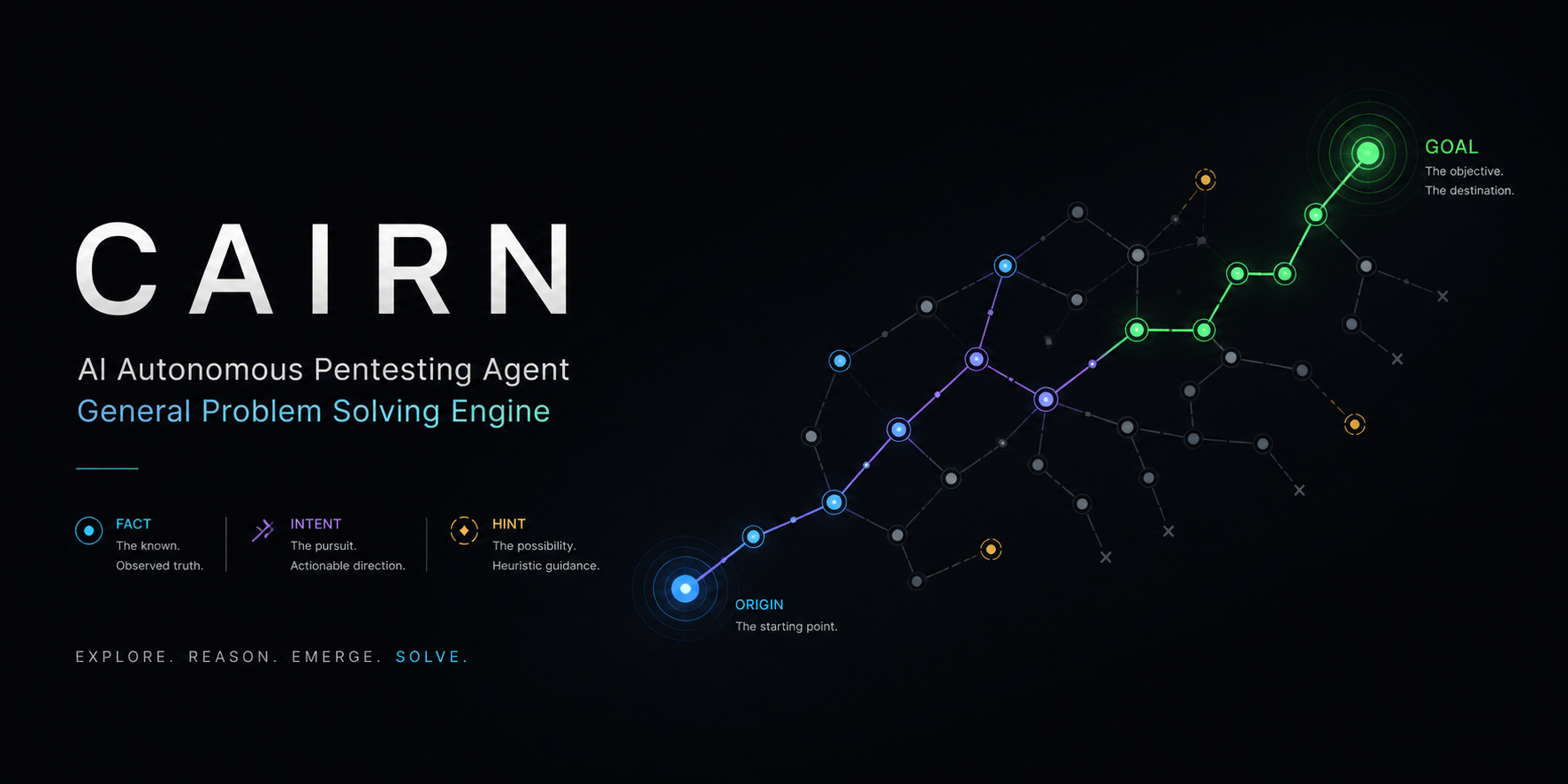
The engine is built on a Blackboard Architecture with an explicit fact-intent graph. Three primitives are all it needs:
| Concept | Meaning |
|---|---|
| Fact | A confirmed, objective finding written to the board |
| Intent | A declared direction of exploration, not yet executed |
| Hint | Human judgment injected at any time; absorbed by agents on the next read |
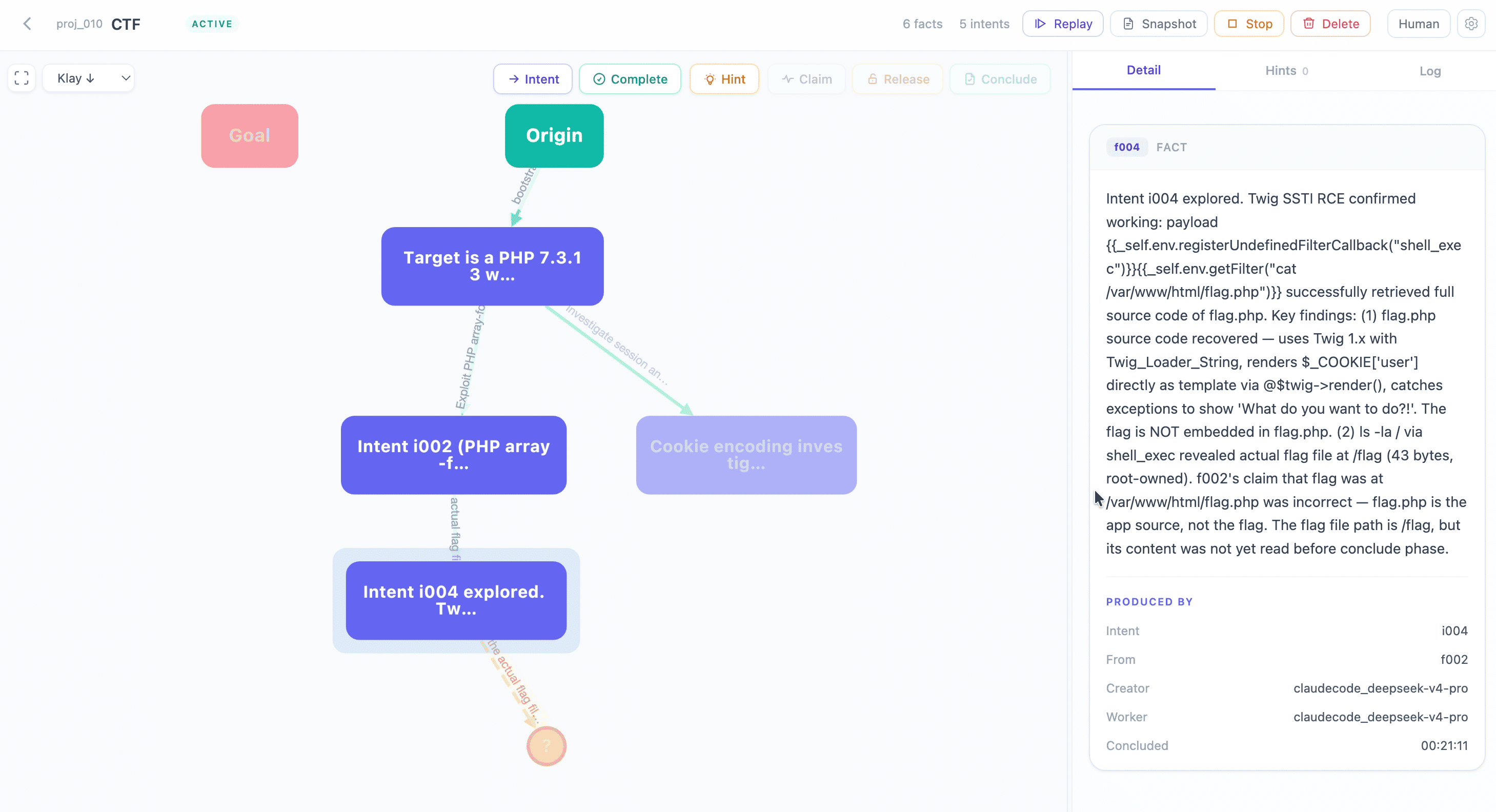
The graph grows from origin toward goal. Every new Fact is a stepping stone; every Intent is a step into the unknown.
Agent Workers run an OODA loop — Observe the full graph, Orient to the current state, Decide on next intents, Act to explore — and write their findings back as new Facts. Workers have no fixed roles. Tasks are generated at runtime from the graph's current state, not from predefined job descriptions.
Agents coordinate exclusively through the shared board (Stigmergy). No direct communication. No information silos.
Cairn in Action
https://github.com/user-attachments/assets/e557b1ac-dda4-41cb-87dd-9d56dbf05133
How It Works
Three task types, all executed by the same Worker:
| Task | What it does | Output |
|---|---|---|
| Bootstrap | At project start, attempts to solve the problem directly | Fact + possible Complete |
| Reason | Reads the full graph: is the goal met? What should be explored next? | Complete / new Intents / no-op |
| Explore | Claims one Intent, executes the exploration, reports findings | One Fact |
System architecture:
          ┌──────────────────────────────────┐
          │           Cairn Server           │
          │    Facts + Intents + Hints       │
          └─────────────────┬────────────────┘
                            │
                     Read / Write API
                            │
          ┌─────────────────┴────────────────┐
          │             Dispatcher           │
          │   Schedules tasks, manages       │
          │   containers, writes protocol    │
          └──────────┬───────────────┬───────┘
                     │               │
     ┌───────────────┴──┐     ┌──────┴──────────────┐
     │  Worker Container│     │  Worker Container   │
     │   (Project A)    │     │   (Project B)       │
     │  ┌────┐  ┌────┐  │     │  ┌────┐  ┌────┐     │
     │  │ W. │  │ W. │  │     │  │ W. │  │ W. │     │
     │  └────┘  └────┘  │     │  └────┘  └────┘     │
     └──────────────────┘     └─────────────────────┘
Cairn Server maintains graph consistency only.
Cairn Dispatcher reads the graph, schedules tasks, spins up and tears down worker containers, and is the sole writer to the protocol. Each project gets its own Worker Container; multiple Agent Workers run concurrently inside it. Agent Workers only receive a prompt and return structured output.
Workers can also run directly on the dispatcher host instead of in per-project containers — local mode, no Docker required. See Local mode below.
Supported worker backends: Claude Code, Codex, and Pi.
Results
Tencent Cloud Hackathon · AI Penetration Testing Challenge · 2nd Edition
610 teams · 1,345 participants · top universities and security firms across China
| Metric | Value |
|---|---|
| Problems solved | 54 / 54 — only team to AK |
| Final ranking | 3rd |
The system had never been tested before the competition. The full pipeline came online for the first time at 4 AM on race day. No training, no tuning, no domain-specific tooling. Zero MCP tools, zero RAG, zero predefined agent roles.
Further Reading
- The Strongest AI Penetration Testing Agent: Postmortem of the Only Team to Achieve AK at the TCH Tencent Cloud Hackathon Intelligent Penetration Testing Challenge (2nd Edition)
- The Pathless Path: Cairn AI from Penetration Testing to General Problem Solving
Getting Started
Prerequisites
- macOS or Linux
- Python ≥ 3.12
- Docker (container execution only — not needed for local mode)
Pull required images
Both setup methods require the worker container image:
docker pull --platform=linux/amd64 ghcr.io/oritera/cairn-worker-container:latest
Create your local dispatcher configuration and fill in your LLM endpoints and API keys:
cp dispatch.example.yaml dispatch.yaml
Docker Compose (recommended)
Pull the base image used to build Cairn:
docker pull ghcr.io/astral-sh/uv:python3.13-trixie
docker compose up --build
This starts cairn-server on port 8000 and cairn-dispatcher once the server passes its health check. The dispatcher mounts dispatch.yaml from the project root and connects to Docker via the host socket. Data is persisted to ./datas/cairn/.
Manual
# Start the server
uv run --project cairn cairn serve

# Run the dispatcher
uv run --project cairn cairn dispatch --config dispatch.yaml

# Run startup health checks only
uv run --project cairn cairn dispatch --config dispatch.yaml --startup-healthcheck-only
Local mode (no Docker)
Instead of one container per project, workers can run directly on the dispatcher host, reusing the machine's already-configured claude / codex / pi CLIs — no Docker, and no API keys in the config.
cp dispatch.local.example.yaml dispatch.yaml

# Start the server
uv run --project cairn cairn serve

# Run the dispatcher on the same host, where the CLIs are installed and logged in
uv run --project cairn cairn dispatch --config dispatch.yaml
Local mode is selected by runtime.execution: local (see dispatch.local.example.yaml). On startup the dispatcher checks each configured worker CLI is installed and runnable, and reminds you they must already be logged in. Each project gets an isolated working directory under local.workspace_root (default: the dispatcher's current directory). Run the dispatcher directly on the host — not inside Docker — since the agents run with your user's permissions and no sandbox.
Tests
Run the fast regression suite without Docker or live model endpoints:
uv run --project cairn --group dev pytest
Disclaimer
Cairn is a general-purpose problem-solving engine. Although it supports penetration testing, CTF solving, security assessment, and vulnerability research workflows, it is intended to be used only in environments where you have explicit authorization to operate.
You are solely responsible for how you use this project. Do not use Cairn against systems, networks, applications, or data without clear prior permission from the owner or operator. Unauthorized security testing, exploitation, or data access may be illegal and may