



Navigate the web like a human does.
Find an available slot, pick a date and time, handle the CAPTCHA, and book a driving test.
Explore more demos and prompts ↗
Which Browser Use do I need?
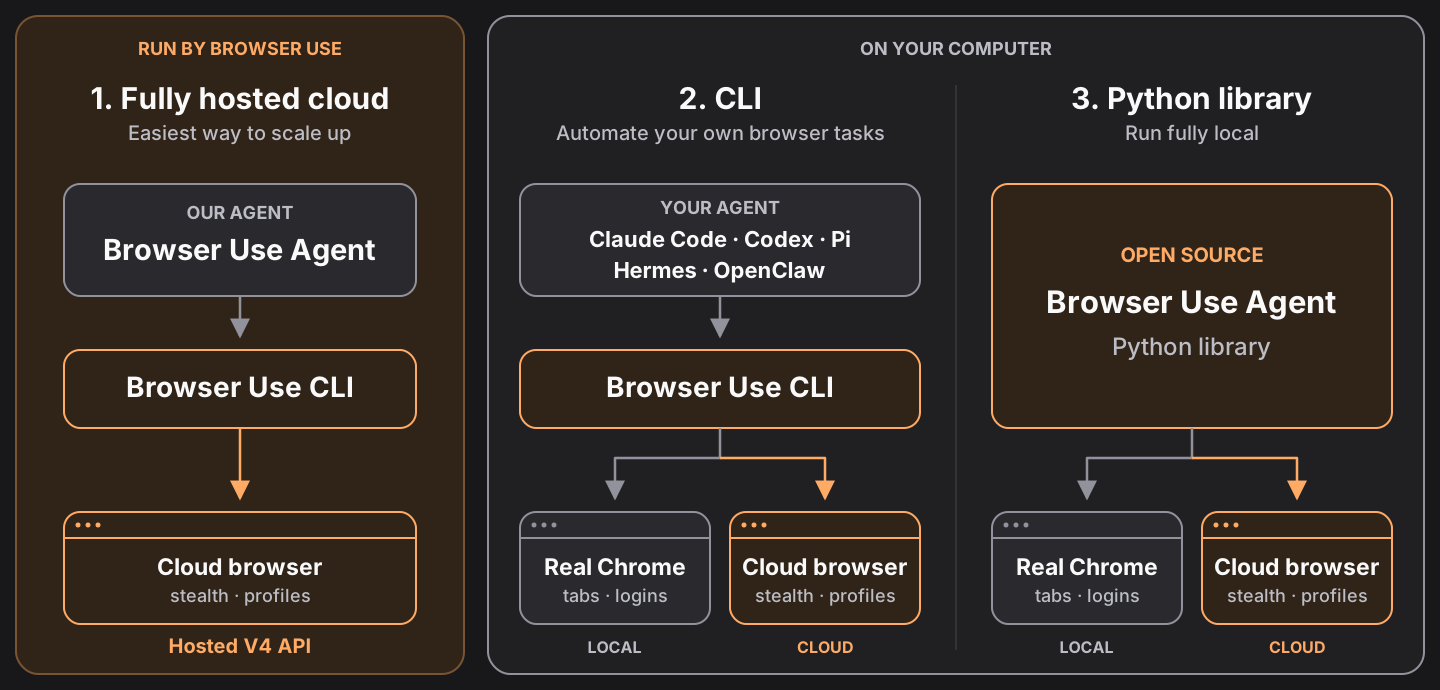
- Path 1: Fully Hosted Cloud: Scale up with a fully hosted agent and browser.
- Path 2: CLI: Automate your own browser tasks.
- Path 3: Python Library: Run the open source Browser Use agent locally from your own code.
Quickstart
Path 1: Fully Hosted Cloud
Scale browser automation with our hosted agent, stealth browsers, and infrastructure for profiles, recordings, and data policies.
New Google, GitHub, or Microsoft signups get $15 cloud credit.
Path 2: CLI
Paste this prompt into Claude Code, Codex, Hermes, OpenClaw, or your favorite agent.
Install or upgrade browser-use to the latest stable version with uv using Python 3.12, run `browser-use skill install` to register the skill, and connect it to my browser. If setup or connection fails, follow https://github.com/browser-use/browser-harness/blob/main/install.md.
Path 3: Python Library
Run the Browser Use agent locally from Python, with your choice of model and a local or cloud browser:
1. Install Browser Use (Python >= 3.11):
With uv installed, run uv init --python 3.12 first if you're starting a new project.
uv add browser-use
2. Add your OpenAI API key to .env:
# .env
OPENAI_API_KEY=your-key
# BROWSER_USE_API_KEY=your-key  # Optional: BU2 model or cloud browser
For either optional Browser Use service, get a Browser Use API key.
3. Save this as agent.py:
import asyncio

from browser_use import Agent, Browser, ChatBrowserUse, ChatOpenAI
from dotenv import load_dotenv

load_dotenv()

async def main():
    llm = ChatOpenAI(model='gpt-5.6-luna', reasoning_effort='xhigh')
    # llm = ChatBrowserUse(model='bu-2-0')  # Use BU2 instead; requires BROWSER_USE_API_KEY
    agent = Agent(
        task="Find the number of stars of the browser-use repo",
        llm=llm,
        # browser=Browser(use_cloud=True),  # Use a cloud browser; requires BROWSER_USE_API_KEY
    )
    history = await agent.run()
    print(history.final_result())

if __name__ == "__main__":
    asyncio.run(main())
To use BU2, replace the ChatOpenAI line with the commented ChatBrowserUse line. The cloud-browser option works with either model.
4. Run it:
uv run agent.py
The agent opens a browser, looks up the repository, and prints its answer.
Browser Use Benchmark v2

This very hard benchmark targets the hardest browser tasks. On easier tasks, even smaller models can achieve very high success rates. Results shown are from a 60-task subset of BU Bench V2.
Integrations, hosting, custom tools, MCP, and more on our Docs ↗
FAQ
Should I use the fully hosted cloud, CLI, or Python library?
- Fully Hosted Cloud: Send tasks through the API and let Browser Use run the agent, browser, and infrastructure.
- CLI: Give an existing agent (Claude Code, Codex, Hermes, OpenClaw, Pi, Cursor, etc.) browser access. You can use it interactively or in scripts.
- Python Library: Run the open source agent in your own application, with custom tools, structured output, and your choice of model.
The CLI and Python library can each connect to a local or cloud browser. A cloud browser hosts the browser; the fully hosted API runs the agent as well.
What's the best model to use?
We recommend BU2, our model optimized for browser automation: ChatBrowserUse(model='bu-2-0'). It uses BROWSER_USE_API_KEY; ChatBrowserUse() currently selects the same model.
The best choice depends on your tasks, latency, and budget. See the BU2 model card, benchmark, and supported models and pricing to compare options.
Can I use Claude / GPT / Gemini through ChatBrowserUse?
Yes. ChatBrowserUse accepts provider-prefixed model IDs through the Browser Use gateway, using BROWSER_USE_API_KEY:
from browser_use import Agent, ChatBrowserUse

llm = ChatBrowserUse(model='anthropic/claude-sonnet-4-6')  # or 'google/gemini-3-pro'
agent = Agent(task='...', llm=llm)
You can also use providers directly through wrappers such as ChatOpenAI, ChatAnthropic, and ChatGoogle, with each provider's own API key. See supported models.
Do I need to provide a system prompt?
No. Agent(...) supplies the Browser Use system prompt automatically, including when you change models. Put your task