



bomber is an application that scans SBOMs for security vulnerabilities.
Overview
So you've asked a vendor for an Software Bill of Materials (SBOM) for one of their closed source products, and they provided one to you in a JSON file... now what?
The first thing you're going to want to do is see if any of the components listed inside the SBOM have security vulnerabilities, and what kind of licenses these components have. This will help you identify what kind of risk you will be taking on by using the product.
Finding security vulnerabilities and license information for components identified in a SBOM is exactly what bomber is meant to do. bomber can read any JSON or XML based CycloneDX format, or a JSON SPDX or Syft formatted SBOM, and tell you pretty quickly if there are any vulnerabilities.
Table of Contents
- Open vs. Closed Source
- Purpose
- Supported SBOM formats
- Providers
- Installation
- Using bomber
- Output Formats
- Ignoring Vulnerabilities
- Filtering Output
- Data Enrichment
- Advanced stuff
- Experimental Features
- Messing around
- Notes
- Contributing
- Software Bill of Materials
- Sponsors
- Credits
Open vs. Closed Source
Software can either be open or closed source. You can look at third party components you'll find in Github, or any public source repository as open source. Technically, the software you create internally at your own company is open source as well - it's not public, but your internal teams can see it. Closed source software can also be internal, but usually this is software that you purchase from external vendors.
Companies can use SCA tools provided by vendors such as Github, Sonatype, Snyk, etc. to scan any kind of open source and provide vulnerability data - and even generate SBOMs in some cases. What they can't do (yet...) is scan closed source software that you don't have visibility into. This is where SBOMs and bomber come into play. SBOMs provide the composition of software that you can't access, and bomber determines if anything in the SBOM has vulnerabilities.
Purpose
We created bomber to scan the closed source SBOMs that are provided when you receive them from vendors. It can scan open source SBOMs too, and technically you could use bomber as an open source SCA tool if you wanted to.
Supported SBOM formats
There are quite a few SBOM formats available today. bomber supports the following:
Providers

bomber supports multiple sources for vulnerability information. We call these providers. Currently, bomber uses OSV as the default provider, but you can also use the Github Advisory Database, the Sonatype OSS Index, or Snyk.
At this time, please note that OSV is free and does not require any credentials to use, Sonatype OSS Index is free but requires you to register and obtain a token, and Snyk support requires a Snyk license.
In addition to data bomber collects from Providers, it also enriches vulnerability data with extra information such as exploitation probabilities.
Provider Support
Please note that each provider supports different ecosystems, so if you're not seeing any vulnerabilities in one, try another. An ecosystem is simply the package manager, or type of package. Examples include rpm, npm, gems, etc. It is important to understand that each provider may report different vulnerabilities. If in doubt, look at a few of them.
If bomber does not find any vulnerabilities, it doesn't mean that there aren't any. All it means is that the provider being used didn't detect any, or it doesn't support the ecosystem. Some providers have vulnerabilities that come back with no Severity information. In this case, the Severity will be listed as "UNDEFINED"
Provider Documentation
Provider documentation for bomber can be found:
Installation
Mac
You can use Homebrew to install bomber using the following:
brew tap devops-kung-fu/homebrew-tap
brew install devops-kung-fu/homebrew-tap/bomber
If you do not have Homebrew, you can still download the latest release (ex: bomber_0.4.1_darwin_all.tar.gz), extract the files from the archive, and use the bomber binary.
If you wish, you can move the bomber binary to your /usr/local/bin directory or anywhere on your path.
Linux
To install bomber, download the latest release for your platform and install locally. For example, install bomber on Ubuntu:
dpkg -i bomber_0.5.0_linux_arm64.deb
Using bomber
You can scan either an entire folder of SBOMs or an individual SBOM with bomber. bomber doesn't care if you have multiple formats in a single folder. It'll sort everything out for you.
Note that the default output for bomber is to STDOUT. Options to output in HTML or JSON are described later in this document.
Single SBOM scan
# Using OSV (the default provider) which does not require any credentials
bomber scan cyclonedx.sbom.json

# Using a provider that requires credentials (ossindex)
bomber scan --provider=xxx --username=xxx --token=xxx [sbom.json]
If the provider finds vulnerabilities you'll see an output similar to the following:
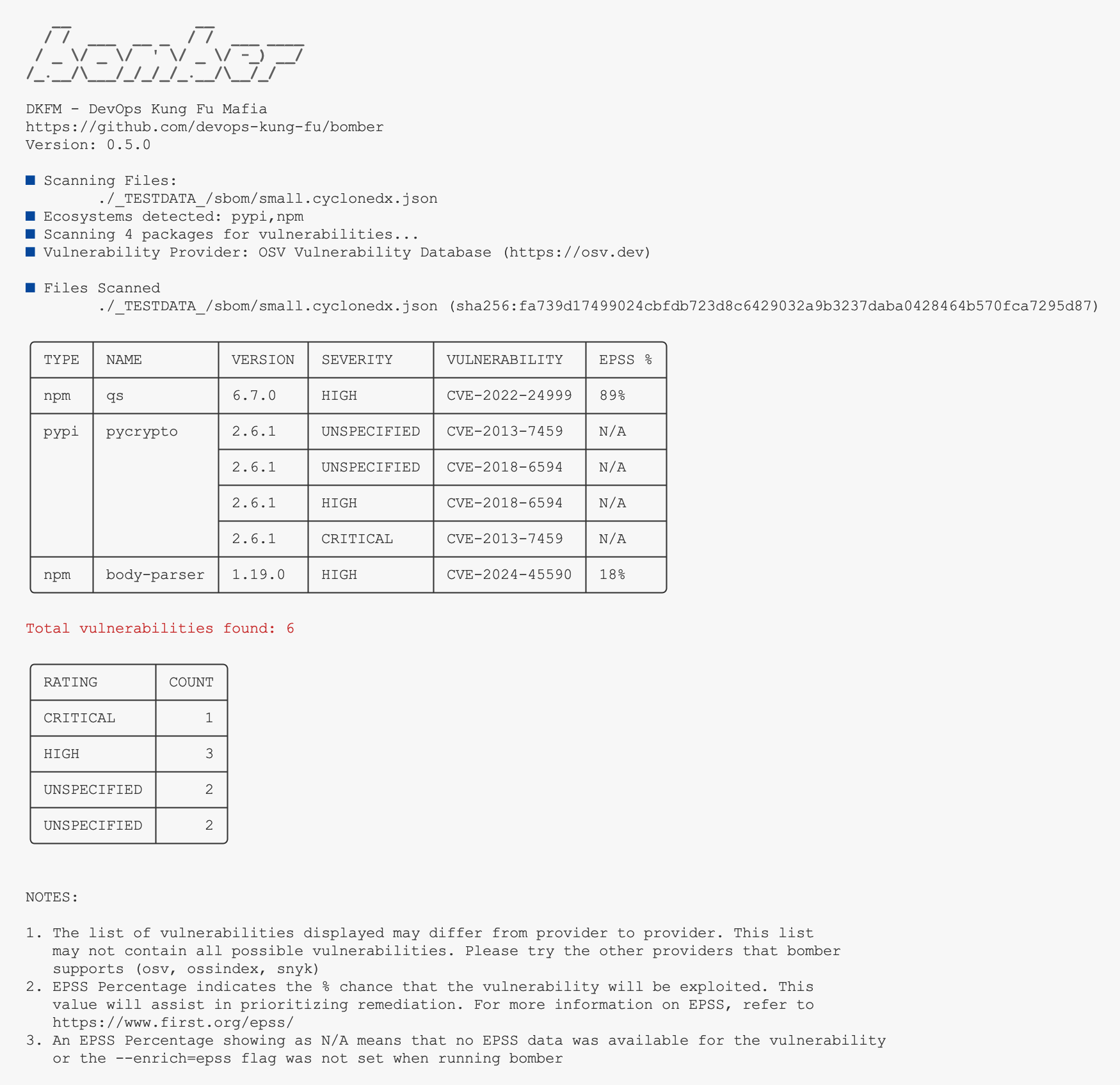
If the provider doesn't return any vulnerabilities you'll see a message saying no vulnerabilities were found.
NOTE: Just because may not have found any vulnerabilities using a specified provider doesn't mean there are no vulnerabilities. Please try the other providers that bomber supports.
Entire folder scan
This is good for when you receive multiple SBOMs from a vendor for the same product. Or, maybe you want to find out what vulnerabilities you have in your entire organization. A folder scan will find all components, de-duplicate them, and then scan them for vulnerabilities.
# scan a folder of SBOMs (the following command will scan a folder in your current folder named "sboms")
bomber scan --provider=xxx --username=xxx --token=xxx ./sboms
You'll see a similar result to what a Single SBOM scan will provide.
Output Formats
bomber outputs data into three useful formats. By default, output is rendered to the command line. For enhanced reporting, you can output to HTML using the --output=html flag. To output to JSON, utilize the --output=json flag. Use comma separated output specification to get output in multiple formats --output=html,stdout,json.
HTML Output
If you would like a readable report generated with detailed vulnerability information, you can utilized the --output flag to save a report to an HTML file.
Example command: