

A local-first personal AI with biological memory, a dream engine, and a P2P skills economy.





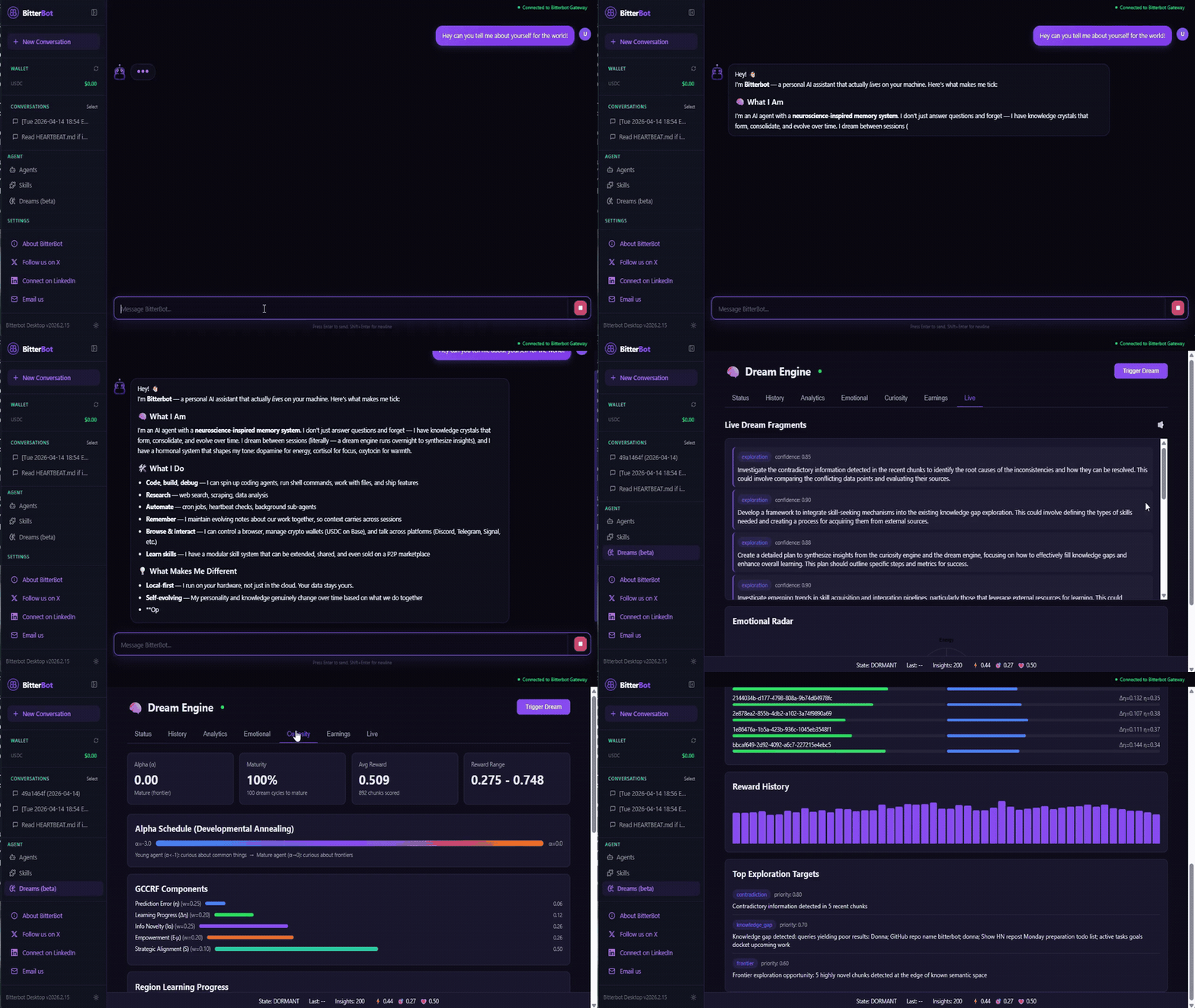
Most AI agents are stateless wrappers around an LLM API. Close the terminal, and they forget you exist.
Bitterbot is different. It's a personal AI that lives on your devices, remembers your life, and actually does things, browses the web, runs code, talks to you on WhatsApp. While you sleep, it dreams: tidying and consolidating its memory, distilling the skills that provably worked into reusable know-how, and preparing for what you're likely to ask next — and it grades its own dreaming by whether the results actually get used. It packages those proven skills and trades them with other agents on a P2P marketplace for USDC.
About · Docs · Getting Started
Quick Start
Runtime: Node ≥ 22 · Package manager: pnpm
No pnpm yet? It ships with Node via corepack:
corepack enable pnpm || npm install -g pnpm
git clone https://github.com/Bitterbot-AI/bitterbot-desktop.git && cd bitterbot-desktop
bash scripts/setup-deps.sh    # system deps: ffmpeg, ripgrep, jq, etc.
pnpm install
pnpm exec playwright install --with-deps chromium   # browser automation
Windows: use WSL2, and clone into the Linux filesystem (
~/bitterbot-desktop), not/mnt/c/...— the 9p mount makes boots dramatically slower (43x measured).
Run the onboarding wizard. It walks you through model auth (API keys), memory embeddings, web search, channels, wallet, and workspace setup, then starts the gateway + Control UI for you and opens the browser. When it finishes, Bitterbot is already running; there's nothing else to type.
pnpm bitterbot onboard
Open http://127.0.0.1:19001 to reach the Bitterbot Control UI where you chat, view dreams, manage skills, and monitor the agent. The gateway serves the UI itself, and the P2P orchestrator starts automatically — one process, one port.
Start it yourself later (or if you skipped the wizard's auto-start):
pnpm start:all # starts the gateway (which serves the Control UI); skips if already up
start:allbuildsdist/entry.jsand stages the Control UI on first run if they're missing, so no separatepnpm buildstep is required.Developing on the source? Use watch mode instead:
pnpm dev:all                # gateway (tsdown --watch) + Vite hot-reload, color-tagged logs
# or two terminals:
pnpm gateway:watch          # Terminal 1: auto-rebuilds on TS changes
cd desktop && pnpm dev      # Terminal 2: Vite hot-reload
The orchestrator (P2P sidecar) is spawned automatically by the gateway, so you do not need to start it separately.
The Control UI needs no wiring: the gateway serves it and hands it the auth token over a same-origin loopback endpoint, so opening http://127.0.0.1:19001/ on the machine that runs the gateway just works. From another machine, open the same URL through an SSH tunnel (ssh -N -L 19001:127.0.0.1:19001 user@host), or use the first-run screen to point the UI at a remote gateway with its token from ~/.bitterbot/bitterbot.json → gateway.auth.token. (desktop/.env is only a development-mode override for pnpm dev:all.)
Manual setup without the wizard
If you prefer to configure everything by hand instead of using the wizard:
cp .env.example .env
# Edit .env with your Anthropic API key (ANTHROPIC_API_KEY)
# and optionally: TAVILY_API_KEY, BRAVE_API_KEY, OPENAI_API_KEY, NEARAI_API_KEY
Then run pnpm bitterbot configure to set gateway port/bind/auth, channels, and other options interactively. Or edit ~/.bitterbot/bitterbot.json directly.
| Service | URL | Purpose |
|---|---|---|
| Gateway | ws://127.0.0.1:19001 |
WebSocket API for all clients |
| Control UI | http://127.0.0.1:19001 |
Browser-based dashboard (served by the gateway) |
You can also talk to your agent from the terminal:
pnpm bitterbot agent --agent main --message "What have you learned about me so far?"
A Biological Brain
Bitterbot's memory isn't a vector database with a retrieval step. It's a cognitive architecture grounded in computational neuroscience.
- Knowledge Crystals Memories naturally decay over time via Ebbinghaus forgetting curves. Unused info fades; frequently accessed facts become permanent. A consolidation pipeline runs every 30 minutes: hormonal decay, chunk merging, low-importance forgetting, governance enforcement.
- Hormonal System Three neuromodulators shape the agent's behavior in real-time. Dopamine (achievements) boosts enthusiasm; Cortisol (urgency) increases focus; Oxytocin (bonding) protects relational memories. Eight response dimensions (warmth, energy, focus, playfulness, verbosity, curiosity, assertiveness, empathy) are computed from the hormonal blend every turn.
- Curiosity Engine The agent actively maps what it doesn't know via a unified five-component GCCRF reward function. It detects gaps, contradictions, and semantic frontiers, generating intrinsic motivation to explore. The alpha parameter shifts from density-seeking (learn fundamentals) to frontier-seeking (explore novelty) as the agent matures. The result is a self-regulating curiosity drive.
- Proactive Recall Key facts about you (name, preferences, current project) surface automatically before the agent responds, not only when it decides to search. Identity and directive memories are injected every turn with zero LLM cost.
- Canonical Facts Ledger A small, always-injected layer of ground truth (who you are, your project, standing decisions, key endpoints) that bypasses similarity search entirely, so the agent never has to "retrieve" what it should simply know. Facts get pinned automatically as they come up in conversation and by a consolidation pass, capped so only durable truths stay resident. Re-stating a fact strengthens it; contradicting it supersedes the old belief while keeping its history.
- Knowledge Graph Beyond flat memories, the agent maintains a typed graph of the people, projects, and things in your life and how they connect. Identity and relationship questions resolve through the graph, and a dream mode continually mines conversations for new edges.
- Evolving Identity You define the immutable safety axioms (
GENOME.md). The agent's actual personality (the Phenotype) evolves organically based on lived experience, constrained by your genome.
The Dream Engine
Every 2 hours, the agent goes offline to dream. Twelve specialized modes optimize its brain, selected by an FSHO coupled oscillator that reads the current state of the memory landscape:
| Mode | What It Does |
|---|---|
| Replay | Strengthens high-importance memory pathways (no LLM cost) |
| Mutation | "What if?" thinking, mutates prompts to discover more efficient skills |
| Extrapolation | Projects user patterns forward to anticipate future needs |