Binner






Binner is a free open-source parts inventory tracking system you can run locally in Windows or Unix environments. It was created for makers (like myself), hobbyists or professionals to keep track of your parts inventory.
Screenshots
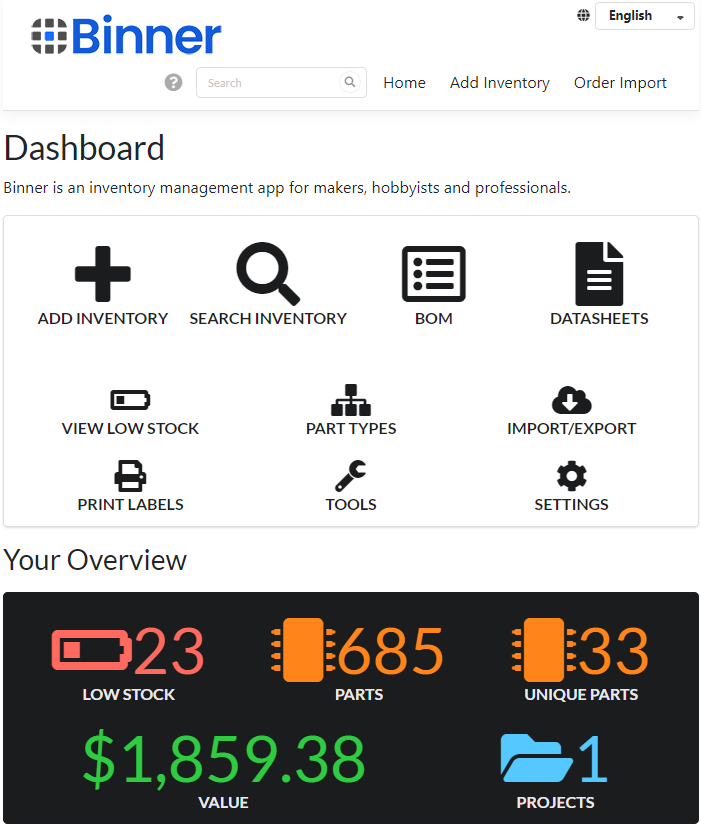
Features
- Standard inventory management input
- Import your orders from Digikey, Mouser, Arrow, or
AliExpress - Customizable nested category placement
- Track parts by Project
- Automated datasheet retrieval / Datasheet search
- Automated part lookup on Digikey/Mouser/Arrow/Octopart/Nexar/TME
- Flexible search engine
- Export your data to CSV / Excel if you need
- Proprietary file-based database (or use providers for other formats such as SQL Server)
- No web server installation required, uses standalone Kestrel service API
- Based on .Net - runs on Windows, Unix and embedded devices like Raspberry PI
- Simple web-based UI
- Barcoding support
- Label printing
- KiCad HTTP Library support
- Supports adding custom fields to your data
Limitations
We try to include as many features as possible in the free open-source version. In order to keep active development going additional features and limitations can be unlocked with a paid license.
- Max 3 Users (additional users can be unlocked with a subscription)
Planned Upcoming Features for 2025
- Dedicated datasheet repository (Q1)
- Schematics repository for example circuits per part (Q1)
- Local upload of datasheets/images
- Integration of Arrow's API for orders and parts (Q1)
- Multiple language support (Q1)
- Auto update (Q1)
- Full BOM / PCB management (Q1)
- TME parts api support (Q2)
- KiCad HTTP Library api support (Q2)
- Ability to add custom fields (Q2)
- Electronic bins support (Q2)
- Maybe a parts marketplace? with lasers?
Installation
Binner is a cross-platform distribution and runs on Windows, Raspberry Pi OS, Ubuntu, Docker and more!
Installation on Docker
Pull the latest Docker image and run an instance using docker run --name Binner -d binnerofficial/binner:latest.
Docker is best configured using docker compose. Full Docker installation details available at Docker Hub or the official wiki.
Installation on Windows
Download the Windows installer from the latest release  .
.
Binner can be run as a standalone console application, or as a service.
To run as a service, run the following in an Administrative console:
.\Binner.Web install
.\Binner.Web start
Other commands are available to manage the service such as uninstall, stop, help.
To run as a console application:
.\Binner.Web.exe
Proceed to the web interface at https://localhost:8090 to start using Binner!
Login
The first time you login you will be prompted for a username and password. The default credentials are:
Username: admin
Password: admin
Installation on Ubuntu
Download the ubuntu.14.04-x64.tar.gz from the latest release .
// extract the archive
tar zxfp ./Binner_ubuntu.14.04-x64-VERSION.tar.gz

// to install as a service
sudo chmod +x ./install-as-service.sh
sudo ./install-as-service.sh

// or you can just run directly
sudo chmod +x ./Binner.Web
./Binner.Web
Installation on Raspberry Pi OS
Download the linux-arm.tar.gz from the latest release .
// extract the archive
tar zxfp Binner_linux-arm-VERSION.tar.gz

// to install as a service
sudo chmod +x ./install-as-service.sh
sudo ./install-as-service.sh

// or you can just run directly
sudo chmod +x ./Binner.Web
./Binner.Web
See the Wiki for help installing on other platforms.
Description
Binner is designed for electronics in mind, however it could be used for other types of inventory management (chemistry, retail). It is purpose built for quick data entry and fast performance. I built it because I couldn't find good free alternatives for tracking inventory in my home maker lab - it's easy to forget what you bought and where you put them and I end up sometimes ordering things I already have around. Saves money and time! It's built on .Net Core / C# with a React js front end.
I welcome all who want to contribute to this project, and please suggest features in the Issues section.
What if I want to use it but not to install it myself?
A free online version of Binner is available at Binner.io. This service offers both free and paid subscriptions based on inventory size requirements and additional features. Compared to other options out there it's incredibly useful for makers, and it helps me keep this project alive!
Getting Help
Help with your installation, questions, reporting bugs, suggesting features can be provided in multiple ways:
- If you simply have a question or need help with installation issues, you have 2 options:
- create a post in Discussions
- join our Discord server for a more real-time response
- If you are reporting a bug or suggesting a feature, create a New Issue
Storage Provider
Binner supports multiple storage providers. If your needs are simple, you can continue to use the built-in Binner storage provider which is configured by default. Alternatively, you can specify to use any of the following supported storage providers:
- Binner
- SqlServer
- Postgresql
- MySql
- Sqlite
Configuring Binner Provider (default)
In appsettings.json under StorageProviderConfiguration set the Provider to Binner and under ProviderConfiguration specify the database file location as "Filename": "C:\\Binner\\binner.db" or the location of your choice. It should look like the following:
"StorageProviderConfiguration": {
    "Provider": "Binner",
    "ProviderConfiguration": {
      "Filename": "C:\\Binner\\binner.db" // for unix environments use: "./binner.db"
    }
  },
Configuring SQL Server
In appsettings.json under StorageProviderConfiguration set the Provider to SqlServer. Example:
"StorageProviderConfiguration": {
    "Provider": "SqlServer",
    "ProviderConfiguration": {
      "ConnectionString": "Server=localhost;Database=Binner;Trusted_Connection=True;TrustServerCertificate=True;Integrated Security=True;"
    }
  },
Configuring Postgresql
In appsettings.json under StorageProviderConfiguration set the Provider to Postgresql. Example:
"StorageProviderConfiguration": {
    "Provider": "Postgresql",
    "ProviderConfiguration": {
      "ConnectionString": "Server=localhost;Port=5432;Database=Binner;Userid=postgres;Password=password;SslMode=Disable;Persist Security Info=true;"
    }
  },
Configuring MySql / MariaDb
In appsettings.json under StorageProviderConfiguration set the Provider to MySql. Example:
"StorageProviderConfiguration": {
    "Provider": "MySql",
    "ProviderConfiguration": {
      "ConnectionString": "Server=localhost;Database=Binner;Uid=root;Pwd=password;"
    }
  },
Configuring Sqlite
In appsettings.json under StorageProviderConfiguration set th