
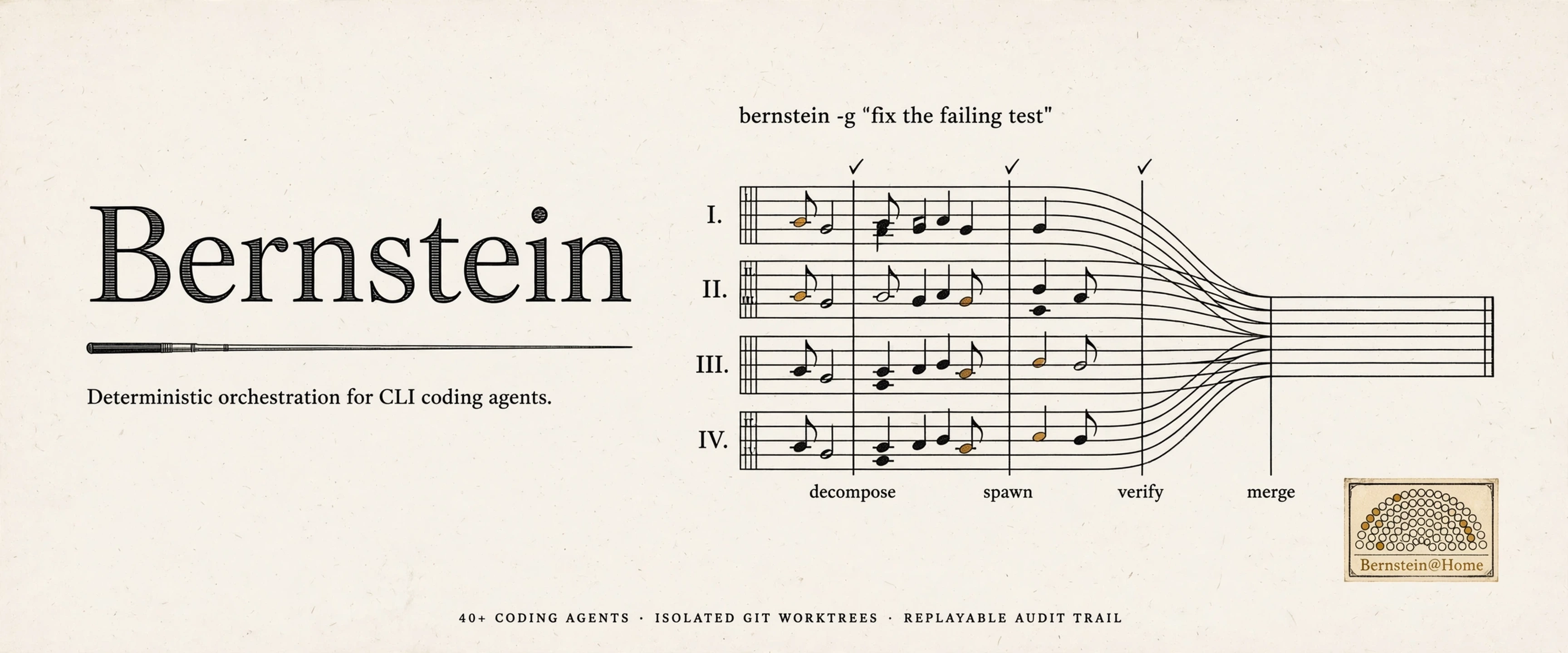
"To achieve great things, two things are needed: a plan and not quite enough time." - attributed to Leonard Bernstein
the open-source governance layer for AI agents









website · docs · install · first run · glossary · limitations · name policy · discord · sponsor
简体中文 · 繁體中文 · 日本語 · 한국어 · हिन्दी · বাংলা · Русский · Español · Português · Deutsch · Français · Italiano · Nederlands · Polski · Svenska · Suomi · Українська · Türkçe · العربية · עברית · Bahasa Indonesia · Tiếng Việt · ไทย
Status: beta. Solo-maintained, under active development. The version number counts releases, not maturity - minor versions may change interfaces. Pin the version for anything you depend on; regressions get fixed fast, file them.
Bernstein is the open-source governance layer for AI agents. It runs on policy as code: you write the policy - who may do what, what needs approval, what must be recorded - and Bernstein enforces it and produces the verifiable record. A deterministic scheduler - no model in the coordination loop - runs agents in parallel, gates what they produce, and records every step, so a run can be verified after the fact, offline, from the artifacts alone. CLI coding agents work out of the box (Claude Code, Codex, Gemini CLI, and 40+ more), and the same layer governs any agent workload: the deliverable can be a diff, a research report, a dataset, or an audit evidence pack. Air-gap install profile included. Apache-2.0.
at a glance
Four things set it apart; everything after is detail.
- No LLM in the coordination loop. Scheduling is plain Python, so a run is reproducible end to end. Replay yesterday's plan and get yesterday's task graph.
- Checkable after the fact. The replay journal records every run, and the always-on lineage spine records every lineage-bearing step; the opt-in HMAC-chained audit log (
BERNSTEIN_AUDIT=1) adds receipts you verify offline. Non-determinism surfaces as a hash mismatch at the exact step, not a flaky re-run. Non-code deliverables get the same treatment: a task can declare an artifact contract (report, dataset, action log, ops result) and completes on a signed lineage receipt rather than a git commit. - Isolated by construction. Each coding task gets its own git worktree behind merge gates; artifact-mode tasks get a working directory under
.sdd/workspaces/. Agents share no mutable workspace by default; the only shared state is the task backlog, which is claimed atomically. Stricter filesystem enforcement is opt-in, from the sandbox backends. Disable worktrees and every task runs in the shared checkout. - Broad and local. 40+ CLI agent adapters plus a generic
--promptwrapper, file-based state, no SaaS hop, no third-party data plane.
The full list is on the capabilities page; the feature matrix is the exhaustive index.
what a run looks like
One YAML file declares the run: phases, roles, dependencies, and the conditions under which a node runs at all. The scheduler executes it as plain Python - nothing in the file is a prompt, and no model decides what happens next. This graph produces an audit evidence pack; the full file ships at .bernstein/workflows/audit-evidence-pack.yaml.
name: audit-evidence-pack
version: "1.0.0"

phases:
  - name: scope
    allowed_roles: [manager, architect]
  - name: collect
  - name: validate
    allowed_roles: [qa, security]
  - name: deliver
    allowed_roles: [security, manager]

nodes:
  define-control-inventory:
    phase: scope
    role: architect

  collect-audit-logs:
    phase: collect
    role: security
    depends_on: [define-control-inventory]

  # three more evidence streams collect in parallel:
  # collect-sboms-and-attestations, collect-runbooks-a