Aurelio is a self-hosted wealth-management and financial-planning app for individuals who want portfolio and net-worth tracking with an optional AI advisor, running entirely on their own computer.
What it is
Aurelio is a personal finance application built with FastAPI and React that keeps every record on your machine, in a local backend/data.db file, and offers an AI advisor you can talk to. The AI component is optional: it runs through OpenRouter with your own API key, and the default model is Claude Opus 5.5, with the ability to pick another model in the chat. The project is written in Python and TypeScript and is released under the MIT licence.
The concrete problem it addresses is that people with holdings scattered across banks and brokers need one trustworthy view of what they actually own — their cash, positions, funds, real assets and debts — without handing those records to a hosted service. Aurelio consolidates that picture locally: it prices every position from the market, tracks cost, gain and dividends, and provides look-through into what funds really hold by country, sector, company and currency, alongside plans, homes, debts, cash flow and goal-return requirements.
Key capabilities
- Track wealth across banks and brokers, including their cash and dated situations of what you hold.
- Price every portfolio position from the market, showing cost, gain and dividends.
- Perform look-through analysis of fund holdings broken down by country, sector, company and currency.
- Model plans, homes and debts: recurring investments, real assets and the loans financing them.
- Compute cash flow and goals, covering income, expenses, savings rate and the return each goal needs.
- Chat with "Ask Aurelio", which answers from your own records, can search the web, and proposes every change as a card you confirm.
- Run "the analysis", where an analyst and a confidant argue over your portfolio and a synthesis says what to look at first.
Who uses it and how
- Individuals who want to run wealth tracking on their own computer rather than on a hosted service, keeping records in
backend/data.db.
- Users who start on an invented demo household with
./start.sh --demo (macOS and Linux) or ./start.ps1 -Demo (Windows) before switching to their own data.
- Self-hosters with an OpenRouter account and their own key who enable the AI advisor and ask questions, request advice with web search, or run analyses.
- Developers running the test suites with
uv run pytest in backend/ and npm test in frontend/, or using hot reload via uv run uvicorn app.main:app --port 8000 and npm run dev.
Getting started
Clone the repository, install Git, Node.js 22 or later and uv, then run ./start.sh (or ./start.ps1 on Windows); the first start installs what it needs inside the folder and opens the app.
How it compares
No paid products this replaces are named in the available facts, and the registry lists no comparable tools for it, so Aurelio stands alone in this registry.
When to use it — and when not
The AI features are not free to run: you must create an OpenRouter account, add credit and set OPENROUTER_API_KEY in backend/.env, with measured October 2026 costs of $0.11 for a first question, $0.16 for advice with one web search and $0.33 to $0.51 for an analysis. It is also a desktop-oriented tool you must operate yourself — cloning the repo, running the start script and accepting that your records live in a local SQLite file that the app backs up before each format change — so anyone wanting a mobile-first or managed hosted service should look elsewhere.
project readme (upstream, from github) — read inline
Aurelio

Aurelio is a wealth-management and financial-planning app that runs on your
own computer, with an AI advisor you can talk to. Your records are kept on your
machine. The AI part is optional: it goes through
OpenRouter with your own key.
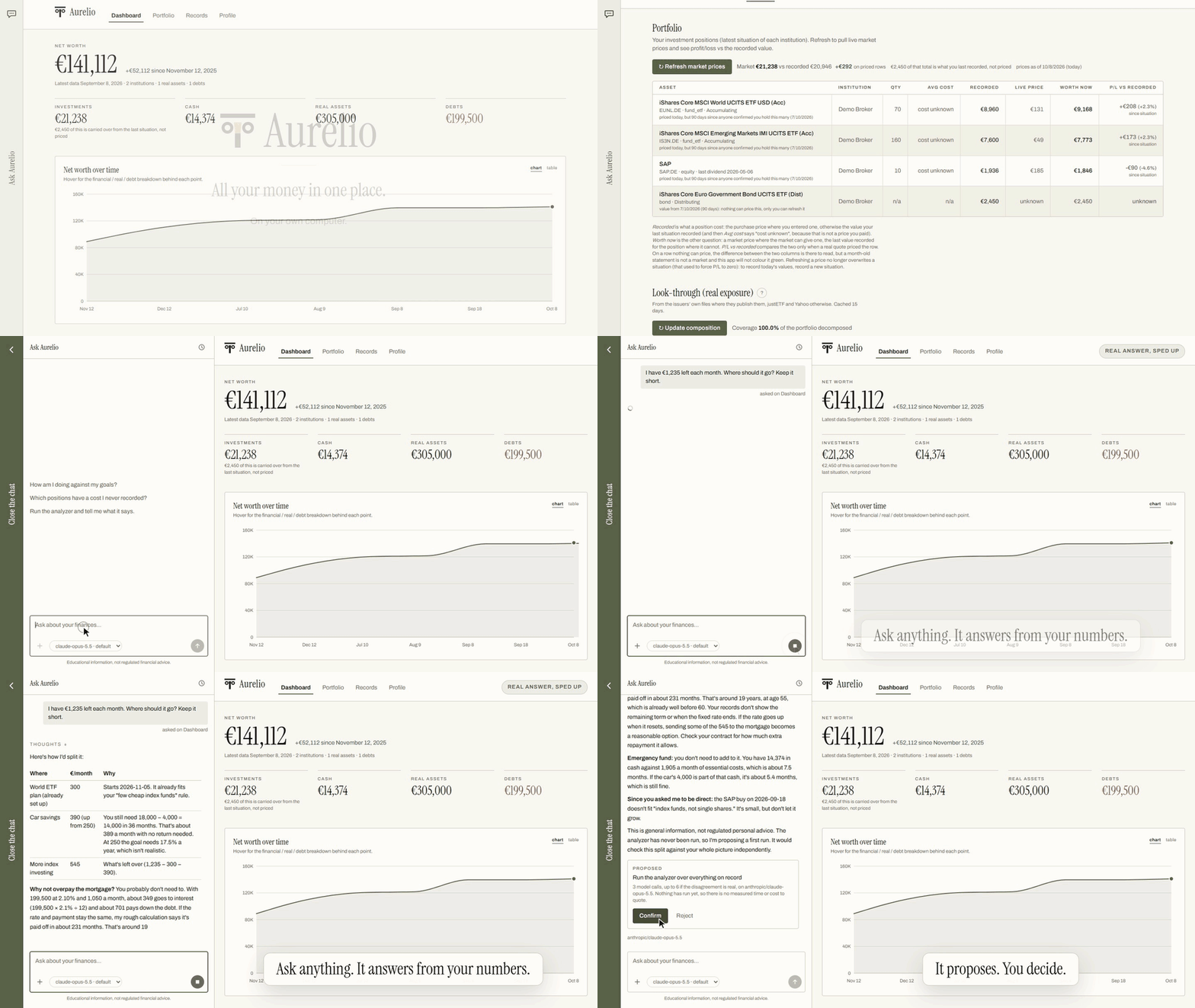
Try it on invented data
You need Git, Node.js 22 or later
and uv. Then:
git clone https://github.com/LosaLosSantos/aurelio-finance.git
cd aurelio-finance
./start.sh --demo          # macOS and Linux
git clone https://github.com/LosaLosSantos/aurelio-finance.git
cd aurelio-finance
./start.ps1 -Demo          # Windows, in PowerShell
If PowerShell says that running scripts is disabled, use
powershell -ExecutionPolicy Bypass -File .\start.ps1 -Demo.
The first start installs what it needs inside the folder and opens
on an invented household, kept in a file of its own.
Start without the flag to use your own data.
Run it on your own data
./start.sh # macOS and Linux
./start.ps1 # Windows
Your records live in backend/data.db. Before an update changes its format,
the app saves a copy next to it.
What it does
- Wealth: your banks and brokers, their cash, and dated situations of what
you hold.
- Portfolio: every position priced from the market, with its cost, gain and
dividends.
- Look-through: what your funds really hold, by country, sector, company
and currency.
- Plans, homes and debts: recurring investments, real assets and the loans
that finance them.
- Cash flow and goals: income, expenses, savings rate, and the return each
goal needs.
- Ask Aurelio: a chat that answers from your own records, can search the
web, and proposes every change as a card you confirm.
- The analysis: an analyst and a confidant who knows you argue over your
portfolio, and a synthesis says what to look at first.
How Aurelio reasons explains the ideas
underneath.
The AI part
- Create an account at , add credit, and create a key at
.
- Copy
backend/.env.example to backend/.env and set OPENROUTER_API_KEY.
The default model is Claude Opus 5.5 ($4 per million input tokens, $20 per
million output tokens); you can pick another in the chat. What it cost,
measured in October 2026:
Development
uv run pytest in backend/ and npm test in frontend/. For hot reload,
run uv run uvicorn app.main:app --port 8000 in backend/ and npm run dev in
frontend/.
License
MIT, see LICENSE.