Alexandrie is a free, open source project & work management project written in Vue and released under MIT. It has 2,752 GitHub stars, 193 forks and 29 open issues, and was last pushed 4 days ago. On this registry it ranks #28 of 62 tracked projects in Project & Work Management, with 5 head-to-head comparisons available. It gained 5 stars over the last 3 tracked days.

What is Alexandrie?

What it is

Alexandrie is an open-source, self-hosted knowledge base and project & work management tool. It lives in the Vue/Nuxt, Golang, Docker, and offline-first web app ecosystem. It provides an extended Markdown editor for organizing, searching, sharing, and exporting notes from desktop or mobile devices.

The concrete problem it solves is team knowledge management that must remain self-hosted, offline-capable, and exportable. It gives teams and individuals a wiki with multi-tenant workspaces, granular permissions, offline PWA support, diagrams, snippets, Kanban boards, and S3-compatible backups. It is positioned as an alternative to Notion, Obsidian, and Confluence.

Key capabilities

  • The editor uses CodeMirror 6 with extended Markdown, LaTeX, custom containers, interactive checkboxes, frames, snippets, native diagrams, and speech-to-text.
  • Alexandrie supports offline-first PWA installation on desktop and mobile devices, with synchronization when connectivity is available.
  • Multi-tenant organization includes Teams, Workspaces, Categories, nested Documents, integrated Kanban boards, and a five-level access model from None to Owner.
  • Search and navigation include Ctrl + K command center, full-text indexing, snippet highlights, and relevancy sorting.
  • Authentication and sharing include OIDC SSO providers, public links, group rules, invitation codes, custom scopes, and team allocation tables.
  • Storage pipelines support S3-compatible object stores such as RustFS, Garage, MinIO, or AWS, plus PDF and over 30 media format previews.
  • Data portability includes ZIP import/export tools and backup or restore of selective nodes.

Who uses it and how

  • Teams and individuals use it as a self-hosted wiki for shared documents, workspaces, and nested document hierarchies.
  • Technical writers use the extended Markdown environment for notes containing LaTeX, diagrams, snippets, and checkboxes.
  • Organizations with identity providers use OIDC SSO to connect existing user accounts to the application.
  • Administrators use Docker to deploy the full stack and S3-compatible storage for media, backups, and restores.
  • Individuals or teams use the PWA offline mode to read and edit notes on desktop or mobile devices.

Getting started

The README describes one-command deployment of the full-stack application using Docker. No hosted option is listed in the provided facts.

When to use it β€” and when not to

Use Alexandrie when a team needs a self-hosted, offline-capable Markdown wiki that can replace Notion, Obsidian, or Confluence. Do not choose it if a fully managed service is required, because the provided facts describe self-hosting with Docker, object storage, backups, and OIDC configuration. The project is MIT-licensed and has 2,745 stars, but the facts also show 29 open issues and no listed contributor count, so evaluators should inspect maintenance status before adoption.

project readme (upstream, from github) β€” read inline

Alexandrie

A self-hosted, open-source knowledge base with an extended Markdown editor.
Organize, search, share and export your notes from any device, even offline.
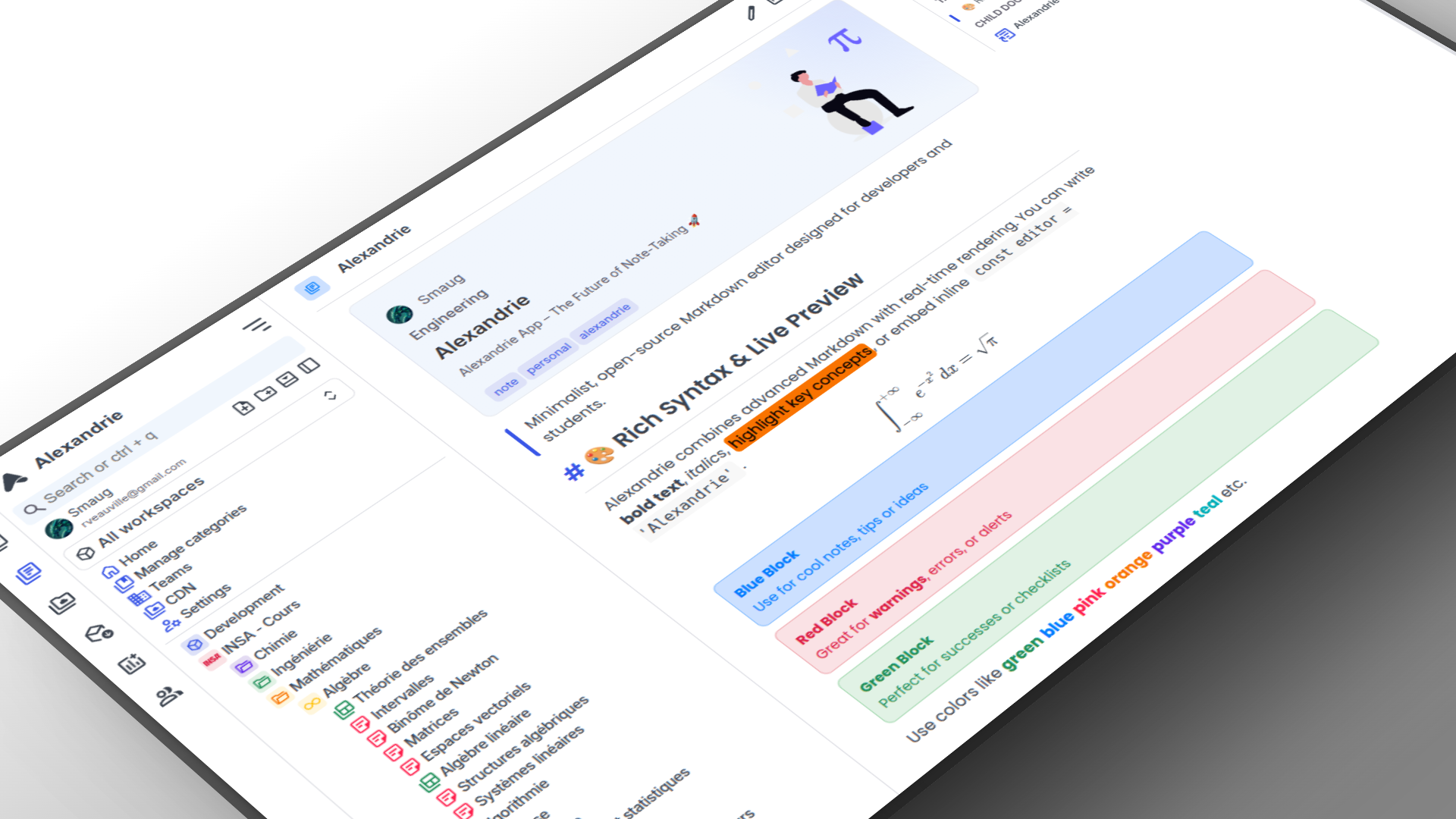

Alexandrie Preview

GitHub Repo stars GitHub release GitHub license Discord

Why Alexandrie?

Alexandrie is an open-source self-hosted wiki and knowledge management platform built for teams and individuals. It combines a powerful Markdown editor, offline support, collaboration tools, and enterprise-grade permissions, making it an alternative to Notion, Confluence and Obsidian.

  • One-Command Deployment: Bring up the entire full-stack application instantly using Docker.
  • Advanced Markdown Engine: Native support for LaTeX, custom containers, interactive checkboxes, frames, snippets, and integrated diagram building.
  • Granular Organization: Multi-tenant architecture supporting Teams, Workspaces, Categories, and nested Documents.
  • Offline-First PWA: Install on any desktop or mobile device with full offline capabilities and seamless synchronization.
  • Production Ready: Built-in OpenID Connect (OIDC) SSO providers, automated full-system backup/restore pipelines, and a robust media storage architecture.

Core Features

Advanced Writing & Rich Markdown

Alexandrie features an extended CodeMirror 6 environment tailored for technical writing. It handles complex academic blocks, custom styles, global theme alignment, and real-time scroll synchronization seamlessly.
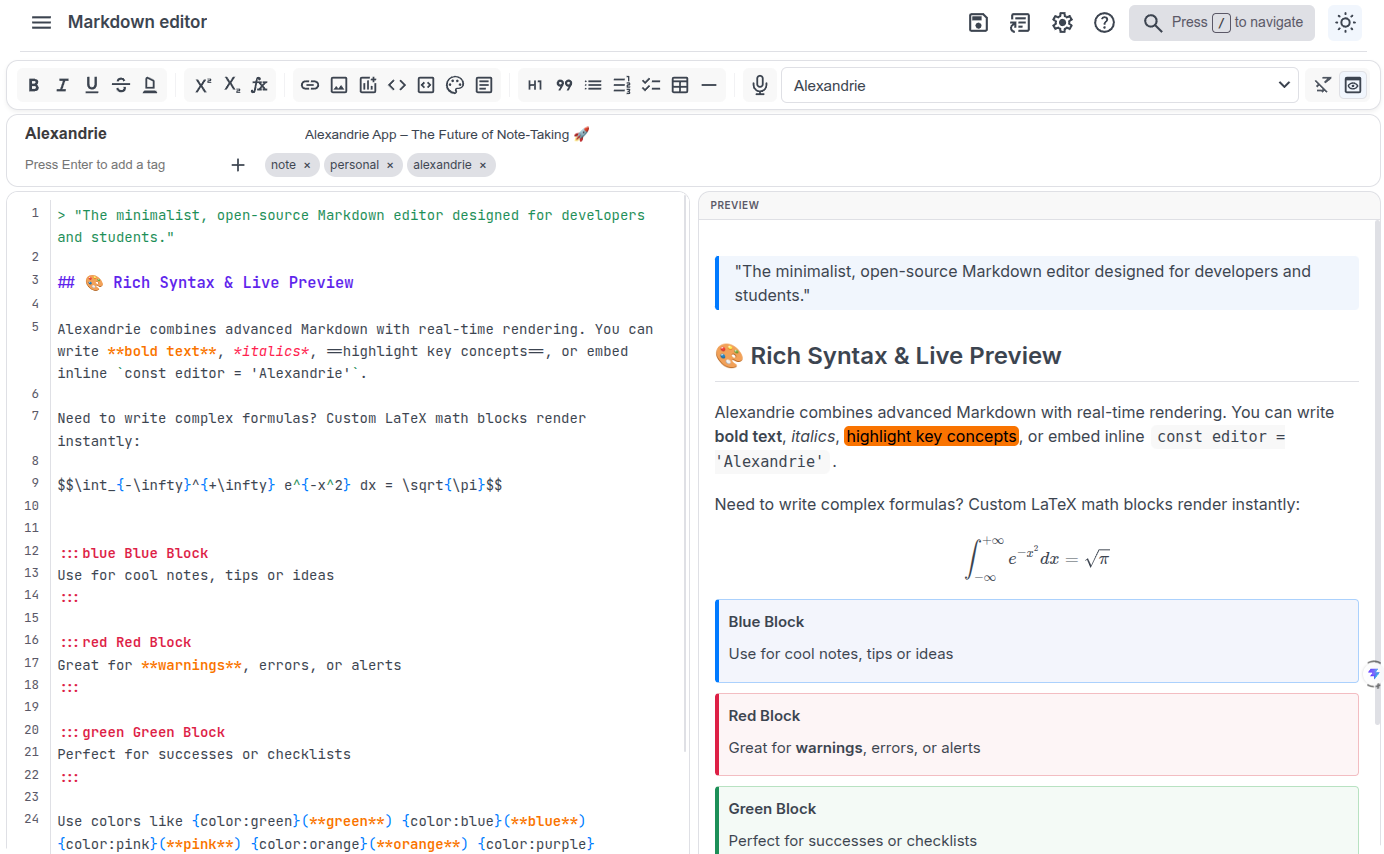
Markdown Editor Preview

  • Speech-to-Text: Dictate notes directly into your editor using integrated voice-recognition APIs.

  • Native Diagrams: Create, edit, and render flowcharts or structural diagrams right inside your Markdown flow.

  • Snippet Manager: Save, reuse, and import/export frequently used templates or code fragments.

Team Workspaces & Access Control

Manage multi-user environments with clear hierarchy and strict isolation. Securely share knowledge across organizations through unique public links or granular group rules.
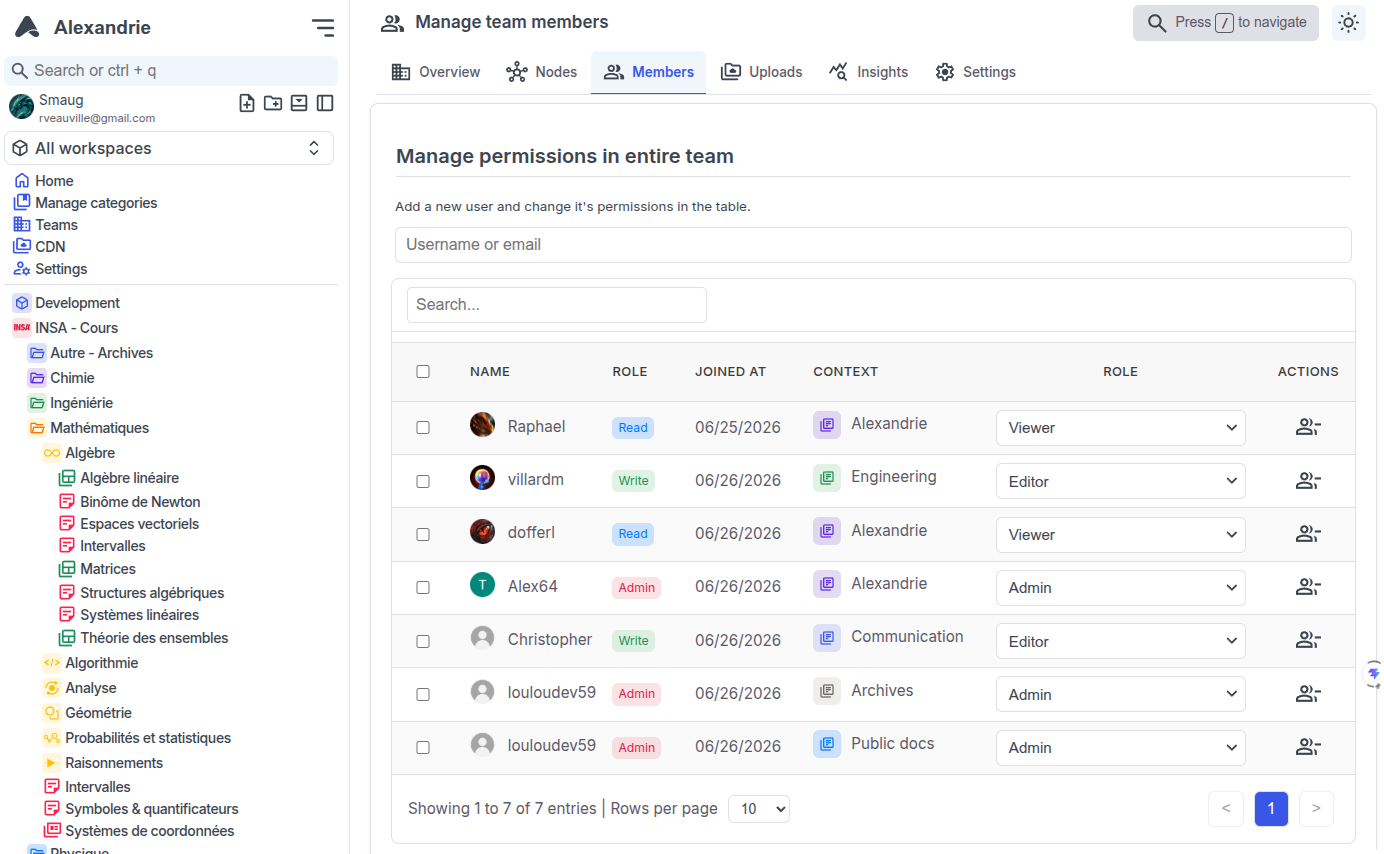
Team Workspaces Preview

  • 5-Level Access Model: Fine-tune user privileges from None, Read, Write, Admin, to Owner status per node or workspace.

  • Enterprise Operations: Generate temporary invitation codes, configure custom scopes, and track team allocation tables instantly.

Navigation & Discovery

Locate documents across complex hierarchies effortlessly with deep structural layouts and high-speed searching tools.
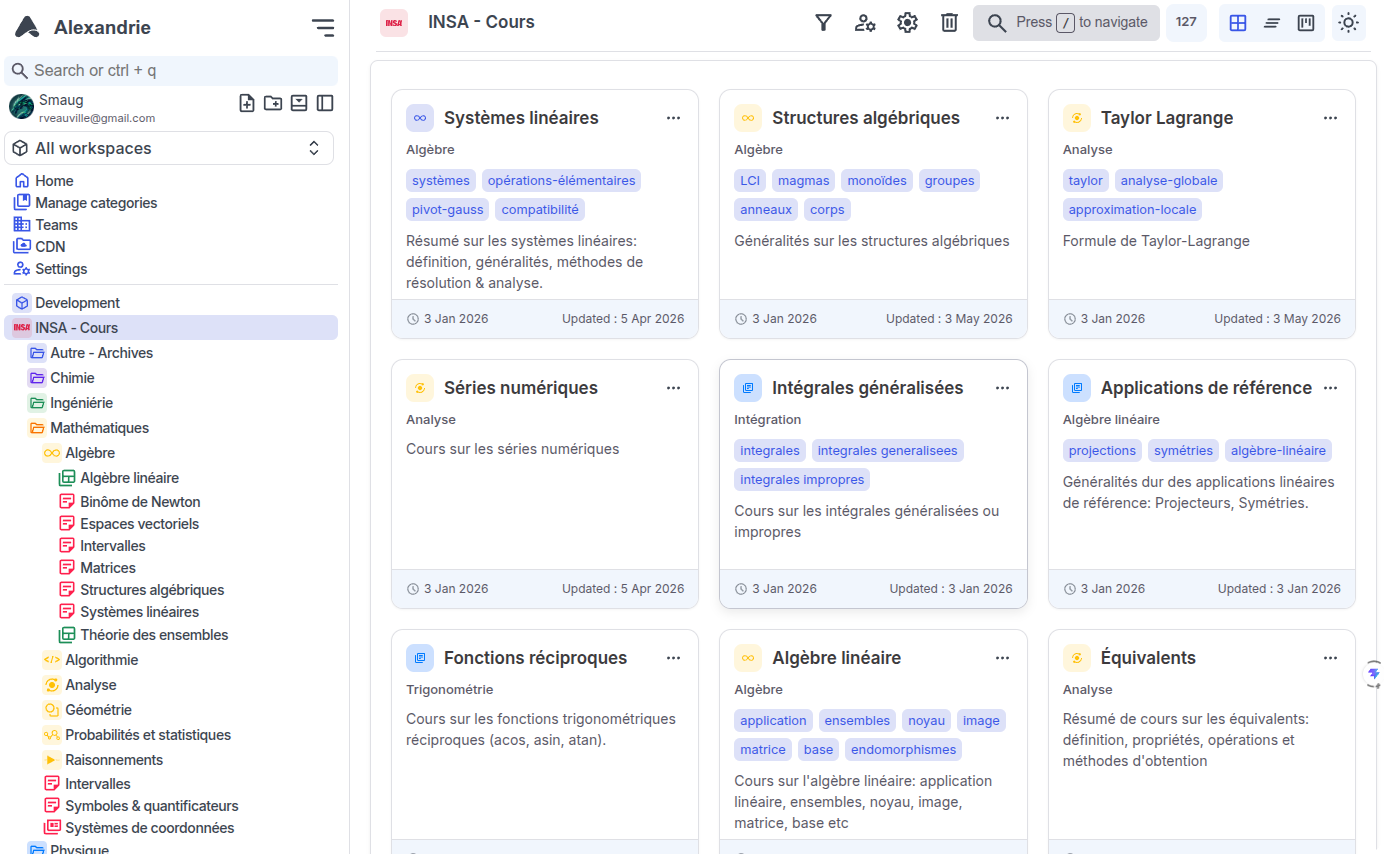
Navigation Preview

  • Command Center (Ctrl + K): A keyboard-driven global overlay allowing you to navigate the app, execute actions, or trigger contextual operations instantly.

  • Full-Text Indexing: Instant lookup with snippet highlights and precise relevancy sorting scores.
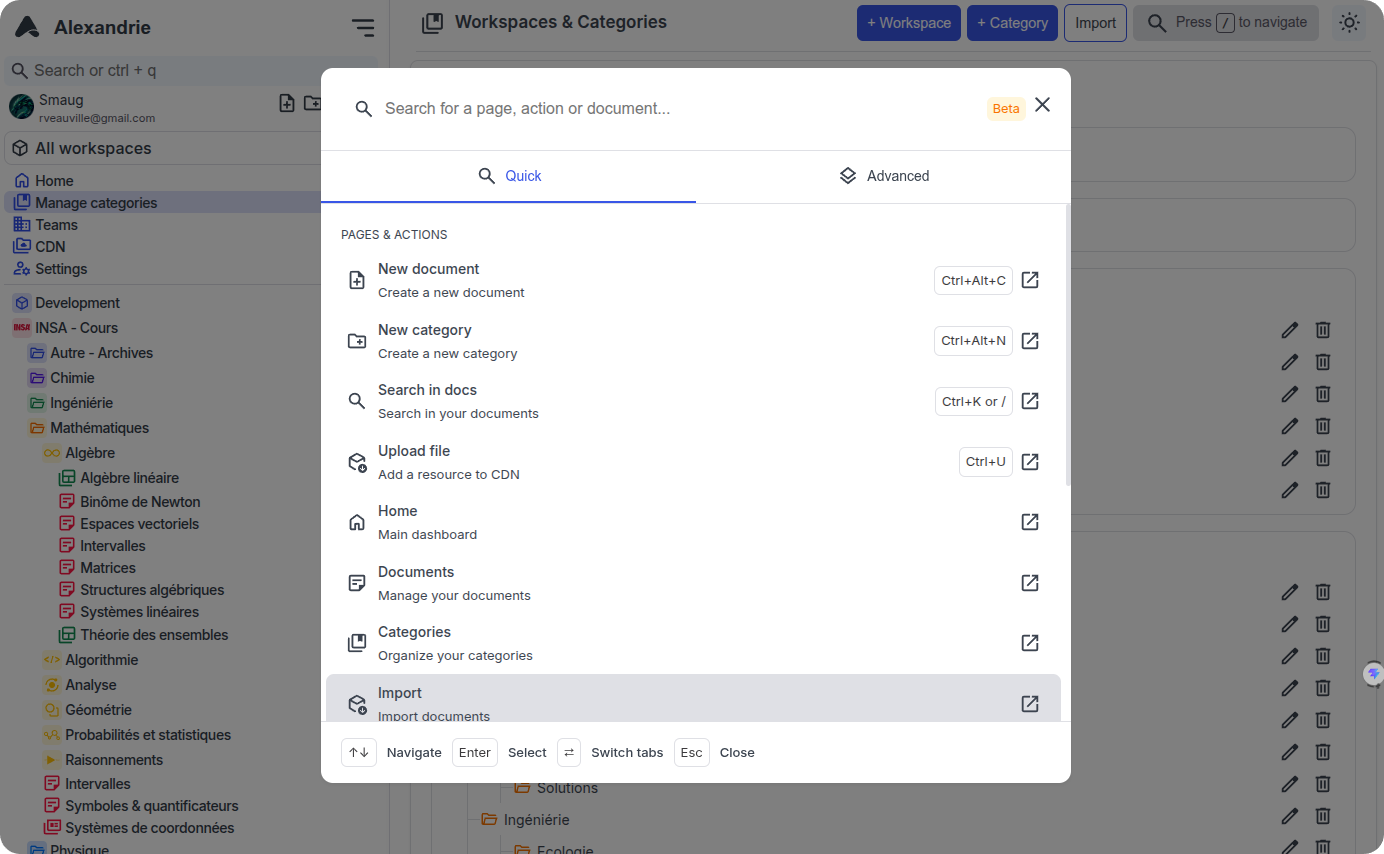
Command Center Preview

  • Task Management: Every workspace includes integrated Kanban boards to organize objectives alongside your documentation.

Sovereign Assets & Storage Pipelines

Maintain total ownership over your binaries, media streams, and backups. Alexandrie relies on decoupled storage engines to preserve performance without external analytics dependencies.
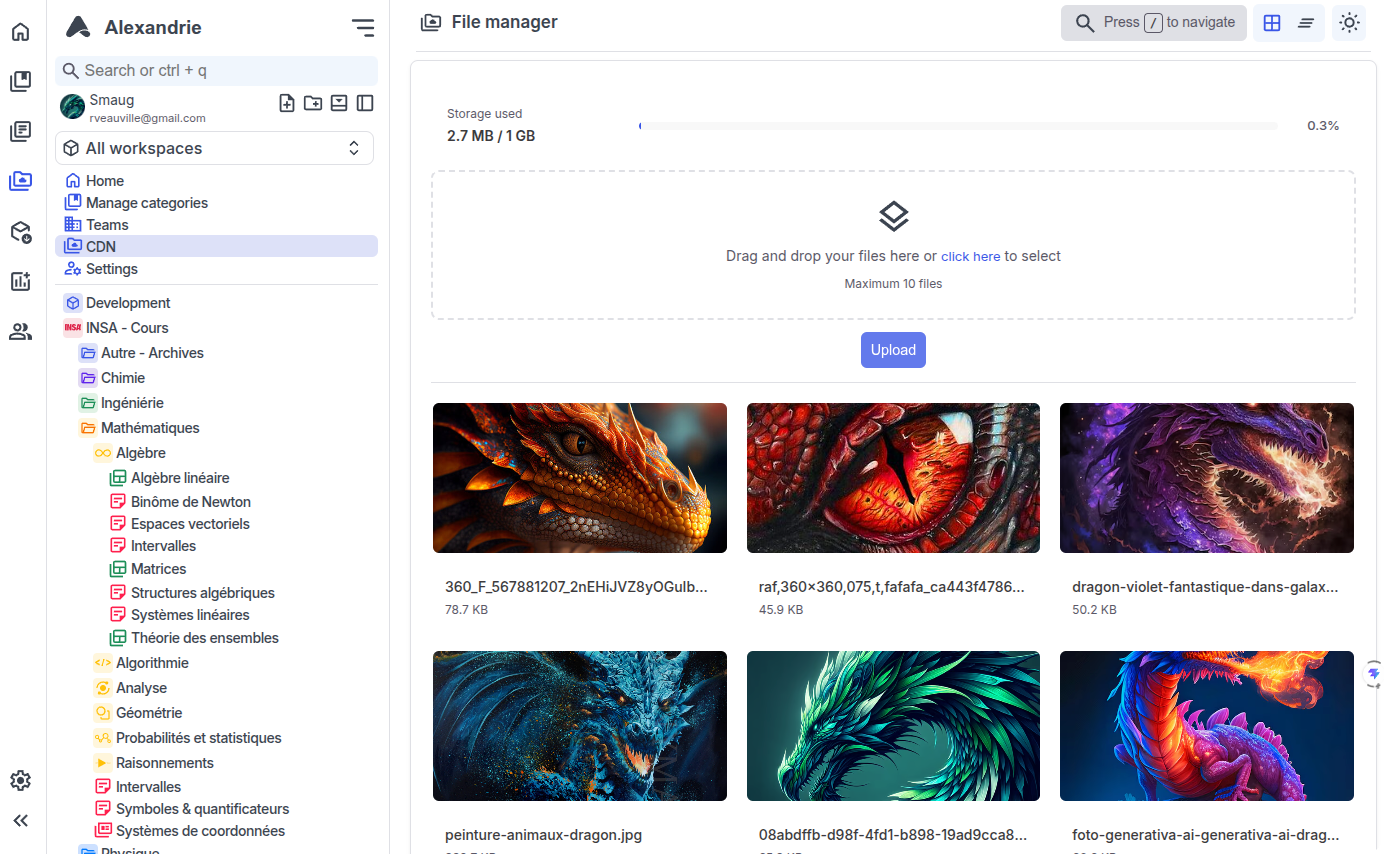
Storage Preview

  • S3 Integration: Native compatibility with decentralized modern object stores (such as RustFS, Garage, MinIO, or AWS).

  • Media Sandbox: In-app PDF view rendering and multi-format previewing for over 30 image, audio, and video formats.

  • Data Portability: Comprehensive ZIP import/export tools allow users to backup or restore selective nodes, metadata configurations, or entire platform states in a single action.

Quick Start

Get your instance running in less than a minute:

# 1. Download the .env.example and docker-compose.yml files
curl https://raw.githubusercontent.com/Smaug6739/Alexandrie/main/.env.example -O .env.example
curl https://raw.githubusercontent.com/Smaug6739/Alexandrie/main/docker-compose.yml -O docker-compose.yml

# 2. Configure environments
cp .env.example .env

# 3. Launch the stack
docker compose up -d

Open http://localhost:8200 to create your primary owner account.

For advanced local development guidelines and technical architecture details, please refer to CONTRIBUTING.md.


Built with ❀️ by Smaug6739 and contributors.

Frequently asked questions

Is Alexandrie free to use?

Alexandrie is open source under the MIT licence. There is no licence fee and no seat count β€” you can self-host it or, where the project offers one, pay a vendor for a managed version instead.

What does Alexandrie do?

πŸ“š The open-source, offline-first Notion, Obsidian & Confluence alternative. Advanced Markdown, multi-tenant teams, OIDC/SSO, and local S3 backups. Deploy in on

What is Alexandrie written in?

Alexandrie is primarily written in Vue. Its source is publicly available at https://github.com/Smaug6739/Alexandrie, and it has 2,752 GitHub stars.