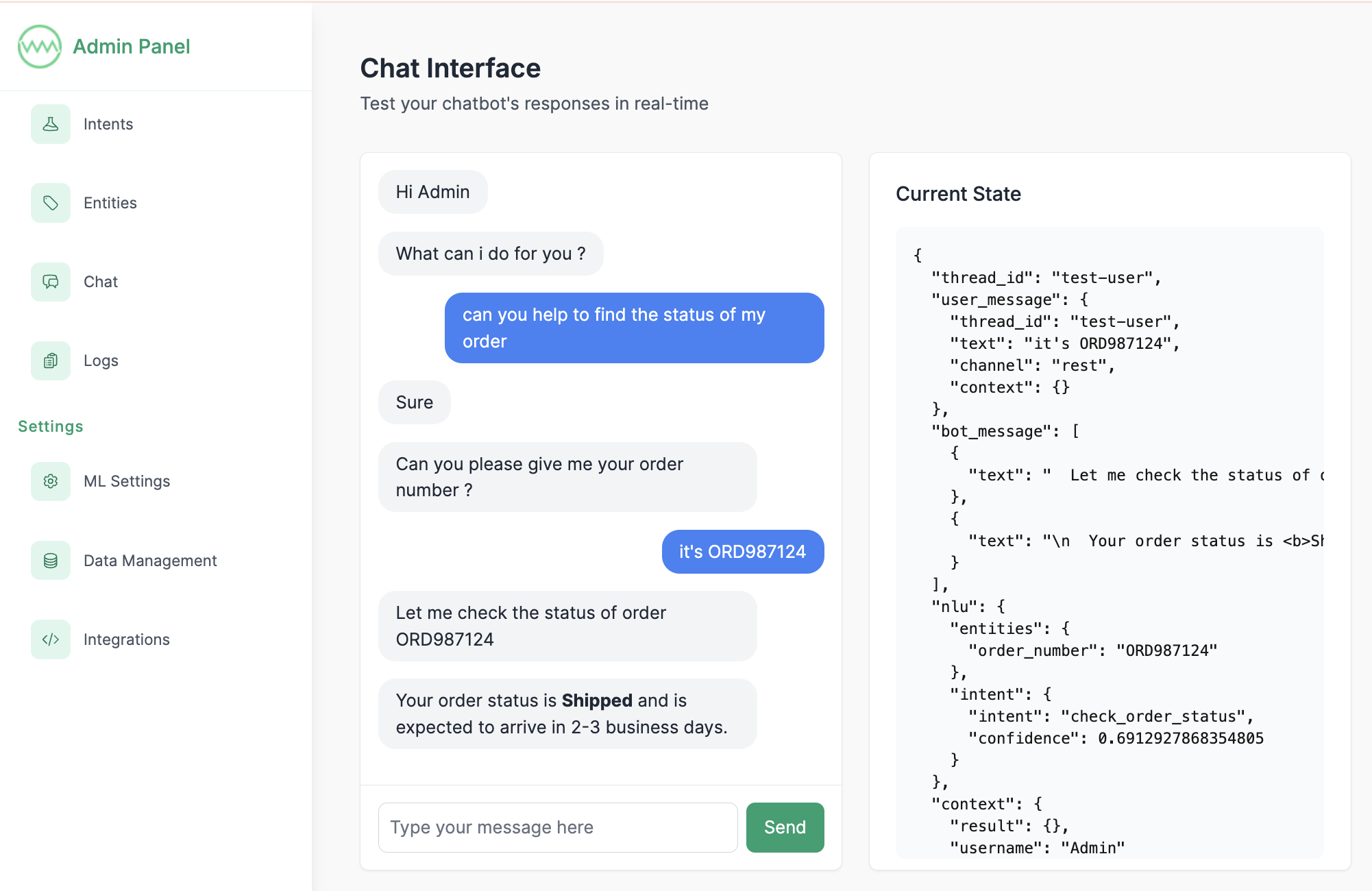
AI Chatbot Framework is an open-source, MIT-licensed, self-hosted DIY platform for building Natural Language conversational bots, aimed at teams and individuals who want AI-powered chatbots without deep artificial intelligence expertise or coding effort.
What it is
AI Chatbot Framework is a Python chatbot framework with Natural Language Understanding and artificial intelligence, distributed as an open-source project under the MIT licence. It combines a low-code admin dashboard for authoring and training conversation scenarios with a machine learning NLU pipeline and optional large language model support. The repository carries 2,168 stars and 748 forks, and its most recent push was on 26 August 2026.
The concrete problem it solves is the gap between a raw NLU or LLM library and a finished, deployable bot. Instead of assembling intent recognition, entity extraction, context handling, fulfilment calls and channel connectors by hand, users configure multi-turn conversational scenarios in a web UI and train them there. It replaces do-it-yourself glue code and, for teams that want to avoid external platforms, it keeps the whole bot inside infrastructure the operator controls.
Key capabilities
- Fully self-hosted deployment, with no reliance on a vendor-hosted bot platform.
- Low-code, DIY admin dashboard for bot development: conversations can be created and trained through the UI without writing code.
- Multi-turn conversations backed by persistent memory and context management.
- API request fulfilment, exposed as tool calling, so a bot can act on external services.
- Advanced NLU combining intent recognition and entity extraction trained with machine learning, using Spacy word embeddings alongside scikit-learn, Tensorflow, Keras and python-crfsuite.
- Zero-shot NLU using large language models, with the topic list naming langchain, openai and deepseek.
- Channel integrations, including the web via REST API and chat snippet, and Facebook Messenger, with Slack and WhatsApp via Twilio listed as coming soon.
- Conversation logs for reviewing bot interactions, plus knowledge base and FAQ answering using RAG, which the README marks as in development.
Who uses it and how
- Teams that need full data ownership run the entire stack on their own infrastructure, since the project is fully self-hosted and MIT-licensed.
- Non-specialists author bots: the README states that users do not need to be experts in artificial intelligence to build a bot with AI capabilities, because scenarios are created and trained in the admin dashboard.
- Smaller deployments follow the Docker and docker-compose path, while larger or orchestrated environments use the Kubernetes and Helm options listed in the tech stack.
- Product and support teams embed a bot in an existing application through the web REST API or chat snippet, or attach it to Facebook Messenger as a channel.
- Open-source contributors work against the hacktoberfest and help-wanted topics, the Gitter lobby, and the contribution guidelines in CONTRIBUTING.md.
Getting started
The README directs users to the documentation at docs/README.md to get started. Deployment uses Docker and docker-compose, with Kubernetes and Helm listed for orchestrated environments.
How it compares
No list of paid products that this project replaces is provided in the facts, so no licence or pricing contrast can be drawn. The nearest names in the topic list are langchain, openai and deepseek, but the README presents them as LLM capabilities the framework can use rather than as alternatives to it. On the evidence available, the framework stands as a self-hosted bot-building platform rather than a drop-in substitute for a named commercial product.
When to use it — and when not to
A self-hoster must operate the full stack: Python with FastAPI and Pydantic on the backend, MongoDB through Motor for persistence, and React with NextJS on the frontend, all containerised. Anyone wanting a managed hosted bot service, or an immediately complete feature set, should look elsewhere, because knowledge base and FAQ answering via RAG is still in development and the Slack and WhatsApp via Twilio integrations are marked coming soon. Note also that the registry metadata lists the primary language as TypeScript while the README describes a Python backend, so a deployer should expect to maintain both a Python and a JavaScript toolchain.