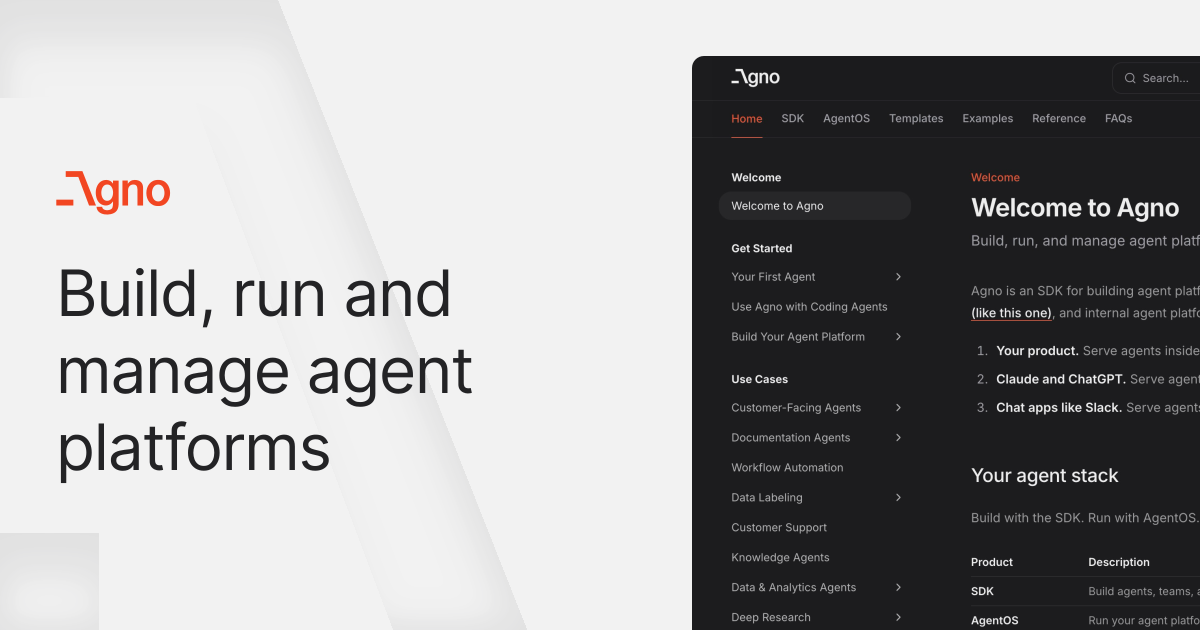

Agno is a free, open source ai development platforms project written in Python and released under Apache-2.0. It has 42,219 GitHub stars, 5,948 forks and 1,419 open issues, and was last pushed 7 hours ago. On this registry it ranks #19 of 61 tracked projects in AI Development Platforms, with 5 head-to-head comparisons available. It gained 72 stars over the last 6 tracked days.

Agno — Model-agnostic platform for building intelligent AI agents

What is Agno?

What it is

Agno is a model-agnostic platform for building, running, and managing AI agent platforms. It provides both a Python SDK for agent development and a runtime environment (AgentOS) for serving agents as services, backed by a web-based control plane. Agno lives in the Python-based AI development ecosystem and targets teams seeking full ownership of their agent infrastructure without vendor lock-in.

It solves the problem of fragmented agent tooling by unifying agent orchestration, storage, security, and deployment into a single stack. Developers can define agents once and deploy them across environments—local, cloud, or hybrid—while retaining control over data, memory, and access policies.

Key capabilities

  • Serve agents via a production REST API with 50+ endpoints, including Server-Sent Events and WebSockets
  • Store sessions, memory, knowledge, and traces in a user-provided Postgres database
  • Integrate with 100+ external systems (e.g., GitHub, Slack, Postgres) using pre-built toolkits
  • Access live context from Slack, Google Drive, wikis, MCP servers, and custom sources
  • Enforce JWT-based role-based access control (RBAC) for multi-user, multi-tenant isolation
  • Trigger human approval workflows to pause runs or block sensitive tool execution
  • Schedule background jobs and cron-based agent runs without external infrastructure

Who uses it and how

  • Teams building internal agent platforms deploy using Docker or cloud templates (Railway, AWS, GCP, Azure, Fly, Render, Modal, Helm)
  • Product engineers integrate agents into existing apps via the REST API and webhooks
  • Developers use the SDK to prototype agents in 20 lines of code, then productionize them with observability and security features

Getting started

Clone a starter template like agentos-railway, agentos-docker, or another platform-specific repo, then run docker compose up. The runtime auto-provisions a Postgres DB, MCP server, and control plane. Documentation and MCP indexing (docs.agno.com/mcp) support IDE integration.

When to use it — and when not to

Use Agno when you need full control over your agent stack, multi-tenancy, and observability out of the box, and are comfortable managing Postgres and container deployments. Avoid it if you require a fully managed SaaS with no infrastructure overhead, or if you lack resources to operate your own database and authentication layer. Agno replaces self-built stacks but not hosted agent platforms—it trades convenience for portability and compliance.

project readme (upstream, from github) — read inline
Agno

Build, run, and manage agent platforms.

Introduction

Agno is a framework and runtime for agent platforms. Build agents, run them as a service, manage your platform using a web UI.

  • Build your agent platform using the Agno SDK.
  • Run your agent platform using the AgentOS runtime.
  • Manage everything using the AgentOS UI.

Agno allows you to own your agent stack. Maintain control of your data, memory, and security posture (JWT-based RBAC), and turn your agent platform into a learning loop with simulations and usage data.

demo-os

Get started

Hand this prompt to your coding agent (Claude Code, Cursor, Codex):

Help me set up my agent platform.

Clone https://github.com/agno-agi/agentos-railway into a folder called
agent-platform, cd in, read the README, and follow the get started guide.

Your coding agent will set up your agent platform and run it locally using Docker, giving you a REST API for serving your agents, a Postgres database for storing your data and traces, an MCP server, and a control plane.

Deploying somewhere else? Use the same prompt but point it to a different repo. The starter templates are identical except for the deploy scripts: swap agentos-railway for agentos-docker, agentos-aws, agentos-gcp, agentos-azure, agentos-fly, agentos-render, agentos-modal, or agentos-helm.

Prefer to code by hand?

Features

  • Production API. 50+ endpoints with SSE and websockets to build a product on top.
  • Storage. Store sessions, memory, knowledge, and traces in your own database.
  • 100+ integrations. Connect to GitHub, Slack, Postgres, and more using pre-built toolkits.
  • Context Providers. Access live data from Slack, Drive, wikis, MCP, and custom sources.
  • Human approval. Pause runs for user confirmation. Block tools that require admin approval.
  • Observability. Monitor with OpenTelemetry tracing, run history, and audit logs.
  • Security. Get JWT-based RBAC and multi-user, multi-tenant isolation out of the box.
  • Interfaces. Expose your agents via Slack, Telegram, WhatsApp, Discord, AG-UI, A2A.
  • Scheduling. Cron-based scheduling and background jobs with no external infrastructure.
  • Deploy anywhere. Run on any cloud platform that runs containers. Docker, Railway, AWS, GCP.

Use Agno with your coding agent

Two options:

  1. Recommended: Add Agno docs as an MCP server. Add docs.agno.com/mcp to your favourite coding agent.
  2. Add Agno docs as an indexed source. In Cursor: Settings → Indexing & Docs → Add https://docs.agno.com/llms-full.txt. Also works in VSCode, Windsurf, and similar tools.

Read the full guide here.

Community

  • X: follow for releases and demos
  • Newsletter: monthly updates on what's shipping

Contributing

See the contributing guide.

License

Agno is distributed under the Apache-2.0 license.

Telemetry

Agno sends a telemetry event per agent run so we know which model providers to prioritize. Prompts, messages, and outputs are never sent. Disable by setting AGNO_TELEMETRY=false.

↑ Back to top

Frequently asked questions

Is Agno free to use?

Agno is open source under the Apache-2.0 licence. There is no licence fee and no seat count — you can self-host it or, where the project offers one, pay a vendor for a managed version instead.

What does Agno do?

Model-agnostic platform for building intelligent AI agents

What is Agno written in?

Agno is primarily written in Python. Its source is publicly available at https://github.com/agno-agi/agno, and it has 42,219 GitHub stars.