
AgentOS · TypeScript AI Agent Framework
Agents that remember, forge their own tools, and survive long-running sessions. Persistent cognitive memory, optional HEXACO personality, multi-agent orchestration, and one dispatch interface across 11 LLM providers. Apache-2.0.











Benchmarks * Website * Docs * npm * Discord * Blog
AgentOS is an open-source TypeScript framework for AI agents that remember, adapt, and write their own tools.
- Top open-source memory benchmarks: 85.6% on LongMemEval-S at $0.0090/correct (gpt-4o), and 70.2% on LongMemEval-M, the only open-source library above 65% on M with reproducible methodology.
- Runtime tool forging. An agent writes a TypeScript function with a Zod schema, an LLM judge approves it, and it runs in a hardened
node:vmsandbox before joining the catalog for the rest of the session. - Persistent cognitive memory with 8 neuroscience-backed mechanisms: Ebbinghaus decay, retrieval-induced forgetting, reconsolidation, source-confidence decay.
- Optional HEXACO personality, 6 orchestration strategies, guardrails, and voice across 11 LLM providers; 100+ extensions and 88 skills auto-load at startup.
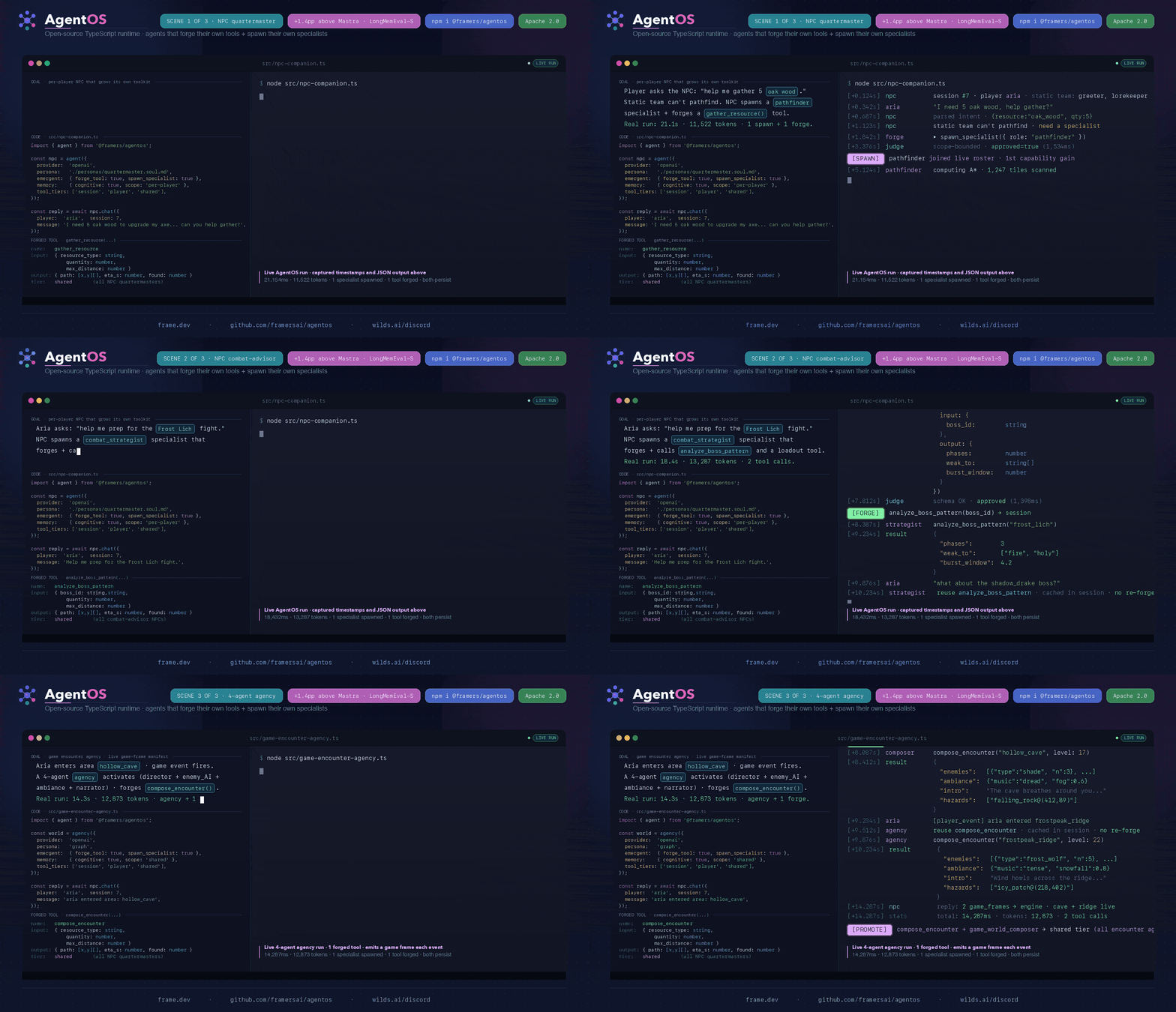
Runtime tool forging + multi-agent collaboration. Reproduce with node examples/emergent-hierarchical-spawning.mjs.
Install
npm install @framers/agentos
import { agent } from '@framers/agentos';

const tutor = agent({
  provider: 'anthropic',                          // resolves to claude-sonnet-4-6 (provider default)
  // model: 'claude-opus-4-8',                    // pin a specific model to override the default
  instructions: 'You are a patient CS tutor.',
  personality: { openness: 0.9, conscientiousness: 0.95 },
  memory: { types: ['episodic', 'semantic'], working: { enabled: true } },
});

// Provider auto-detected from env when `provider` is omitted.

const session = tutor.session('student-1');
await session.send('Explain recursion with an analogy.');
await session.send('Can you expand on that?'); // remembers context
Full quickstart * Examples cookbook * API reference
Sessions in 0.10. Sessions carry a lossless conversation transcript — assistant tool calls, tool results, thinking blocks — independent of the memory subsystem, bounded by default (whole-block eviction past a ~120K-token estimate). memory: false no longer makes a session stateless; pass history: false for that. Long tool-driving loops get session.reseed(snapshot) (atomic history replacement with in-flight epoch guarding), session.messages() as checkpoint material, and per-send generation overrides (toolChoice, requestTimeout, cache, cacheDiagnostics, blockLabel):
// Before 0.10 — stateless unless memory was on:
const s = agent({ model, memory: false }).session('job-1'); // kept no history

// 0.10 — sessions remember by default; opt out explicitly:
const stateless = agent({ model, memory: false, history: false }).session('job-1');
const bounded = agent({ model, history: { maxTokens: 60_000 } }).session('job-2');
bounded.reseed([{ role: 'user', content: 'compact resume snapshot' }]);
Cache note: history byte-stability holds for the stored transcript between eviction events; the wire request can still legitimately differ when dynamic memory context or message-mutating hooks inject per-call content.
Emergent Design
Three things accumulate across a session and compose into behavior: memory (what was said, decided, retrieved), the tool surface (which grows when an agent forges a tool the judge approves), and an optional HEXACO personality vector that biases retrieval, routing, and decisions. Each is configurable and observable.
Runtime tool forging. When no tool covers a sub-task, the agent writes a TypeScript function with a Zod schema; a separate LLM judge approves it; it runs in a hardened node:vm sandbox (5s wall clock, no eval/require/process), then joins a discoverable index for the rest of the session. First forge costs full tokens; reuse costs tens. Promoted tools export as SKILL.md skills. Emergent capabilities ->
HEXACO personality (optional). Off by default; the runtime behaves identically without it. When supplied, the kernel weights retrieval, specialist routing, and tool selection by trait values, so the same prompt and tools yield measurably different decision sequences. It lives in the kernel, not the prompt, so it persists under context pressure. HEXACO docs ->
Soul files. Identity, voice, hard limits, and HEXACO scores can live in a SOUL.md workspace. Its memory/ directory is a markdown wiki (an index.md catalog plus entities/, concepts/, log/ pages with [[wikilinks]]) that is the agent's long-term memory: markdown is the source of truth, the vector/graph index is rebuilt from it, and souledAgent() wires it end to end. Soul Files ->
import { souledAgent } from '@framers/agentos';

const aria = await souledAgent({ provider: 'anthropic', soul: '~/.agentos/agents/aria' });
Memory Benchmarks
gpt-4o reader, gpt-4o-2024-08-06 judge, full N=500, single-CLI reproduction with bootstrap 95% CIs and per-benchmark judge-FPR probes.
- LongMemEval-S: 85.6% at $0.0090/correct, 3,558 ms p50: +1.4 points over