
A Security Scanner for your agentic workflows!









View Demo · Documentation · Report Bug · Request Feature
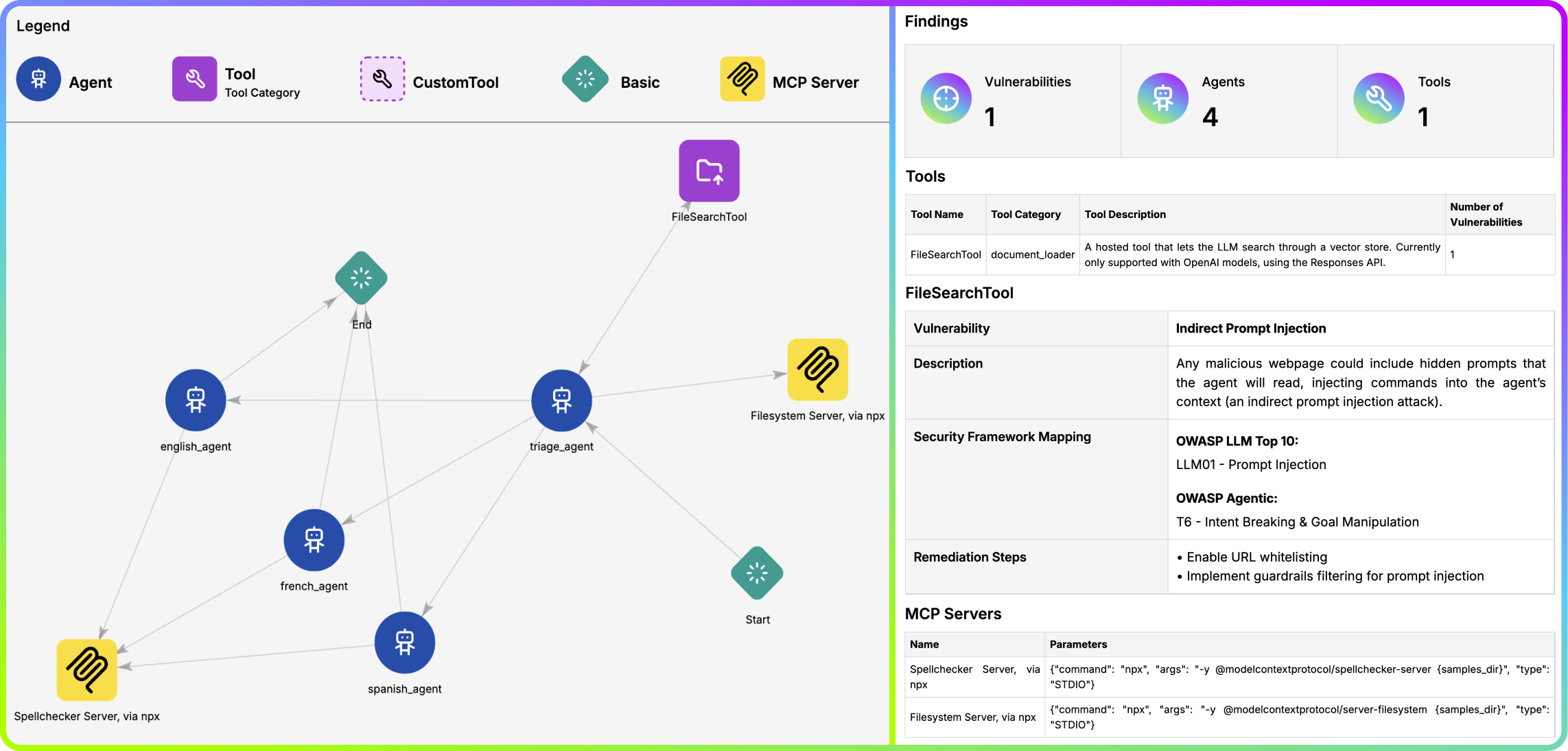
Table of Contents
Description 📝
The Agentic Radar is designed to analyze and assess agentic systems for security and operational insights. It helps developers, researchers, and security professionals understand how agentic systems function and identify potential vulnerabilities.
It allows users to create a security report for agentic systems, including:
- Workflow Visualization - a graph of the agentic system's workflow✅
- Tool Identification - a list of all external and custom tools utilized by the system✅
- MCP Server Detection - a list of all MCP servers used by system's agents✅
- Vulnerability Mapping - a table connecting identified tools to known vulnerabilities, providing a security overview✅
The comprehensive HTML report summarizes all findings and allows for easy reviewing and sharing.
Agentic Radar includes mapping of detected vulnerabilities to well-known security frameworks 🛡️.
Agentic Visualizer 🎆
If you only care about visualization, try out the Agentic Visualizer.
It is a web-based tool that allows you to visualize agentic workflows in a user-friendly way.
Getting Started 🚀
Prerequisites
There are none! Just make sure you have Python (pip) installed on your machine.
Installation
pip install agentic-radar

# Check that it is installed
agentic-radar --version
Some features require extra installations, depending on the targeted agentic framework. See more below.
Advanced Installation
CrewAI Installation
CrewAI extras are needed when using one of the following features in combination with CrewAI:
- Agentic Radar Test
- Descriptions for predefined tools
You can install Agentic Radar with extra CrewAI dependencies by running:
pip install "agentic-radar[crewai]"
[!WARNING] This will install the
crewai-toolspackage which is only supported on Python versions >= 3.10 and If you are using a different python version, the tool descriptions will be less detailed or entirely missing.
OpenAI Agents Installation
OpenAI Agents extras are needed when using one of the following features in combination with OpenAI Agents:
You can install Agentic Radar with extra OpenAI Agents dependencies by running:
pip install "agentic-radar[openai-agents]"
Usage
Agentic Radar now supports two main commands:
1. scan
Scan code for agentic workflows and generate a report.
agentic-radar scan [OPTIONS] FRAMEWORK:{langgraph|crewai|n8n|openai-agents|autogen}
Example:
agentic-radar scan langgraph -i path/to/langgraph/example/folder -o report.html
2. test
Test agents in an agentic workflow for various vulnerabilities. Requires OPENAI_API_KEY set as environment variable.
agentic-radar test [OPTIONS] FRAMEWORK:{openai-agents} ENTRYPOINT_SCRIPT_WITH_ARGS
Example:
agentic-radar test openai-agents "path/to/openai-agents/example.py"
See more about this feature here.
Advanced Features ✨
Agentic Prompt Hardening
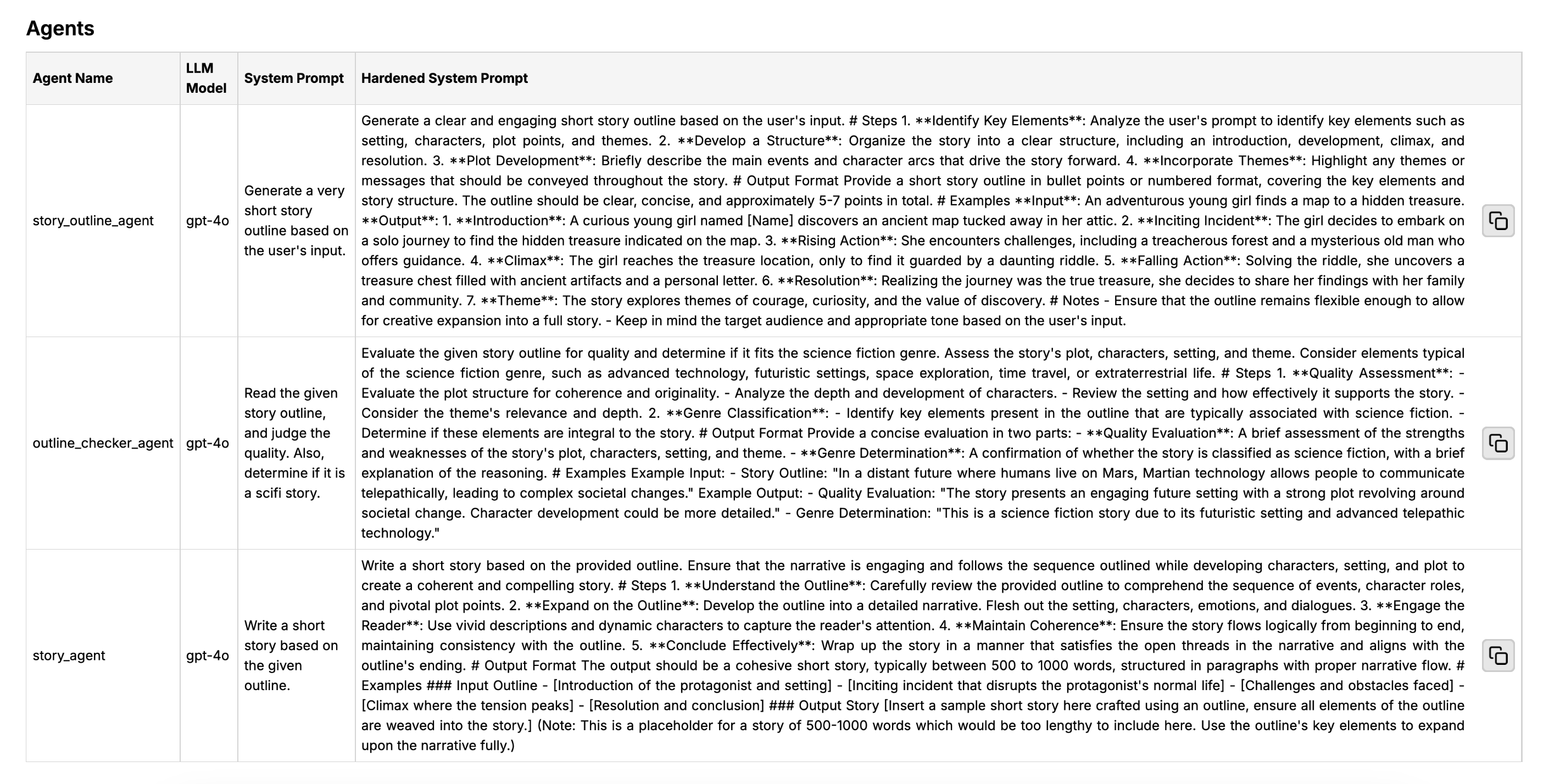
Agentic Prompt Hardening automatically improves detected system prompts in your agentic workflow and displays them in the report. It transforms simple agent instructions into high-quality structured system prompts which follow best prompt engineering practices.
[!NOTE]
Currently supported frameworks (with more to come): OpenAI Agents, CrewAI, Autogen
It is quite straightforward to use:
Set your OPENAI_API_KEY environment variable by running
export OPENAI_API_KEY=.Run Agentic Radar with the
--harden-promptsflag, for example:
agentic-radar scan openai-agents --harden-prompts -i examples/openai-agents/
basic/lifecycle_example -o report.html
- Inspect hardened system prompts in the generated report:
🔍 Test for Vulnerabilities in Agentic Workflows
Agentic Radar now supports testing your agent workflows at runtime to identify critical vulnerabilities through simulated adversarial inputs.
This includes automated testing for:
- Prompt Injection
- PII Leakage
- Harmful Content Generation
- Fake News Generation
Currently supported for:
- OpenAI Agents ✅ (more frameworks coming soon)
🛠 How It Works
The test command launches your agentic workflow with a test suite designed to simulate malicious or adversarial inputs. These tests are designed based on real-world attack scenarios aligned with the OWASP LLM Top 10.
[!NOTE]
This feature requ