

Ackee is a free, open source marketing & customer engagement project written in JavaScript and released under MIT. It has 4,706 GitHub stars, 385 forks and 48 open issues, and was last pushed 13 hours ago. On this registry it ranks #25 of 70 tracked projects in Marketing & Customer Engagement, with 5 head-to-head comparisons available.

What is Ackee?

Ackee is a self-hosted, Node.js and MongoDB web analytics tool for website owners who want traffic statistics without cookies, cookie banners or identifiable visitor tracking, and it is aimed at developers and small teams who do not need a full-featured marketing analytics platform.

What it is

Ackee is a self-hosted website analytics application written in JavaScript and licensed under MIT. It runs on your own server, analyzes the traffic of your websites, and presents useful statistics in a minimal interface. The stack is deliberately lightweight: a Node.js application backed by MongoDB, distributed as open source and listed in Awesome Selfhosted. It lives in the self-hosted web analytics corner of the ecosystem, alongside the deployment tooling that surrounds it.

The concrete problem it solves is the trade-off between useful traffic insight and visitor identification. Full marketing analytics suites such as Google Analytics and Matomo collect far more than many site owners need, and the tracking they require carries privacy obligations and consent banners. Ackee replaces that model by keeping tracked data anonymized, so users are not identifiable, while still reporting the statistics a site owner actually reads. It is explicitly positioned for everyone who does not need a full-featured marketing analytics platform.

Key capabilities

  • Self-hosted deployment: Ackee runs entirely on your own server and is 100% open source.
  • No cookies and no unique user tracking, which removes the need for a cookie message.
  • Event tracking for button clicks, newsletter subscriptions and similar actions beyond pageviews.
  • A fully documented GraphQL API, with every view in the UI built from data the API delivers; a live GraphQL Playground is available at the /api path of the demo.
  • Configuration through environment variables, with support for .env files in the project root, documented in docs/Options.md.
  • Documented setup for SSL and HTTPS and for CORS headers, in the /docs folder.
  • The companion ackee-tracker package for transferring data to Ackee.

Who users it and how

  • Site owners leaving Google Analytics: the project's article list includes a walkthrough on quitting Google Analytics and self-hosting Gatsby statistics with Ackee.
  • Developers deploying to managed platforms: dedicated guides cover Heroku, Vercel, Netlify, Qovery, Render, Railway, Koyeb and Zeabur.
  • Operators already running containers: official paths exist for Docker Compose, plain Docker and Helm.
  • Teams extending the product: because the interface is rendered from the GraphQL API, custom tools can be built on the same endpoints.

Getting started

Ackee ships with first-class Docker paths: start it with Docker Compose, with plain Docker, or with Helm for Kubernetes, and a "without Docker" route exists for direct Node.js installs. Managed deployment options are also documented for Netlify, Vercel, Heroku, Qovery, Render, Railway, Koyeb and Zeabur, with configuration via environment variables, SSL and CORS documented separately.

How it compares

Google Analytics and Matomo are the named reference points, and Ackee deliberately does less than both: it is not a full-featured marketing analytics platform, so anyone needing campaign attribution, audience segmentation or deep user-level reporting will find it thin. Against them, Ackee is MIT-licensed, fully self-hosted, and stores anonymized data on infrastructure the operator controls, with no cookie-based tracking and no vendor bill for the analytics itself. The trade is depth for ownership and simplicity.

When to use it — and when not to

Self-hosting Ackee means operating a Node.js service plus a MongoDB instance, configuring environment variables, and handling SSL, HTTPS and CORS yourself, so the operator carries the database and reverse-proxy work that a hosted SaaS would absorb. Choose it when anonymized traffic statistics and event counts are enough and data ownership matters. Do not choose it if you need a full marketing analytics feature set, cross-session user identification, or a product with no database to run; the README is focused on setup and API rather than feature breadth, and the project is maintained primarily by its author with community donations.

project readme (upstream, from github) — read inline
Ackee logo

Ackee

Test Mentioned in Awesome Selfhosted Donate via PayPal

Self-hosted, Node.js based analytics tool for those who care about privacy. Ackee runs on your own server, analyzes the traffic of your websites and provides useful statistics in a minimal interface.

🌍 Website | 🔮 Live Demo | 🧸 GraphQL Playground
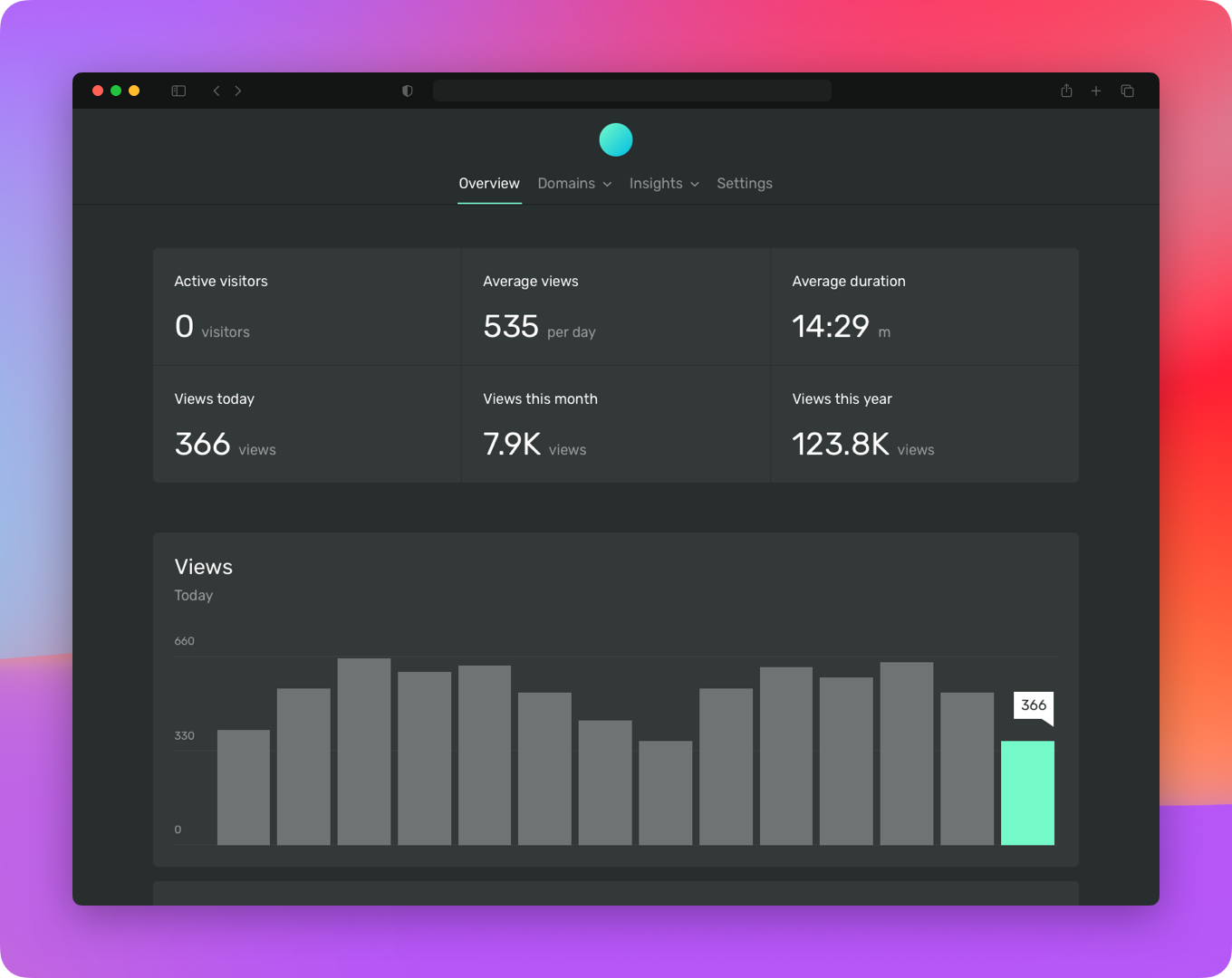

Ackee in a browser

👋 Introduction

Ackee is a self-hosted analytics tool that cares about privacy. We believe that you don't need to track every aspect of your visitors. Ackee keeps tracked data anonymized to avoid that users are identifiable, while still providing helpful insights. It's the right tool for everyone who doesn't need a full-featured marketing analytics platform like Google Analytics or Matomo.

  • Self-hosted: Ackee runs on your own server and is 100% open-source
  • Modern technologies: Lightweight Node.js and MongoDB architecture
  • Beautiful: Minimal and focused interface
  • No cookies: No unique user tracking and therefore no required cookie message
  • Events: Track button clicks, newsletter subscriptions and more
  • GraphQL API: Fully documented GraphQL API that allows you to build new tools upon Ackee

🚀 Get started

Get Ackee up and running…

And configure Ackee and your server correctly…

Take a look at the FAQ if you have any questions left.

📚 Documentation

Documentation and guides are located in the /docs folder. Also take a look at the FAQ if you have any questions left.

API

Ackee features a GraphQL API that allows you to build custom tools upon Ackee. Everything you see in the UI is made from data delivered by the API.

Options

Ackee uses environment variables and supports .env files in the root of the project if you want to store all variables in one file. Options »

Miscellaneous

Donate

I am working hard on continuously developing and maintaining Ackee. Please consider making a donation to keep the project going strong and me motivated.

Articles

Related

Links

Frequently asked questions

Is Ackee free to use?

Ackee is open source under the MIT licence. There is no licence fee and no seat count — you can self-host it or, where the project offers one, pay a vendor for a managed version instead.

What does Ackee do?

Self-hosted, Node.js based analytics tool for those who care about privacy.

What is Ackee written in?

Ackee is primarily written in JavaScript. Its source is publicly available at https://github.com/electerious/Ackee, and it has 4,706 GitHub stars.